
Stop Guessing and Start Sparking with Better Ad Performance
Spark vs In-Feed Performance: Which TikTok Ad Format Actually Wins?
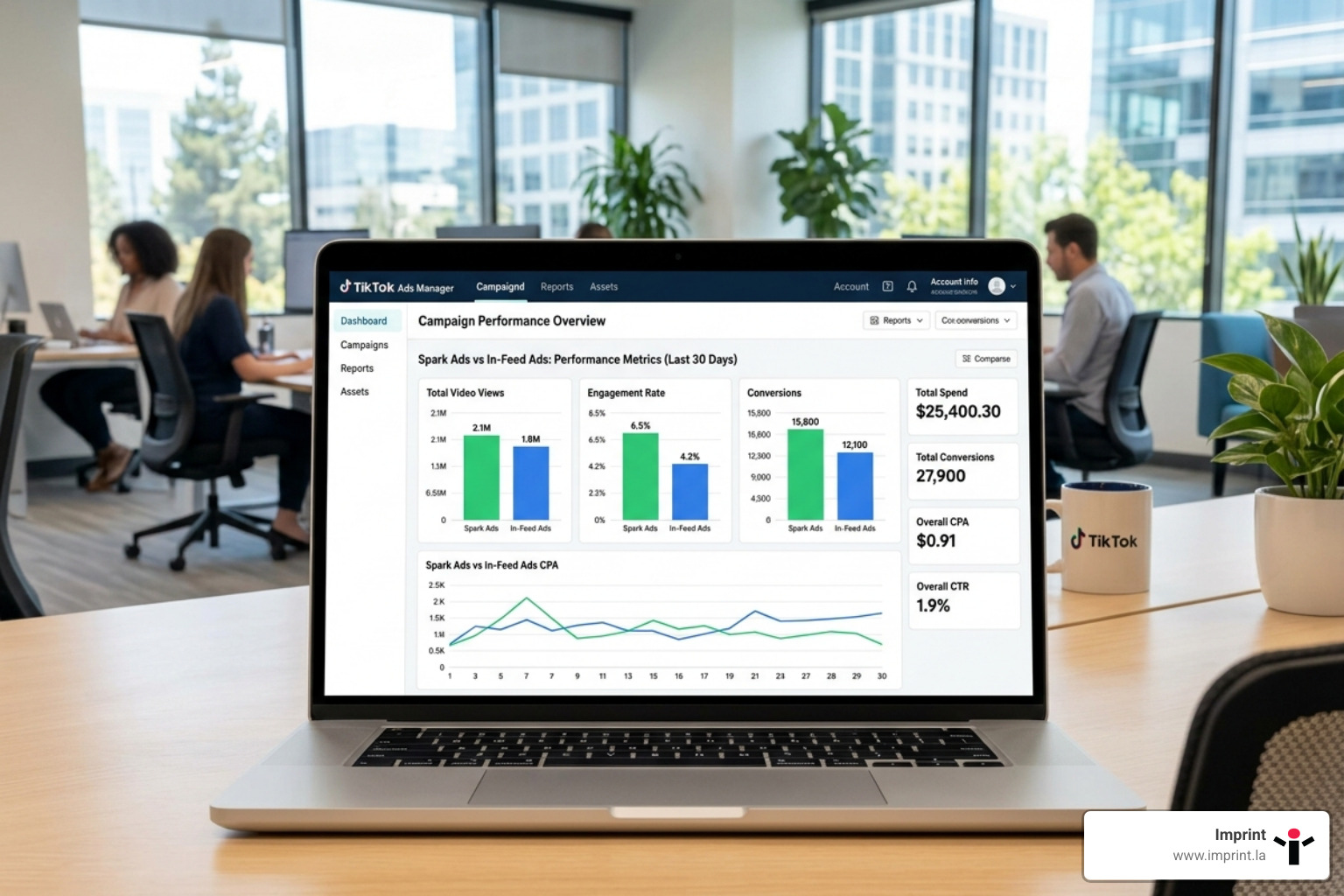
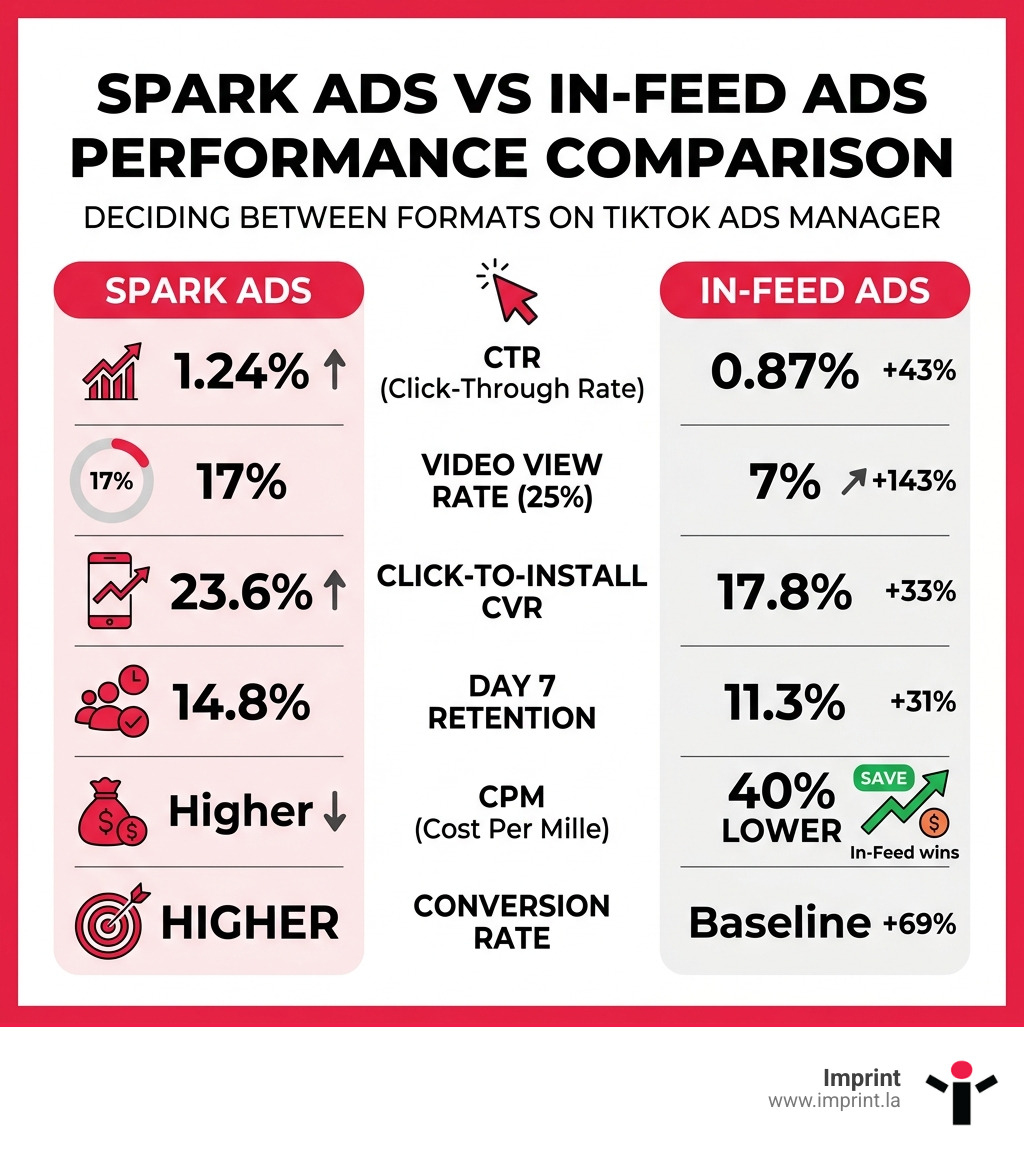
Spark vs infeed performance is one of the most important decisions you'll make when running TikTok ads — and the data makes the answer pretty clear:
| Metric | Spark Ads | In-Feed Ads | Difference |
|---|---|---|---|
| CTR | 1.24% | 0.87% | +43% |
| Video View Rate (25%) | 17% | 7% | +143% |
| Click-to-Install CVR | 23.6% | 17.8% | +33% |
| Day 7 Retention | 14.8% | 11.3% | +31% |
| CPI (App Installs) | $1.41 | $1.93 | -27% |
| CPM | Higher | 40% Lower | In-Feed wins |
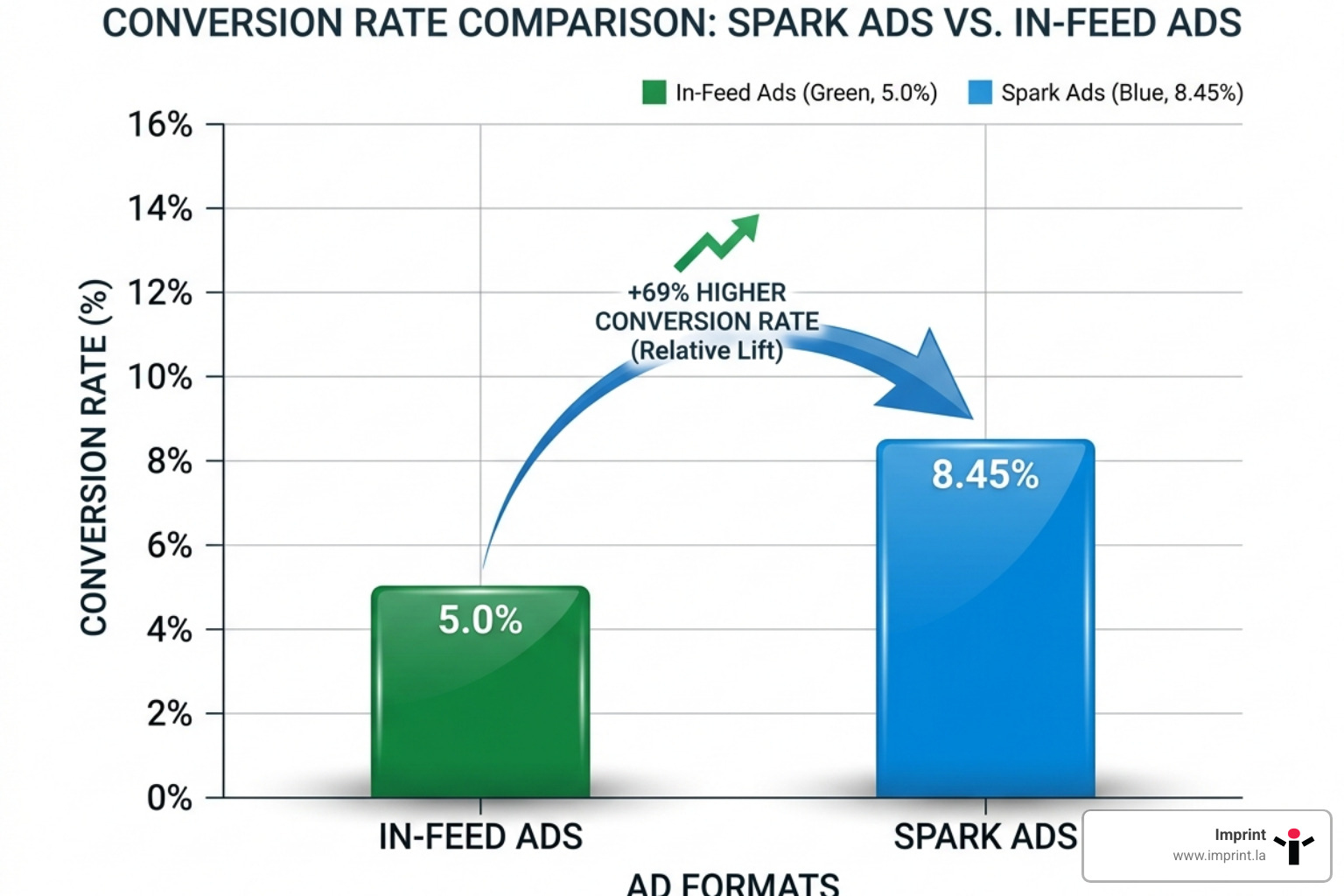
| Conversion Rate | Higher | Baseline | +69% |
Bottom line: Spark Ads outperform In-Feed Ads on nearly every engagement and conversion metric. In-Feed Ads win on raw CPM — but lower cost per impression rarely beats higher cost per result.
That said, each format has a real strategic role. Knowing when to use which one is what separates brands that scale from brands that stall.
TikTok now captures roughly $6.19 billion — or 9% — of all U.S. social media ad spend. That's a massive pool of competition, and most brands are leaving serious performance on the table by defaulting to one format without testing both.
If your ROAS on paid social feels unpredictable, this comparison will help you stop guessing and start making format decisions based on real numbers.
I'm Brent Burghdorf, founder of Imprint. We are committed to providing high-quality service standards at low-cost pricing, helping brands analyze spark vs infeed performance data across e-commerce, healthcare, and high-ticket service brands to scale efficiently. In this guide, I'll walk you through exactly how to choose — and combine — both formats to build a full-funnel TikTok strategy that compounds over time.
Technical Differences: Social Proof vs. Brand Control
To master spark vs infeed performance, we first have to understand what’s happening under the hood. While both appear in the "For You" feed, they are fundamentally different vehicles.
Spark Ads are essentially "boosted" organic posts. You take a video that already exists on a TikTok profile (either your brand’s or a creator’s) and put ad spend behind it. Because they are tied to a real account, users can click the profile picture or swipe left to visit the actual profile. This creates a "Halo Effect" where your paid spend drives free organic followers and profile views.
In-Feed Ads (Standard Ads) are created from scratch in the Ads Manager. They aren't tied to an organic post on your grid. They are "ghost" ads—they only exist as long as you are paying for them. When the campaign ends, the likes and comments disappear.
The biggest technical advantage of Spark Ads is Creator Whitelisting. This allows a brand to use a creator's handle and organic post as the ad creative. According to the TikTok Sponsored Ads 2025 Guide, leveraging creator trust through their own handles can result in engagement rates that are 159% higher than brand-produced ads.
However, Spark Ads come with stricter rules. You must use the Commercial Music Library to avoid copyright strikes, and once a Spark Ad is live, you cannot edit the caption or the video. In-Feed Ads offer more control, allowing you to use specific product feeds, customizable display names, and aggressive "salesy" copy that you might not want cluttering your beautiful organic grid.
Setup Requirements and Technical Gotchas
Setting up these formats requires different workflows. For In-Feed Ads, you simply upload your video to the TikTok Ads Manager. For Spark Ads, you need a Spark Code.
If you are working with an influencer, they must go into their video settings and authorize the post for advertising to generate a code (usually for 7, 30, 60, or 365 days). A major "gotcha" in 2026 is code expiration; if that 60-day code expires, your high-performing ad will simply stop running, potentially killing your momentum. We always recommend asking creators for 365-day codes upfront to prevent this.
Another technical nuance involves attribution. Because Spark Ads have four exit points (Profile, Caption, Music, CTA) compared to the single-focus CTA of In-Feed Ads, users might wander off to explore the creator’s profile before converting. This is why we emphasize Data Driven Google Ads principles even on TikTok—looking at the full-funnel impact rather than just the last click.
Benchmarking spark vs infeed performance (2026 Data)
When we look at the raw numbers for spark vs infeed performance in April 2026, the gap has widened. Spark Ads currently deliver a 64% higher CTR than standard in-feed versions.
Why? It comes down to the "Social Proof engine." Spark Ads retain all the likes, comments, and shares from their organic life. When a user sees an ad with 50,000 likes, they stop scrolling. In-Feed Ads start at zero every time you launch a new creative, making it harder to build that initial trust.
While In-Feed Ads often boast a 40% lower CPM (cost per thousand impressions), they frequently suffer from lower engagement. In our experience at Imprint, the lower CPM doesn't make up for the fact that only 7% of users reach the 25% video view mark, compared to 17% for Spark Ads. This 143% higher view rate means your message is actually being heard. To see how we analyze these deep-funnel metrics, check out our guide on Meta Ads Data Analysis, which uses similar logic for cross-platform scaling.
Maximizing spark vs infeed performance for App Installs
For our mobile app clients, the spark vs infeed performance debate is settled by the bottom line. 2026 benchmarks show that Spark Ads deliver a $1.41 CPI (Cost Per Install), which is 27% lower than the $1.93 average for standard ads.
But the real magic is in the quality of the user. Spark Ads achieve:
- 33% higher click-to-install CVR (23.6% vs 17.8%).
- 31% better Day 7 retention (14.8% vs 11.3%).
This suggests that Spark Ads attract "higher-intent" users who aren't just clicking an accidental button but are genuinely interested in the content. We often use Value-Based Optimization (VBO) for these campaigns, which tells TikTok’s algorithm to find users likely to spend money, not just download. For more on identifying these high-value signals, see 10 Signs Of Good TikTok Ad Conversions And How To Achieve Them.
Analyzing spark vs infeed performance in Full-Funnel Strategies
At Imprint, we don't view this as an "either/or" situation. A sophisticated strategy uses both.
- Top of Funnel (Awareness): Use Spark Ads to leverage creator trust. This builds the "Halo Effect," growing your follower count and brand sentiment.
- Middle of Funnel (Consideration): Retarget users who watched 50% of your Spark Ad with an In-Feed Ad that has a stronger, more direct call-to-action.
- Bottom of Funnel (Conversion): Use In-Feed Ads with product catalogs or specific discount codes to drive the final sale.
This hybrid approach ensures you aren't just "shouting" at users with ads, but building a relationship. Using Creative Lead Gen Ads as a framework, we ensure every touchpoint adds value while moving the user closer to a conversion.
Strategic Use Cases: When to Choose Each Format
Despite Spark’s dominance in engagement, there are times when In-Feed Ads are the superior choice.
The "Ugly Ad" Strategy: Sometimes, the most effective ad is a high-contrast, neon-colored "50% OFF" banner. You probably don't want that eyesore living permanently on your brand's curated organic grid. In-Feed Ads allow you to run these aggressive sales pitches without tarnishing your brand aesthetic.
High-Volume Testing: If you have 20 variations of a video to test, posting all 20 organically to your profile would look like spam. We use In-Feed Ads for "low-stakes" testing. Once we identify a winning creative, we then post it organically and scale it as a Spark Ad.
Influencer Partnerships: This is where Spark Ads shine. When a creator reviews your product, boosting that post from their handle is infinitely more believable than downloading their video and running it from your brand handle.
By following Data Driven Lead Strategies, we can determine exactly which format is pulling the most weight in your specific industry.
Creative Best Practices: The 1.3-Second Hook
Regardless of the format, TikTok is a "hook-first" platform. In 2026, the window to grab attention has shrunk. You no longer have 3 seconds; you have 1.3 seconds.
To maximize spark vs infeed performance, your creative must include:
- The 1.3-Second Hook: Immediate movement, a face on camera, or a bold text overlay.
- Optimal Length: 15–21 seconds is the "sweet spot" for 2026.
- Rapid Scene Cuts: Aim for 5–8 cuts in a 15-second video to maintain dopamine levels.
- UGC Style: Even if it’s brand-produced, it should feel like a native TikTok. High-gloss commercials often have the lowest ROAS.
- Sound Design: Use trending sounds or clear voiceovers. TikTok is a sound-on environment.
We take a rigorous approach to Google Ads Creative Testing and apply those same scientific principles to TikTok. We test hooks independently from the "body" of the ad to find the perfect combination.
Frequently Asked Questions about TikTok Ad Formats
Do Spark Ads cost more than In-Feed Ads?
Technically, no. They use the same bidding system. However, because Spark Ads typically have much higher engagement rates, TikTok's algorithm often rewards them with a "Relevance Discount," which can lead to lower effective costs per result, even if the CPM is slightly higher. At Imprint, we maintain high-quality service standards and low-cost pricing to ensure our clients see the best possible return on their ad spend.
Can I edit a Spark Ad after it goes live?
No. Because Spark Ads are tied to an organic post, you cannot change the video or the caption once the campaign has started. If you need to make a change, you have to delete the organic post, re-upload it, and generate a new Spark code. This is why we double-check every caption before hitting "publish."
Does boosting a post hurt organic reach?
This is a common myth. TikTok treats paid and organic traffic as two separate streams. In fact, we often see that Spark Ads help organic reach by driving new users to your profile who then interact with your other (non-paid) content.
Conclusion
The battle of spark vs infeed performance isn't about picking a favorite; it's about using the right tool for the job. Spark Ads are your engine for trust, engagement, and high-quality app installs. In-Feed Ads are your scalpel for aggressive sales, high-volume testing, and protecting your brand's organic "vibe."
At Imprint, we pride ourselves on our low-cost pricing and high-quality service standards, ensuring we aren't just another "set and forget" agency. Based in Los Angeles, with teams serving Santa Monica and Beverly Hills, we use data-backed strategies to deliver an average 3.8x ROAS for our clients. We believe that professional, high-tier performance marketing should be accessible to growing brands without the bloated "big agency" price tag.
Stop guessing which ad format will work. Let us help you build a TikTok strategy that actually converts. Start Scaling with a High-Quality PPC Agency today and let's turn your ad spend into an investment.
