
Why Your Google Ads Creative Testing is Probably Failing
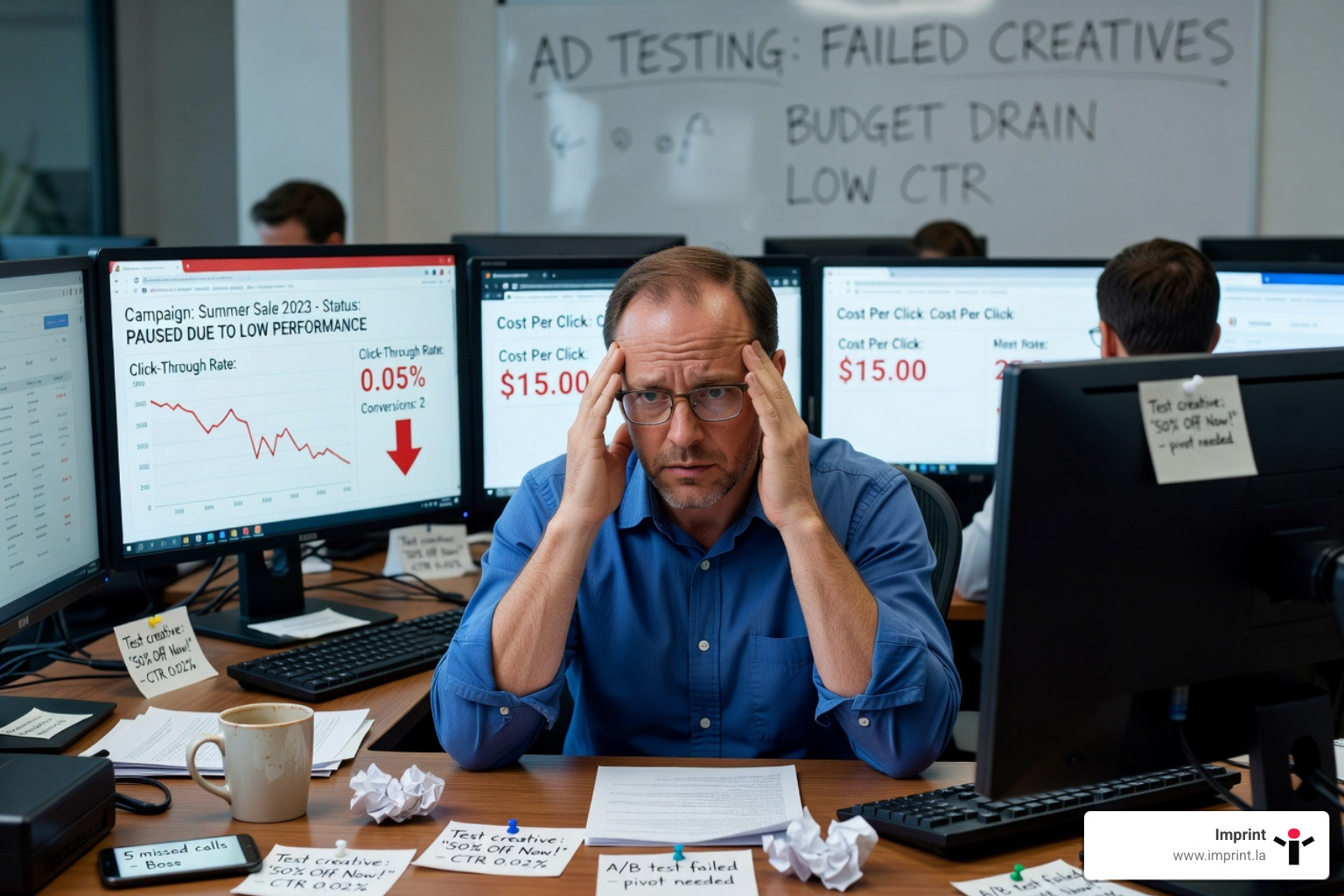
Google ads creative testing is the process of systematically comparing different ad creatives — images, headlines, videos, CTAs — to find what drives the most clicks, conversions, and revenue from your campaigns.
Here's a quick breakdown of how to do it right:
- Form a hypothesis — decide what you're testing and why before you start
- Isolate one variable — change only one element per test (headline, image, CTA)
- Use the right tool — Ad Variations for Search, custom Experiments for broader tests, or Demand Gen A/B tests for visual assets
- Split traffic evenly — a 50/50 split gives you the cleanest data
- Measure what matters — focus on incremental conversions and auction wins, not just CTR
- Scale winners, kill losers — apply what works, document everything, and keep testing
Most advertisers treat creative as an afterthought. That's a costly mistake.
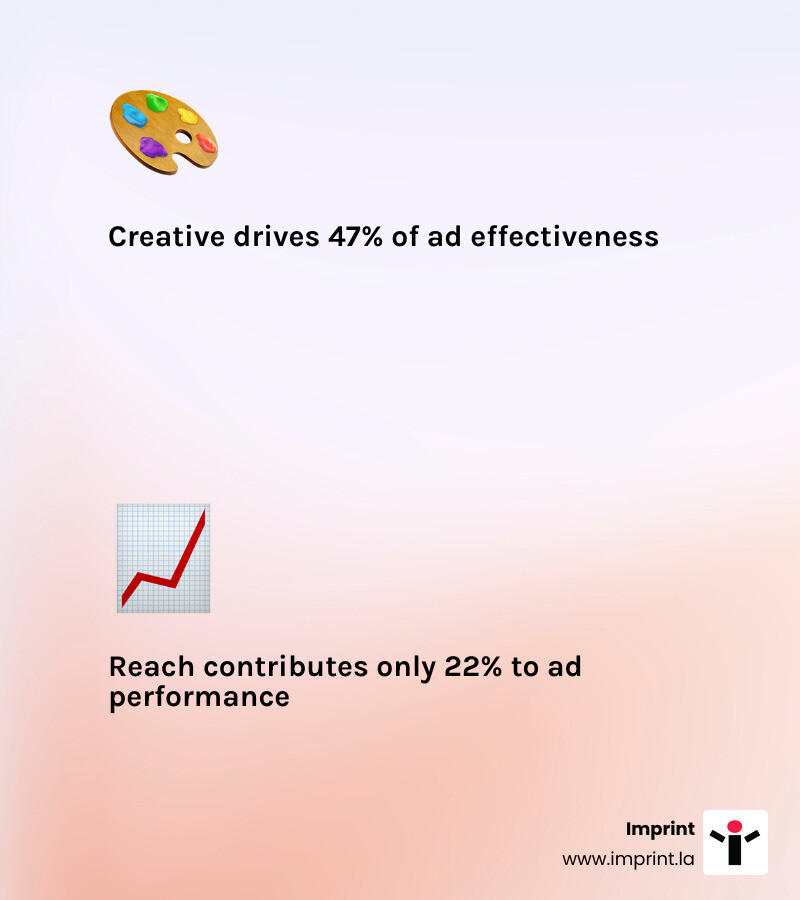
According to Nielsen, creative is responsible for 47% of an ad's effectiveness — more than reach, brand, or targeting combined. NCS research puts the number even higher, attributing 49% of total sales impact to creative alone.
Yet most Google Ads accounts run the same creatives for months. No tests. No rotation. No learning.
The result? Declining CTR, rising CPAs, and a budget that quietly bleeds out while you assume the problem is your bidding strategy.
The truth is, when targeting becomes more automated and audience data gets harder to access, creative is one of the few levers you still fully control.
I'm Brent Burghdorf, founder of Imprint and a performance marketing specialist who has built and scaled paid search systems across e-commerce, healthcare, and high-ticket services — and Google ads creative testing is consistently where I see the biggest untapped gains in underperforming accounts. In this guide, I'll show you exactly how to build a testing system that generates real, compounding improvements.
The Science of Google Ads Creative Testing
Effective creative testing isn't about throwing spaghetti at the wall to see what sticks. It is a scientific process that requires discipline. At Imprint, we believe in Data-Driven Google Ads because gut feelings don't pay the bills—statistically significant data does.
To run a "pro" test, you must start with a hypothesis. A hypothesis isn't just "I think this ad is better." It’s a structured statement: "If we change the headline from 'Buy Now' to 'Get a Free Quote,' then conversions will increase by 10% because it reduces friction for high-intent leads."
Once the test is live, we look for statistical significance. This means the difference in performance between Ad A and Ad B isn't just a fluke of the algorithm. We aren't just looking for a higher Click-Through Rate (CTR). In Responsive Search Ads (RSAs), a higher CTR can sometimes be misleading. We prioritize incremental gains—meaning, does this creative help us win more auctions and drive more total conversions for the ad group?
creative contributes 47% of an ad’s effectiveness. If you aren't testing, you are essentially ignoring half of your campaign's potential.
Leveraging Google Ads Experiments and Ad Variations
Google has made it easier to test without breaking your existing campaigns through Custom Experiments. This tool allows you to propose changes to your Search, Display, Demand Gen, or Video campaigns and run them side-by-side with your original "control" campaign.
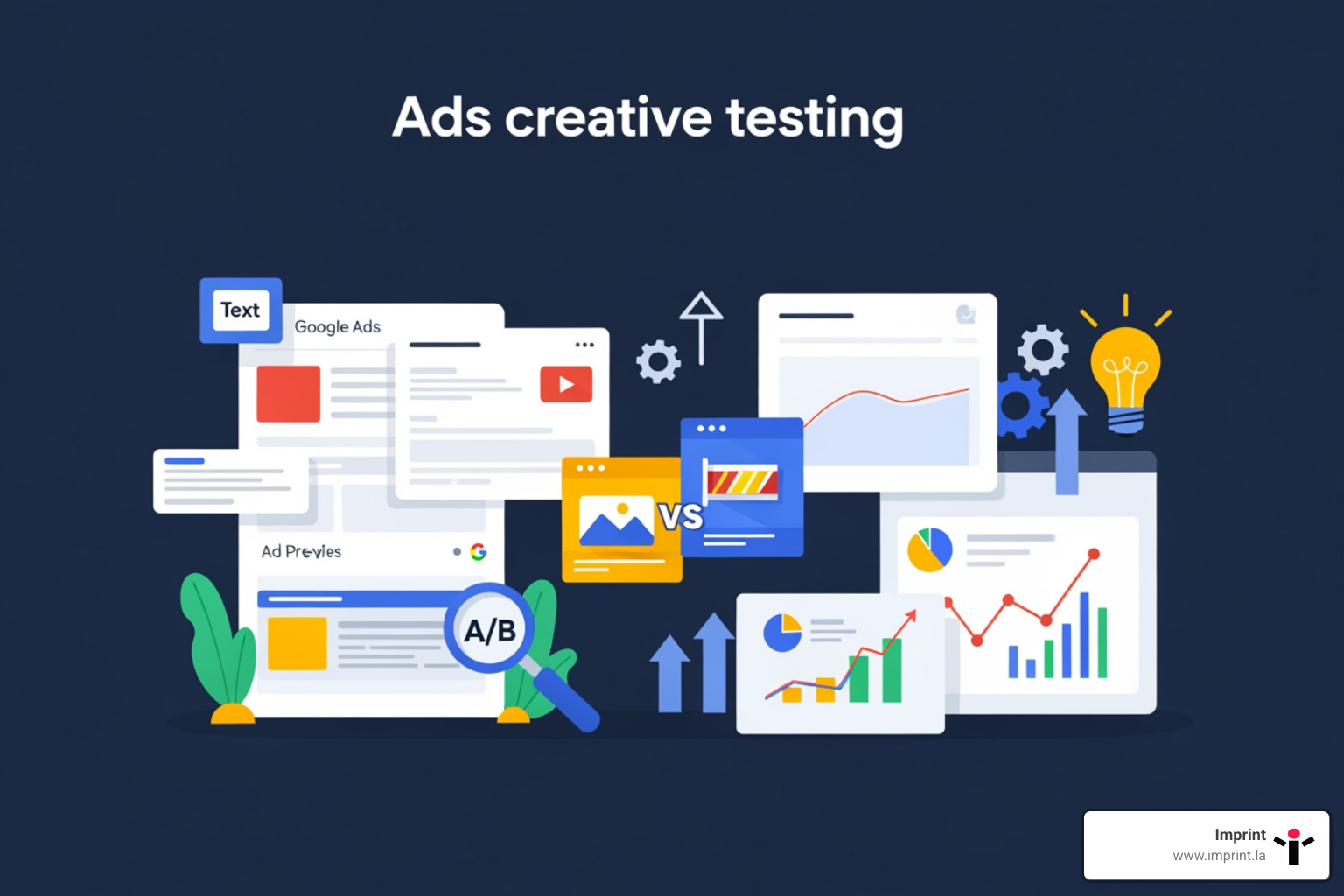
One of the most critical settings here is Cookie-based splitting. This ensures that if a user sees the "Experiment" version of your ad, they will continue to see that version throughout the test. This prevents "data pollution" where a single user sees multiple versions, making it impossible to know which one actually caused the conversion.
We typically recommend a 50/50 traffic split. This allows for the fastest possible data collection. By allocating a specific portion of your budget to the experiment, you protect your main campaign's performance while gaining the insights needed to scale.
Testing Responsive Search Ads with Google Ads Creative Testing
For Search campaigns, Ad Variations are your best friend. This tool allows you to apply changes across multiple campaigns or your entire account with just a few clicks. Want to see if "Free Shipping" performs better than "20% Off" across ten different campaigns? Ad Variations can do that.
You can use "Find and Replace" to swap out specific CTAs or update headlines across the board. When testing RSAs, pay close attention to Ad Strength. Advertisers who improve their Ad Strength from 'Poor' to 'Excellent' see an average of 12% more clicks and conversions. As a PPC/SEM Agency, we often find that simply adding more diverse assets—like business logos and names—can lift conversions by 8%.
Scaling Results through Automated Google Ads Creative Testing
Manual testing is great for small accounts, but as you grow, it becomes a bottleneck. This is where Automated Creative Testing comes in. By using AI-powered generation and asset insights, we can analyze dozens of creative attributes at once.
For example, a financial brand recently analyzed 28 creatives and found that ads featuring specific visual landmarks improved CPC by 45%. AI can detect these patterns—like background colors, the presence of people, or the tone of the copy—that a human might miss. By connecting these attributes to first-party data, we create a feedback loop that constantly refines your creative strategy. Check out our PPC Client Stories to see how these data-backed adjustments drive real-world ROI.
Mastering Creative Testing in Demand Gen and Performance Max
The creative landscape changed significantly with the introduction of Demand Gen campaigns. Recently, Google introduced structured A/B testing for images and videos within these campaigns. As highlighted by Thomas Eccel on Demand Gen A/B testing, this update makes creative testing "real" for visual-first campaigns.
In Demand Gen, Google duplicates your campaign to create experiment arms. You can add or remove specific images and videos to see exactly what drives engagement.
A major key to success in Performance Max (PMax) and Demand Gen is video orientation. Research shows that including at least one video of each orientation (horizontal, vertical, and square) can deliver 20% more conversions on YouTube compared to using horizontal videos alone. Google's AI can even help "flip" your existing videos into different aspect ratios to fill these gaps.
Avoiding Creative Fatigue and Common Testing Pitfalls
Even the best creative won't work forever. This is known as Creative Fatigue. You can spot it by looking at rolling windows (like 7-day or 30-day totals). If your CTR is trending down while your CPA is spiking, your audience is likely bored.
One of the biggest mistakes we see is testing too many things at once. If you change the headline, the image, and the landing page simultaneously, you'll never know which change actually moved the needle. Stick to single-variable testing.
| Feature | Manual Creative Testing | Automated/AI Testing |
|---|---|---|
| Speed | Slow (weeks for results) | Fast (near real-time) |
| Scale | Limited to few variations | Can test dozens of assets |
| Insight | Tells you what worked | Tells you why it worked (attributes) |
| Effort | High manual labor | Low (set it and forget it) |
To get more out of your budget, you might also look at 5 Hacks That Extract More Value from Facebook Optimization Strategies, as many of these cross-platform creative principles apply to Google's Display and Video networks as well.
Frequently Asked Questions about Creative Optimization
What metrics should I prioritize in creative tests?
While CTR is a great indicator of interest, it isn't the end goal. You should prioritize incremental conversions and ROAS. A high CTR ad that doesn't convert is just a waste of money. Also, keep an eye on Impression Share—if a new creative helps you win more auctions, it’s a winner even if the individual click cost is slightly higher.
How do I detect creative fatigue in my account?
Monitor your performance decay. We recommend using a dashboard to track rolling 7-day averages. If you see a consistent drop in engagement and a rise in CPA over a 2-4 week period, it’s time to rotate in new assets. Eye-tracking research shows that only 1 in 3 ads is actually seen by its intended audience—don't let yours become invisible.
Can I test videos in Performance Max?
Yes! You can use the video experiments tool to test different video assets against each other. We highly recommend testing different orientations and "Bumper" ads (6-second videos). Google AI can even help generate these bumpers from your longer clips to ensure you have a variety of formats for the algorithm to test.
Conclusion
At the end of the day, google ads creative testing is the bridge between a campaign that just "runs" and one that actually scales your business. In an era where Google’s AI handles much of the bidding and targeting, your creative strategy is your competitive advantage.
At Imprint, our Los Angeles-based team uses these exact data-backed strategies to deliver an average 3.8x ROAS for our clients. We don't guess; we test, iterate, and win. If you're ready to stop the budget bleed and start seeing real incremental growth, it’s time to get serious about your creative.
Ready to optimize? Partner with a PPC/SEM Agency that puts data first.
