
The No-Nonsense Guide to Data Driven Google Ads
Why Data-Driven Attribution Changes Everything in Google Ads

Data-driven Google Ads attribution is Google's machine learning-based model that distributes conversion credit across every ad touchpoint in the customer journey — not just the last click.
Quick answer: What is data-driven attribution in Google Ads?
- What it does: Uses machine learning to assign fractional credit to each ad interaction that contributed to a conversion
- How it differs: Unlike last-click attribution, it values every touchpoint — from a YouTube view to a branded search ad
- Who it's for: Any Google Ads advertiser who wants more accurate conversion data and smarter automated bidding
- Key benefit: Helps Smart Bidding strategies like Target CPA and Target ROAS optimize on real conversion signals
- Default status: Google has made DDA the default attribution model for all new conversion actions
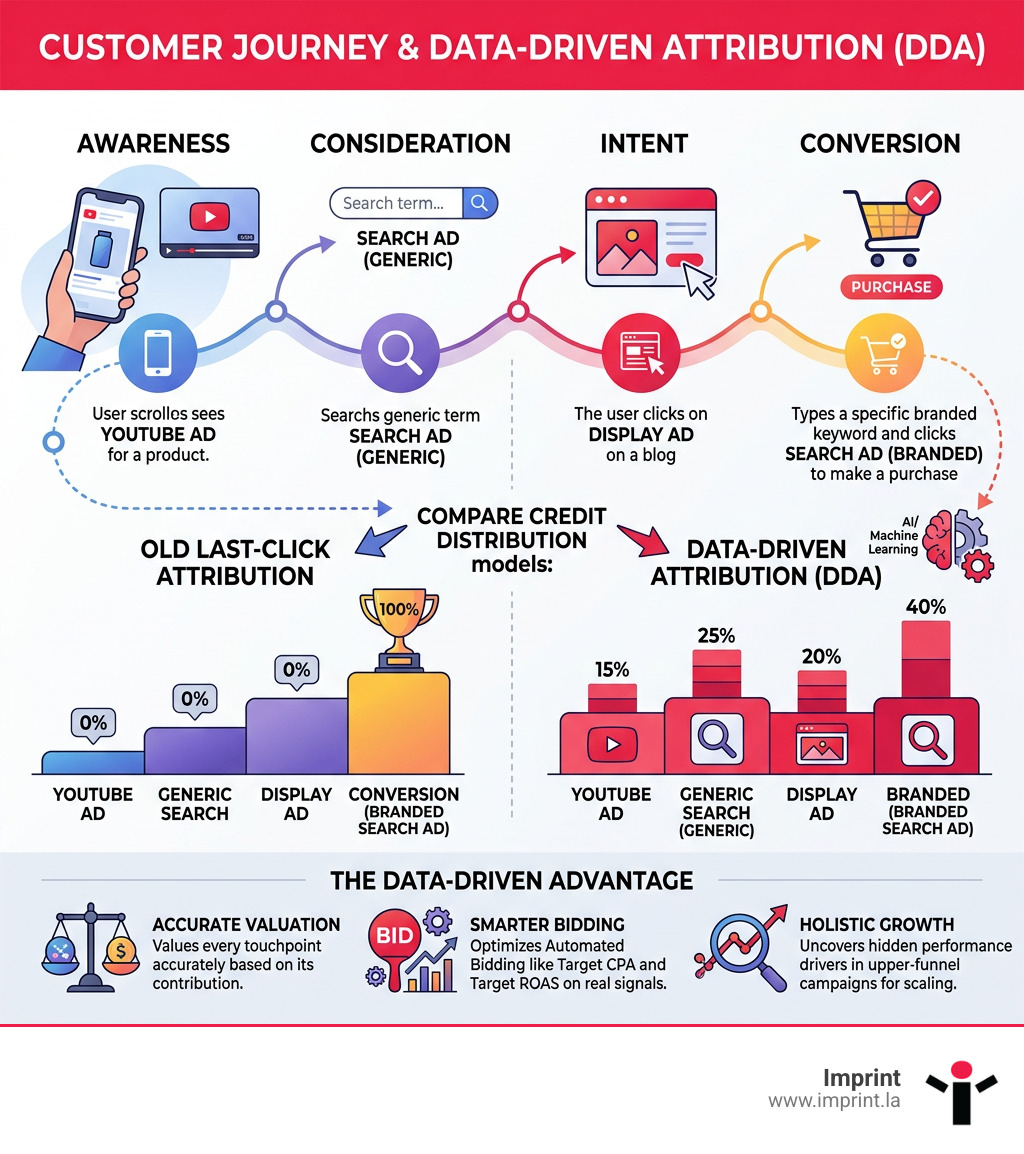
Here's the problem most growth-stage advertisers face: your customer doesn't buy after seeing one ad. They see a display ad, watch a YouTube video, search a generic term, then finally click a branded search ad to convert. Under the old last-click model, only that final click gets credit — and your bidding strategy optimizes around a lie.
That misattribution quietly kills scaling. You underfund upper-funnel campaigns that are doing real work. You overbid on closing keywords that just happened to be last in line. And your reported ROAS looks clean while your actual growth stalls.
Data-driven attribution fixes this by looking at the full path — and using your own account's historical data to figure out what actually moves people toward conversion.
I'm Brent Burghdorf, founder of Imprint and a performance marketing specialist who has built data-driven Google Ads systems across e-commerce, healthcare, and high-ticket service industries. Understanding how attribution models affect bidding efficiency is foundational to the scalable acquisition frameworks we build for our cells.
What is Data-Driven Attribution (DDA)?
At its core, data driven google ads attribution is an algorithmic model. Instead of following a set of rigid, pre-defined rules (like "give all credit to the first click"), it uses machine learning to analyze your account's unique historical data. It looks at the patterns of users who converted versus those who didn't to determine which touchpoints actually moved the needle.
Think of it as a sports team. In a last-click model, only the person who scores the goal gets the credit. In a data-driven model, the person who made the incredible cross-field pass and the defender who started the counter-attack also get their fair share of the "points."
This is vital because the modern buyer is rarely a "one-and-done" visitor. Studies show that consumers engage with a product at least eight times before purchasing. If you only track that eighth interaction, you are flying blind on the first seven.
DDA provides privacy-centric measurement by using aggregated, anonymized data to model these paths. It doesn't need to "spy" on individual users via invasive tracking; instead, it identifies statistical patterns across thousands of interactions to assign fractional credit. This makes it a durable solution in a world where cookies are crumbling and privacy regulations are tightening.
How DDA Handles Complex Customer Journeys
The customer journey has moved far beyond a simple Google Search. Today, your audience might see a Video ad on YouTube, engage with a Discovery (Demand Gen) feed on their phone, and click a Remarketing Display ad before finally searching for your brand name.
Research indicates that it often takes 7-13+ engagements with your business before a lead converts. DDA is designed specifically to handle this cross-channel synergy. It analyzes:
- Search Interactions: Which keywords started the journey?
- YouTube Views: Did a video ad increase the likelihood of a later search?
- Display & Demand Gen: How did visual touchpoints influence the final decision?
By crediting these early-funnel interactions, DDA allows us to see the "assist" value of campaigns that might otherwise look like they are underperforming. When we use data driven google ads strategies at Imprint, we often find that "expensive" top-of-funnel keywords are actually the primary drivers of our most profitable conversions.
Data-Driven Google Ads vs. Traditional Attribution Models
Before DDA became the gold standard, advertisers had to choose from several rule-based models. While these were better than nothing, they were often too "dumb" to reflect reality.
| Attribution Model | How it Assigns Credit | The Major Flaw |
|---|---|---|
| Last-Click | 100% to the final interaction. | Ignores everything that happened before the sale. |
| First-Click | 100% to the first interaction. | Overvalues brand awareness; ignores the "closer." |
| Linear | Equal credit to every touchpoint. | Assumes a generic "hello" is as valuable as a "buy now" click. |
| Time Decay | More credit to interactions closer to the sale. | Undervalues the initial discovery that made the sale possible. |
| Position-Based | 40% to first, 40% to last, 20% to the middle. | A "one-size-fits-all" guess that doesn't use your actual data. |
| Data-Driven | Algorithmic credit based on ML patterns. | Requires a minimum amount of data to be effective. |
Rule-based models are static. They don't care if your business sells $5 socks or $50,000 enterprise software. DDA, however, is dynamic. It learns that for your specific audience in Los Angeles or Santa Monica, a YouTube view might be worth 15% of a conversion, whereas for another business, it might only be worth 2%. You can find more technical details on these differences in the official Google Ads Help documentation.
The Shift from Last-Click to Data-Driven
Google didn't just suggest DDA; they made data-driven attribution our default attribution model for all new conversion actions. This was a seismic shift in the industry.
When you move away from last-click, you will notice a "redistribution" of conversions in your dashboard. You might see fractional numbers (e.g., 0.45 conversions). Don't panic! This doesn't mean you're getting fewer sales; it means the credit is being shared more accurately. This redistribution reveals the true "upper-funnel value" of your campaigns, allowing for much higher reporting accuracy and better-informed budget shifts.
The Strategic Benefits of Data-Driven Google Ads
Why go through the trouble of switching? Because the performance gains are real. A recent study involving hundreds of advertisers using DDA revealed that performance improved when compared to last-click attribution, largely because the system stops penalizing the ads that introduce your brand to new customers.
At Imprint, we've seen this play out across various industries. By moving to a data-backed model, businesses often see a significant conversion lift and a reduction in Cost Per Acquisition (CPA). When your data is accurate, your budget becomes more efficient because you aren't wasting money on "closing" ads that would have converted anyway while starving the "introductory" ads that actually find new customers. You can see how we apply these principles in our PPC Client Stories.
Optimizing Smart Bidding with Data Driven Google Ads
This is where the magic happens. DDA is the "brain," and Smart Bidding is the "muscle."
Smart Bidding strategies like Target CPA (tCPA), Target ROAS (tROAS), and Maximize Conversions rely on signals to decide how much to bid for a specific user in real-time. If you use a last-click model, you're giving the bidding algorithm bad signals. You're telling it, "Only bid on people who click this specific branded ad."
With data driven google ads, you give the algorithm a much richer set of signals. It learns that a user who has seen a video and clicked a generic search term is a "high-intent" user. It can then bid more aggressively for that user's next interaction because it knows the "path to conversion" is nearly complete. This Smart Bidding synergy is what allows our Los Angeles-based agency to achieve an average 3.8x ROAS for our clients.
Scaling Performance via Data Driven Google Ads
The proof isn't just in the theory; it's in the results from some of the world's biggest brands and nimble growth companies:
- Mercedes-Benz Germany saw a 37% increase in conversions by pairing DDA with the "Maximize conversions" bidding strategy.
- Medpex, a mail-order pharmacy, achieved a 29% increase in conversions and a 28% decrease in CPA.
- Select Home Warranty experienced a 36% increase in leads and a 20% decrease in CPA.
- H.I.S., a global travel agency, achieved a 62% increase in conversions at the same CPA by combining DDA with Smart Bidding and Dynamic Search Ads.
On average, advertisers who switch to DDA from a rule-based model see a 6% increase in conversions. While that might sound modest, for a high-volume account in Beverly Hills or Santa Monica, a 6% lift in efficiency can represent hundreds of thousands of dollars in found revenue. As Google notes, the future of attribution is data-driven, and those who adopt it early gain a massive competitive advantage.
Technical Requirements and Setting Up DDA
While Google is making DDA more accessible, there are still some technical "rules of the road" you need to know.
Historically, you needed a massive amount of data to qualify for DDA. However, Google has lowered these barriers significantly. For most conversion actions, there is no longer a strict minimum. However, for certain complex conversion types, Google recommends that you have at least 300 conversions and 3,000 ad interactions within 30 days to be eligible.
To stay eligible, you generally need to maintain at least 2,000 ad interactions and 200 conversions every 30 days. If your data drops below this threshold for an extended period, the model may revert to a last-click or rule-based model until your volume picks back up. If you're struggling to hit these numbers, our PPC/SEM Agency services can help you optimize your funnel to increase volume.
Step-by-Step Implementation Guide
Ready to make the switch? Follow these steps to transition your account:
- Navigate to Goals: Click the Goals icon in your Google Ads account.
- Open Conversions: Click the Conversions dropdown and select Summary.
- Select Your Action: Click on the specific conversion action you want to edit (e.g., "Purchase" or "Lead Form").
- Edit Settings: Click Edit settings at the bottom of the page.
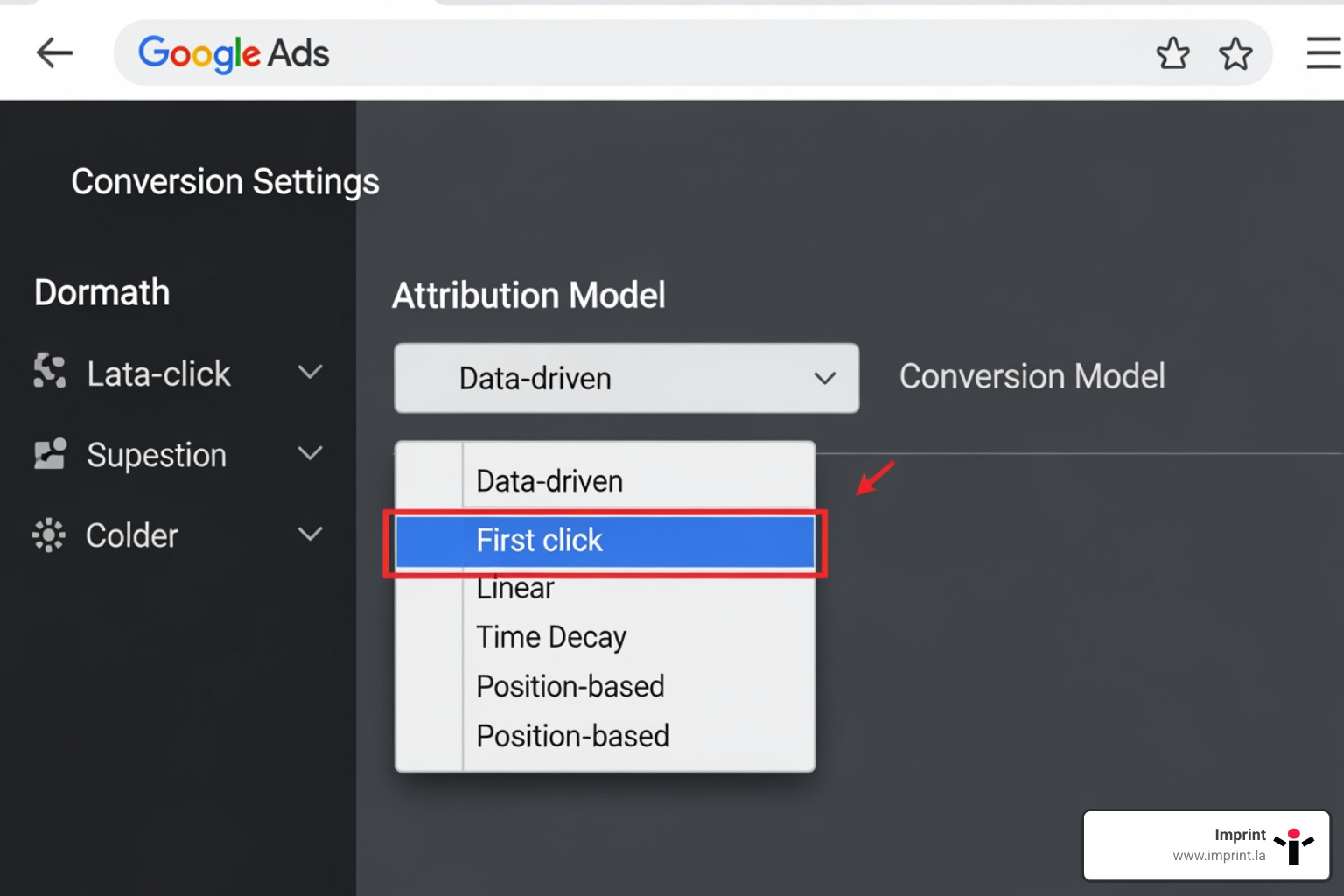
- Change Attribution Model: Click the Attribution model section and select Data-driven from the dropdown menu.
- Save and Done: Click Save, then click Done.
Pro-Tip: Before you switch, use the Model Comparison Tool (found under Tools > Measurement > Attribution). This allows you to compare your current model against DDA side-by-side. You can see exactly how your conversion numbers would have shifted over the last 30-90 days, which helps set expectations for your team or clients.
Considerations When Switching to DDA
Switching to data driven google ads isn't a "set it and forget it" task. You need to be prepared for the "learning period." When you change your attribution model, the Smart Bidding algorithm needs about two weeks to recalibrate. During this time, you might see some initial fluctuations in your CPA or ROAS.
You also need to account for data lag. Because DDA credits multiple touchpoints over time, a conversion that happens today might "give back" credit to an ad click from two weeks ago. This means your reporting for the most recent 2-3 days might look slightly lower until the model "catches up." For a deep dive into the math, you can download the Data-driven attribution methodology PDF.
Monitoring and Improving DDA Performance
Once you've made the switch, your job shifts to optimization. Here is how we handle it at Imprint:
- Audit Your Conversion Tracking: DDA is only as good as the data you feed it. Ensure your tags are firing correctly across all devices.
- Align Search Intent: Now that you can see the value of "research" keywords, make sure your ad copy for those terms is educational rather than just "hard sell."
- Scale Winning Paths: Look at the "Top Paths" report in your Attribution section. If you see that a specific YouTube video often leads to a high-value search conversion, increase the budget for that video!
- Continuous Testing: Never stop A/B testing your creatives. You can learn more about The Importance of Digital Marketing and testing on our blog.
Frequently Asked Questions about Data-Driven Attribution
What happens if my data volume drops below the DDA threshold?
If your account's data volume falls significantly (typically below 2,000 interactions or 200 conversions in a 30-day window), Google Ads may no longer be able to generate an accurate DDA model. In this case, the system will automatically revert the conversion action to a Last-click attribution model until your volume increases again.
Does DDA work with all campaign types?
Yes! As of 2024 and looking into 2025, DDA supports Search, Shopping, Display, YouTube, Performance Max, and Demand Gen (formerly Discovery) campaigns. It even supports in-app and certain offline conversion types, making it a truly holistic measurement tool.
How long does it take for DDA to learn my account data?
While you can switch the setting instantly, we recommend a two-week learning window. During this time, the machine learning algorithms are analyzing your historical data and adjusting bids based on the new fractional credit signals. Avoid making major budget or structural changes during this ramp-up period.
Conclusion
The shift toward data driven google ads isn't just a technical update — it's a fundamental change in how we value marketing. By moving away from the "last-click lie," you gain the clarity needed to scale your business aggressively and intelligently.
At Imprint, we specialize in turning this complex data into actual growth. Based in Los Angeles, with deep roots in Santa Monica and Beverly Hills, our team of performance experts uses data-backed strategies to deliver an average 3.8x ROAS for our clients. We don't just set up ads; we build high-performance acquisition engines that understand the full value of every dollar you spend.
If you're ready to stop guessing and start growing with a PPC/SEM Agency that lives and breathes data, let's talk. Your data is telling a story — we're here to help you read it and write the next chapter of your success.
