
How to Design Lead Gen Ads That Don't Look Like Spam
Why Most Lead Gen Ads Get Ignored (And How to Fix That)

Creative lead gen ads are paid ad formats designed to capture contact information by offering genuine value — not just a flashy button that says "Sign Up."
Here's what makes them work:
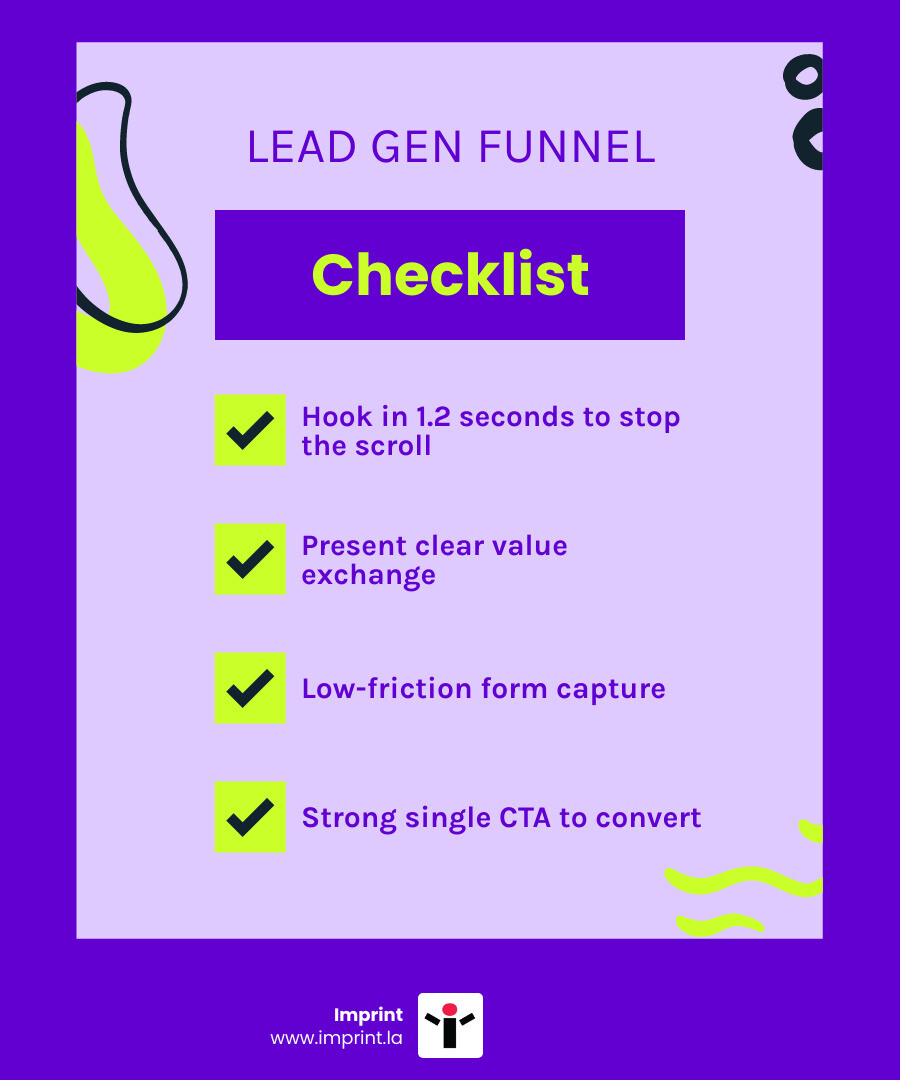
- Hook fast — you have about 1.2 seconds to stop the scroll
- Show clear value — give people a real reason to hand over their info
- Keep friction low — fewer form fields, one obvious CTA
- Build trust — social proof, privacy assurances, and credible visuals
- Match the platform — native-feeling creative outperforms polished, corporate ads
Most lead gen ads fail for a simple reason: they look like spam. Generic stock photos, vague promises, and pushy CTAs train people to scroll right past them. Research consistently shows that ad creative drives over 70% of paid media performance variance — more than your targeting, your budget, or the algorithm.
That's a big number. And it means the design and messaging of your ad matters more than almost anything else.
Meanwhile, audiences are getting smarter. Decision-makers and executives now spend over an hour a week actively reading thought-leadership content. People aren't tuning out — they're just raising the bar for what earns their attention.
The brands winning at lead generation right now treat every ad as a value exchange, not a data grab.
I'm Brent Burghdorf, founder of Imprint and a performance marketing specialist who has built scalable acquisition systems around creative lead gen ads across e-commerce, real estate, healthcare, and high-ticket services. In this guide, I'll walk you through exactly how to design lead gen creatives that convert — without looking like spam.
Core Principles of Creative Lead Gen Ads
When we sit down at our Los Angeles office to build a campaign, we don't start with the budget. We start with the "Hungry Crowd" — the specific audience that has a problem only our client can solve. To reach them, we follow a strict Hook-Problem-Solution framework.
Your ad needs to make one clear promise to one specific audience with one obvious CTA. If you try to sell "everything to everyone," you end up selling nothing to no one. High-performing creative lead gen ads use a strong Creative direction that prioritizes visual hierarchy. This means the most important part of your offer (the benefit) should be the first thing the eye hits.
We also focus heavily on credibility cues. In a world of "fake news" and digital scams, trust is a "conversion tax." If you don't pay it upfront with Social proof and testimonials, your cost per lead (CPL) will skyrocket. People are 4.5x more likely to convert when they see User-Generated Content (UGC) or real customer stories rather than polished corporate graphics. As a Graphic Design Agency, we’ve seen that even a simple "Before and After" or a split-screen transformation can increase engagement by 30%.
Why Video Outperforms Static Imagery
If you aren't using video, you're leaving money on the table. Statistics show that 89% of businesses now use video as a marketing tool, and for good reason: video ads allow you to build an emotional connection that a static image simply can't match.
At Imprint, we follow the ABCD creative guidance:
- Attraction: Hook them in the first 1.2 seconds.
- Branding: Introduce your brand early and often.
- Connection: Help the audience relate to the problem.
- Direction: Tell them exactly what to do next.
One of our favorite "hacks" is the UGC-mirror method. This involves creating ads that look like organic content from a friend rather than a business. Why? Because it bypasses "banner blindness." Furthermore, video allows for advanced retargeting. We can create custom audiences based on "Watch Time," meaning we only spend our heavy remarketing budget on people who actually cared enough to watch 50% or more of our video.
Copywriting Frameworks for High Conversion
Stop writing like a robot. Your prospects are humans, so your copy should sound like a peer-to-peer conversation. We use "You-focused" language that addresses the prospect's specific pain points.
Instead of saying "Our software has 90% faster load times," try "Are you tired of losing customers because your site is too slow?" The latter hits an emotional nerve. Effective copy also addresses objections before they are even raised. If price is a common hurdle, mention the "no-brainer" value or a limited-time incentive to create a sense of scarcity. As a Social Media Agency, we’ve found that specific, outcome-based hooks (e.g., "How I lost 18lbs in 30 days") consistently outperform vague ones (e.g., "Weight loss tips").
Optimizing the Conversion Path: Instant Forms and Landing Pages
Once a user clicks your ad, the experience must be seamless. You have two main choices: Meta Instant Forms (native to the app) or External Landing Pages.
Instant Forms are fantastic for reducing friction because they auto-populate with the user's Facebook data. However, they can sometimes attract lower-quality leads. To fix this, we design them as "mini-landing pages" that include bullet points of benefits and clear Meta advertising regulations compliance, such as a visible link to your privacy policy.
For high-ticket services in Santa Monica or Beverly Hills, we often recommend external landing pages to provide more room for persuasion. No matter which path you choose, immediate follow-up is mandatory. We use 5 Hacks That Extract More Value from Facebook Optimization Strategies to ensure every lead is synced to a CRM instantly via webhooks or automation tools.
TABLE: Instant Forms vs. External Landing Pages
| Feature | Meta Instant Forms | External Landing Pages |
|---|---|---|
| User Friction | Extremely Low (Auto-fill) | Higher (Manual entry) |
| Lead Quality | Moderate (Needs qualifying) | High (Higher intent) |
| Setup Speed | Fast (Built-in) | Slower (Needs design/hosting) |
| Tracking | Simple (In-platform) | Complex (Needs Pixel/CAPI) |
| Best For | E-books, Newsletters, Giveaways | High-ticket sales, Consultations |
Qualifying Leads Without Reducing Volume
A common fear is that adding questions to a form will kill your lead volume. In reality, it often just kills the spam. By adding one or two multiple-choice questions (e.g., "What is your monthly budget?"), you qualify the lead and give your sales team better data.
We also use "Higher Intent" review steps, where the user has to slide a button to confirm their submission. This small extra step ensures the person actually meant to sign up. For B2B clients, we might use interactive tools like ROI calculators or quizzes. A well-designed quiz can generate over 100,000 leads because it offers personalized value in exchange for an email address.
Advanced Tactics for Scaling and Tracking
Scaling creative lead gen ads is where most marketers fail. They find a winner, double the budget, and watch their ROAS (Return on Ad Spend) tank 48 hours later. This is usually due to "algorithmic fatigue."
As a PPC / SEM Agency, we manage scaling by focusing on the creative engine rather than just the "bid" button. We monitor frequency closely; if your target audience in Los Angeles sees the same ad more than 3-5 times, performance will drop. This is "creative fatigue," and the only cure is fresh assets.
Scaling Creative Lead Gen Ads Without Resetting Learning
To scale without throwing the Facebook algorithm into a "Learning Phase" reset, we use the 3x2x1 testing framework. This involves testing 3 Hooks, 2 Angles, and 1 CTA. Once we identify a winning combination, we don't just increase the budget of that ad set. Instead, we duplicate the winning ad set into a new "Scaling Campaign" using Campaign Budget Optimization (CBO).
We recommend increasing budgets gradually — about 20% every 3-4 days. This allows the AI to find new pockets of your audience without getting overwhelmed. 20% of your creatives will likely drive 80% of your results. Your job is to find that 20% and give them the budget they deserve.
Improving Data Accuracy for Creative Lead Gen Ads
In a post-iOS 14 world, standard browser tracking isn't enough. To get the best results, you must Connect Facebook Conversions API. This allows your server to talk directly to Meta's server, bypassing ad blockers and browser limitations.
We also implement webhooks and server-side tracking to ensure that when a lead converts into a sale offline, that data is fed back into the ad platform. This "Offline Conversion Import" tells the algorithm exactly what a "good" lead looks like, allowing it to optimize for revenue, not just clicks. This data-driven feedback loop is how we maintain our 3.8x average ROAS for our clients.
Frequently Asked Questions about Lead Gen Design
How do I qualify leads without losing volume?
The secret is "Value-First Gating." If the resource you are offering is valuable enough (like a custom ROI calculator or a high-level industry report), users won't mind answering 2-3 qualifying questions. Use multiple-choice questions to keep the effort low while still gathering the data you need for lead scoring.
Why do videos outperform images in lead generation?
Videos have a higher "stopping power" in the feed. With an 86% action rate for people who discover products on visual platforms like YouTube and Facebook, video allows you to tell a story. More importantly, it gives you the ability to retarget based on engagement metrics (dwell time), which is impossible with a static image.
What metrics indicate a winning lead gen ad?
While Click-Through Rate (CTR) and Cost Per Lead (CPL) are important, they don't tell the whole story. You need to look at:
- Conversion Rate: Are people actually filling out the form?
- Frequency: Is your audience getting bored of the ad?
- Lead-to-Sale Ratio: This is the ultimate metric. A $2 lead is worthless if they never buy. A $50 lead is a bargain if they close at a 20% rate.
Conclusion
Designing creative lead gen ads that don't look like spam is about moving from a "me-first" mindset to a "value-first" strategy. By focusing on human-centric copy, native-feeling video, and frictionless conversion paths, you can build a lead generation machine that scales.
At Imprint, we specialize in these data-backed creative strategies. Based in Los Angeles, our team serves businesses in Santa Monica, Beverly Hills, and beyond, delivering an average 3.8x ROAS by combining elite UX/UI design with aggressive performance marketing.
Ready to stop guessing and start growing? Whether you need a PPC / SEM Agency to manage your spend or a creative team to overhaul your assets, we’re here to help you turn "background noise" into a high-converting pipeline.
