
How to Turn Raw Data into ROAS Gold
Why Meta Ads Data Analysis Determines Whether You Scale or Stall

Meta ads data analysis is the process of turning raw campaign numbers into decisions that grow revenue — and it's the single biggest lever separating profitable advertisers from those burning budget with nothing to show for it.
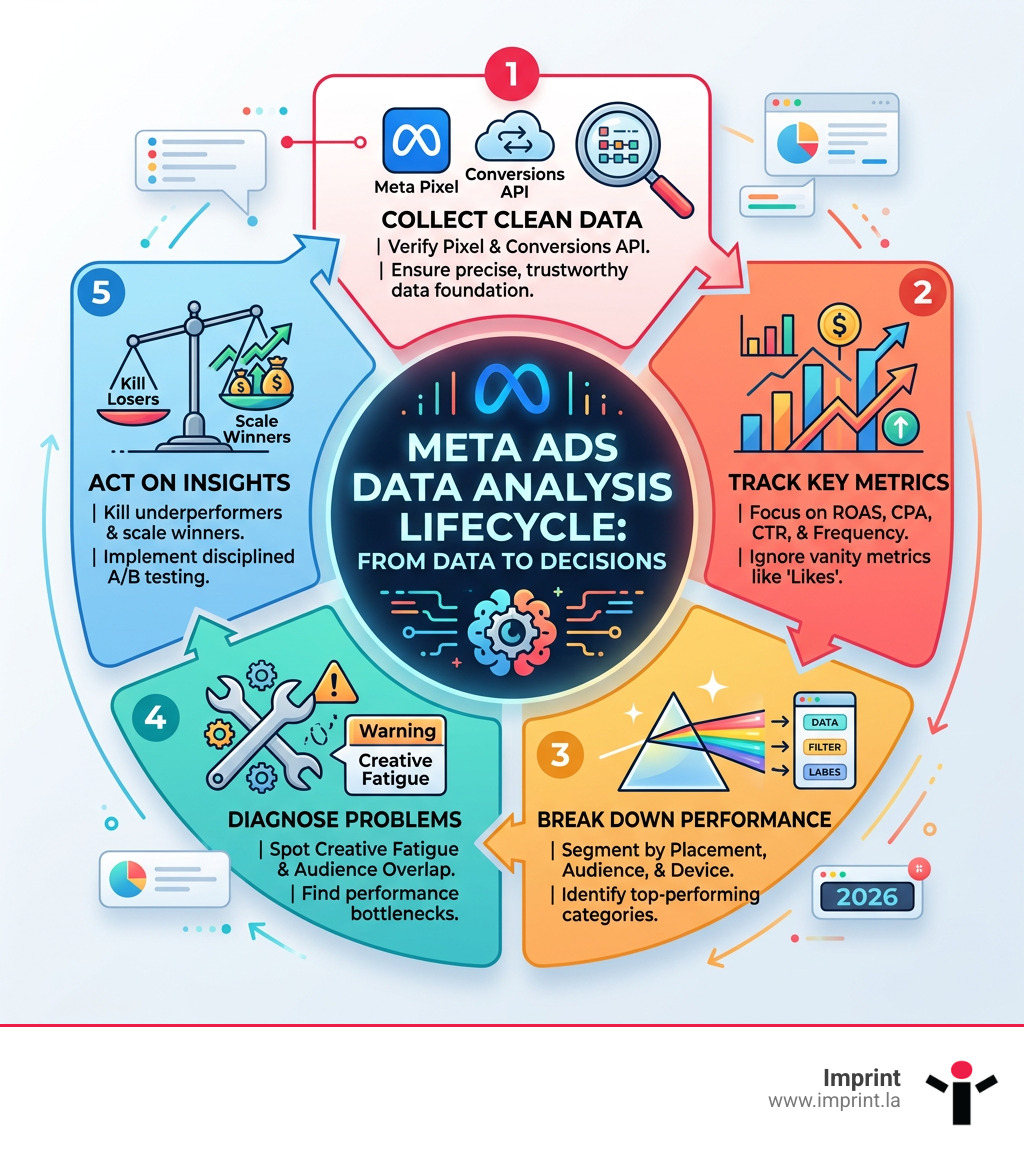
Here's the short version of what effective Meta ads analysis looks like:
- Collect clean data — set up Meta Pixel and Conversions API correctly so your numbers are trustworthy
- Track the right metrics — focus on ROAS, CPA, CTR, and Frequency, not vanity metrics like Likes
- Break down performance — segment by placement, age, gender, device, and region to find what's actually working
- Diagnose problems — identify creative fatigue, audience overlap, and budget drains before they kill your ROAS
- Act on insights — kill losers, scale winners, and test one variable at a time
With over 3.4 billion daily active users across Meta platforms, the opportunity is enormous. But reach means nothing without a system to read the data behind it.
The challenge? Meta's Ads Manager surfaces dozens of metrics by default — most of them distractions. A high impression count feels good. A rising "Reach" number looks promising. But as the saying goes, you can't pay rent with Reach. What actually matters is whether your ad spend is generating profitable returns.
This guide walks you through exactly how to build that system — from setting up your measurement foundation to diagnosing underperformers and scaling what works.
I'm Brent Burghdorf, founder of Imprint and a performance marketing specialist who has built scalable meta ads data analysis frameworks for e-commerce, healthcare, real estate, and high-ticket service brands. The strategies in this guide are the same ones I use to structure campaigns around clear ROI targets and disciplined testing — not guesswork.
The Foundation of Meta Ads Data Analysis
Before we can turn data into gold, we have to make sure the data isn't lead. In meta ads data analysis, your insights are only as good as your tracking. If your "Purchases" column is empty but your bank account is growing, your foundation is cracked.
We primarily interface with three native tools: Ads Manager (the operational hub), Events Manager (the tracking heart), and Business Suite (the bird's-eye view). However, the game changed significantly with Apple’s iOS 14 update. Research shows that less than 25% of iPhone users opted into tracking post-iOS 14, which effectively blinded the standard Meta Pixel for nearly half of all mobile traffic.
To fight back, we use a "belt and braces" approach:
- Meta Pixel: The browser-side tracker that follows user behavior on your site.
- Conversions API (CAPI): A server-side connection that sends data directly from your website server to Meta, bypassing browser blockers and cookie restrictions. This is no longer optional; it is the baseline for Data-Driven Google Ads and Meta campaigns alike.
Understanding attribution windows is equally vital. By default, Meta uses a 7-day click and 1-day view window. This means if someone clicks your ad and buys six days later, Meta claims the win. If they simply see the ad and buy within 24 hours, Meta also claims the win. When analyzing, always cross-reference this with your internal CRM or Shopify data to ensure you aren't over-counting "view-through" conversions that might have happened organically.
Key Metrics and Performance Benchmarks
In our Los Angeles agency, we see many brands get distracted by "vanity metrics." Likes, comments, and shares are great for the ego, but they don't always correlate with cash flow. For a professional meta ads data analysis, we categorize metrics into three buckets:
- Financial KPIs (The "North Star"): ROAS (Return on Ad Spend) and CPA (Cost Per Acquisition).
- Efficiency Metrics: CTR (Click-Through Rate) and CPC (Cost Per Click).
- Delivery Metrics: CPM (Cost Per Mille), Reach, and Frequency.
Industry Benchmarks for 2025
While every business is unique, having a baseline helps you know if you're hitting a home run or striking out.
| Metric | E-commerce Benchmark | Lead Gen Benchmark |
|---|---|---|
| CTR (Click-Through Rate) | 1.0% - 1.5% | 0.8% - 1.0% |
| Conversion Rate | 2% - 4% | 7% - 12% |
| Average CPC | $0.70 - $1.50 | $2.00 - $5.00 |
| Target ROAS | 3.0x - 4.0x | N/A (Focus on CPA) |
According to industry data, the average ROAS across all industries is 2.98x. At Imprint, we aim higher, with a 3.8x average for our clients. If your ROAS is below 2.0x, you are likely at a "break-even" point once you factor in product costs and shipping.
One "hidden" metric we watch closely is Frequency. This is the average number of times each person has seen your ad. In prospecting (cold) audiences, a frequency above 2.5–3.0 usually signals that you’ve saturated that audience, leading to "ad blindness" and rising costs.
Creative Performance and Meta Ads Data Analysis
In 2025, "the creative is the new targeting." Because Meta’s AI has become so efficient at finding buyers, your job is to give the algorithm high-quality fuel. We analyze creative using specific "engagement depth" metrics:
- Hook Rate (Thumb-Stop Ratio): (3-Second Video Plays / Impressions). If this is below 25-30%, your intro isn't grabbing attention. People are scrolling right past you.
- Hold Rate: (ThruPlays / 3-Second Plays). This tells us if your content is actually interesting. If they stop but don't stay, your messaging is falling flat.
- Creative Fatigue: When you see CTR dropping while Frequency and CPM are rising, your creative is "tired." It’s time to refresh the visuals.
The ad's job is to get the click; the landing page's job is to get the sale. If your Meta Ads Landing Pages have a high bounce rate despite a high CTR, the "disconnect" is on your website, not the ad.
Advanced Optimization through Meta Ads Data Analysis
Once you have a baseline, it’s time to play the "strategy game." We use the Experiments tool for formal A/B testing. Unlike a standard split test where the algorithm might favor one ad early on, an official Experiment ensures an even budget split for a set period.
When scaling, we look for Statistical Significance. Don't kill an ad because it had one bad day. We recommend waiting for at least 2-3x your target CPA in spend before making a "Scale or Kill" decision.
For Instagram Ads and E-Commerce brands, calculating your Break-Even ROAS is the first step in advanced analysis.
- Formula: 1 / Profit Margin %.
- If your margin is 50%, your break-even ROAS is 2.0. Anything above that is "ROAS Gold."
A Step-by-Step Framework for Effective Analysis
Don't just open Ads Manager and stare at the default "Performance" view. To perform a high-level meta ads data analysis, you need to customize your workspace.
Step 1: Custom Columns
We set up a custom view that follows the customer journey from left to right:
- Spend -> Impressions -> CPM -> Link Clicks -> CTR -> CPC -> Adds to Cart -> Purchases -> CPA -> ROAS.
Step 2: The "Breakdown" Deep Dive
This is where the real gold is buried. Use the Breakdown menu to slice your data by:
- Placement: Are you overspending on the "Audience Network" with zero conversions? (Pro tip: usually, yes).
- Age & Gender: You might find that while men click more, women actually buy at a 3x higher ROAS.
- Region: In the US, certain states or metro areas (like Los Angeles or Santa Monica) might have higher competition but better conversion intent.
- Device: If your CPC is $0.50 on Android but $2.00 on iPhone, but iPhone users have a 10% conversion rate, the "expensive" click is actually the winner.
By applying these 5 Hacks That Extract More Value from Facebook Optimization Strategies, you can identify "pockets of profitability" that the average advertiser misses.
Troubleshooting and Common Pitfalls
Even the best advertisers hit walls. When your meta ads data analysis shows a sea of red, look for these common culprits:
- The Learning Phase Trap: Meta needs about 50 conversions per ad set per week to "exit learning." If you tinker with your budget or creative every two days, you reset this process. Stop over-optimizing; let the data accumulate.
- Audience Overlap: If you are running multiple ad sets targeting the same people in Beverly Hills, you might be bidding against yourself. Use the "Audience Overlap" tool in the Audiences section to check.
- Budget Drains: Watch out for "Advantage+ Placements" spending 20% of your budget on low-quality sites outside of Facebook and Instagram.
- Scaling Too Fast: Increasing your budget by 500% in one day is a recipe for disaster. We recommend "Vertical Scaling"—increasing the budget of winning ad sets by 20% every 2–3 days to keep the algorithm stable.
If you find yourself overwhelmed by these complexities, working with a specialized PPC/SEM Agency can provide the objective, data-backed oversight needed to navigate these technical hurdles.
Frequently Asked Questions about Meta Ads Analytics
How often should I review my Meta Ads data?
We recommend a tiered approach:
- Daily: Check for "spend anomalies." Is a campaign spending way too fast? Did a tracking pixel break?
- Weekly: This is your deep dive. Look at ROAS and CPA trends. This is when you make "Scale or Kill" decisions.
- Monthly: Strategic audit. Look at year-over-year trends and overall business profitability. Avoid making emotional decisions based on 24 hours of data; Meta's reporting can lag by up to 72 hours due to iOS privacy delays.
What is a good benchmark for CTR and ROAS in 2025?
For most e-commerce brands, a 1% CTR is the "line in the sand." Anything below that suggests your creative is failing to resonate. A 3:1 ROAS is a healthy target for e-commerce, while lead generation should focus on CPL (Cost Per Lead) and lead quality. A 5% CTR is worthless if those clicks have a 90% bounce rate. Quality over quantity, always.
Why does Meta reporting differ from Google Analytics?
This is the #1 question we get at our Los Angeles office. The discrepancy usually comes down to:
- Attribution Models: Meta uses "Last Touch" (including views), while Google Analytics often uses "Last Non-Direct Click."
- Cross-Device Journeys: Someone might see your ad on a phone (Meta tracks) but buy later on a laptop (GA might see as "Direct" or "Search").
- Privacy Blocks: iOS users who opt out of tracking are often "estimated" by Meta but missed entirely by standard GA4 setups.
Conclusion
Mastering meta ads data analysis is what transforms an advertising "expense" into a predictable "investment." By moving past vanity metrics and focusing on the full funnel—from the first "hook" to the final purchase—you can stop guessing and start scaling.
At Imprint, we don't believe in "set it and forget it" marketing. We are a performance-driven agency based in Los Angeles, specializing in data-backed strategies that deliver an average 3.8x ROAS. Whether you are in Santa Monica, Beverly Hills, or anywhere else, our mission is to turn your raw data into ROAS gold.
Ready to see how we've helped other brands dominate their niche? Check out our Client Stories PPC or Work with a leading PPC/SEM Agency today to start your own digital marketing revolution.
