
Why You Need Both Lead Gen and Appointment Setting to Scale
Why Most B2B Sales Pipelines Stall (And What Actually Fixes It)

appointment setting vs leadgen is one of the most misunderstood comparisons in B2B sales — and getting it wrong costs you real pipeline.
Here's the quick answer:
| Lead Generation | Appointment Setting | |
|---|---|---|
| Goal | Find and attract potential buyers | Convert qualified leads into booked meetings |
| Funnel stage | Top of funnel (TOFU) | Middle/bottom of funnel (MOFU/BOFU) |
| Output | Marketing Qualified Leads (MQLs) | Sales Qualified Leads (SQLs) + confirmed meetings |
| Skills needed | Marketing, targeting, content, data | Communication, qualification, objection handling |
| Key metric | Cost per lead, reply rate | Show rate, meeting-to-opportunity rate |
| Speed to results | 8–12+ weeks | 30–60 days |
They are not the same thing. And they're not interchangeable.
Lead generation creates motion — it fills the top of your funnel with interested prospects. Appointment setting creates direction — it takes those prospects and moves them into real sales conversations. One without the other leaves money on the table.
Here's why it matters right now: 43% of B2B sales teams say "too few qualified meetings" is their single biggest bottleneck. The fix isn't always more leads. Often, it's a broken handoff between lead gen and appointment setting.
I'm Brent Burghdorf, founder of Imprint and a performance marketing specialist who has built full-funnel acquisition systems across industries — and the appointment setting vs leadgen distinction is one I help growth-stage brands navigate every day by delivering high-quality service standards at low-cost pricing. In this guide, I'll break down exactly how these two disciplines work, where each fits in your pipeline, and how to combine them for predictable revenue growth.
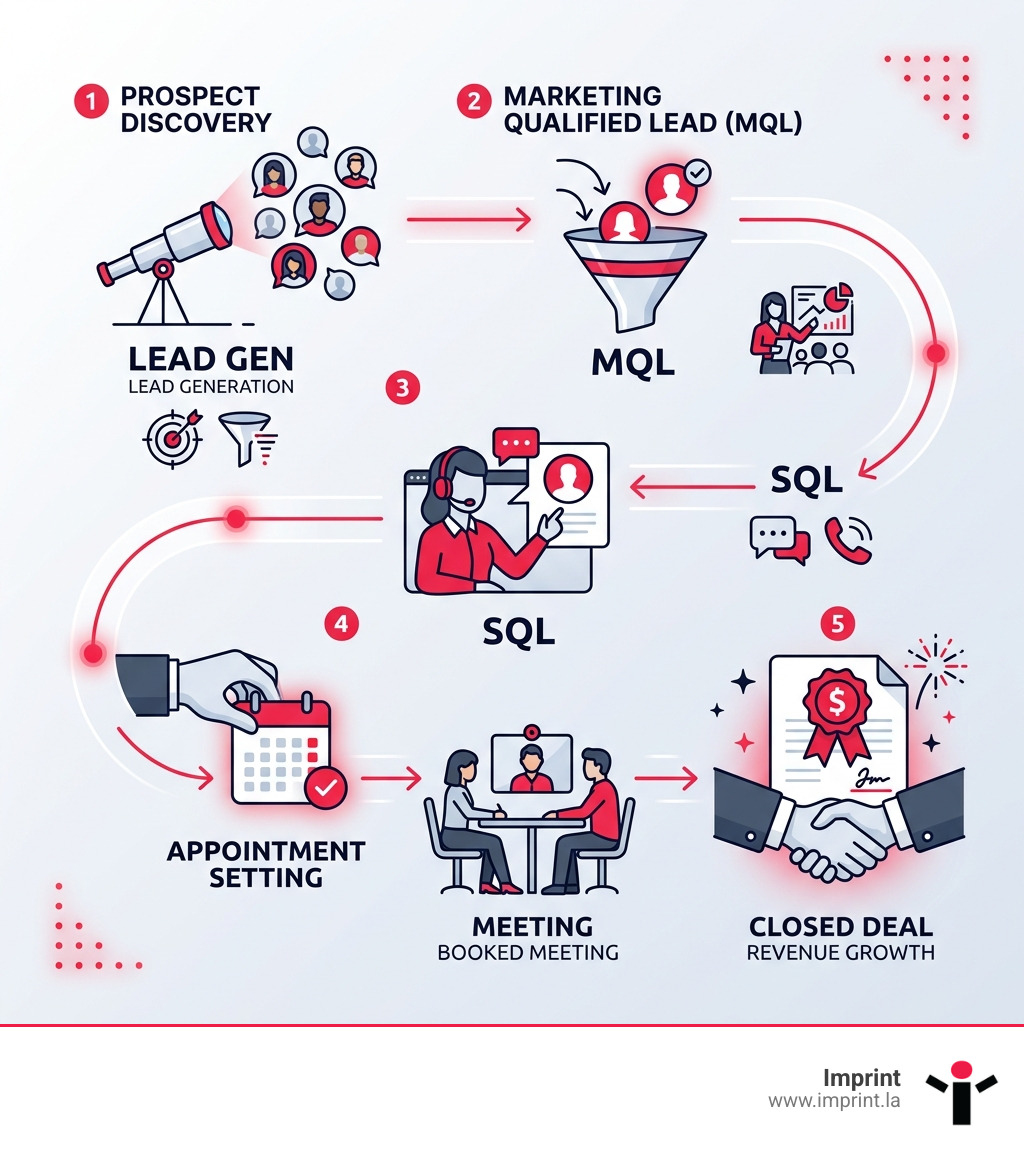
Defining the Roles: Appointment Setting vs Leadgen
To scale a business in April 2026, we have to stop treating the sales funnel like a single, monolithic block. Think of your revenue engine like a relay race. Lead generation is the sprinter who finds the right batons (prospects) and gets them to the exchange zone. Appointment setting is the hand-off pro who ensures that baton is placed firmly and securely into the closer’s hand with the right context.
Lead Generation V/s Appointment Setting: What's The Difference? highlights that these are sequential, complementary disciplines. Lead generation focuses on the Top of Funnel (TOFU), identifying and attracting potential customers who fit your criteria. It produces Marketing Qualified Leads (MQLs)—people who have raised their hand or shown interest but aren't necessarily ready to buy this afternoon.
In contrast, appointment setting lives in the Middle and Bottom of the Funnel (MOFU/BOFU). Its job is to take those MQLs, verify their intent, and turn them into Sales Qualified Leads (SQLs) by booking a firm time on a calendar. At Imprint, we utilize Data-Driven Lead Strategies to ensure this transition happens without "data leakage," where interested prospects fall through the cracks because nobody followed up fast enough.
Why Appointment Setting vs Leadgen Starts with Quality Data
You can have the most charismatic appointment setters in Los Angeles, but if they are calling a list of people who don't need your product, you're just burning cash. The foundation of the appointment setting vs leadgen debate is the Ideal Customer Profile (ICP).
High-quality lead generation relies on firmographics (company size, industry, location), technographics (the software they use), and intent signals (what they are searching for right now). We leverage B2B Lead Gen Meta strategies to find these high-intent users at a low cost of acquisition.
Data validation is the "secret sauce" here. Before a lead ever reaches an appointment setter, it should be scrubbed for accuracy. This means verifying email addresses, LinkedIn profiles, and recent "trigger events"—like a company receiving a new round of funding or hiring a new VP of Sales. By providing our teams with validated data, we reduce wasted effort and maintain our low-cost pricing while upholding high-quality service standards.
The Metrics of Success for Each Discipline
If you measure your appointment setters by the number of leads generated, or your lead gen team by the number of closed deals, you’ll end up with a frustrated team and a broken pipeline.
For lead generation, we look at:
- Cost Per Lead (CPL): How much are we spending to get a "hand-raise"?
- Reply Rate: Are our messages resonating with the target audience? (A healthy benchmark is often 10% to 18%).
- MQL-to-SQL Conversion: How many of these leads are actually "good"?
For appointment setting, the metrics shift toward conversion velocity:
- Show Rate: The "silent killer" of ROI. If your show rate is below 60%, your qualification is too loose. A professional standard is 75–85%.
- Meeting-to-Opportunity Rate: In sectors like B2B SaaS, up to 30% of qualified meetings should convert into active sales opportunities.
- Cost Per Qualified Meeting: This is the ultimate metric for Appointment Setting Services vs. Lead Gen Tools. While tools might seem cheaper upfront, the "all-in" cost of an outsourced service often results in a 30–40% lower cost per meeting due to higher efficiency.
The Strategic Impact of Lead Generation on Your Pipeline

Lead generation is about scale and brand awareness. It’s the process of casting a wide but highly targeted net to fill your database. In 2026, this isn't just about "buying a list." It’s about creating a multi-channel presence that makes your brand familiar before a salesperson ever picks up the phone.
We use Creative Lead Gen Ads across Meta, Google, and TikTok to build this top-of-funnel momentum. When combined with organic efforts like How to Get More Leads with SEO, you create a "warm" environment.
The goal of lead generation is to uncover intent. For example, if a prospect downloads a whitepaper on "Scaling Manufacturing in Southern California," they’ve given us a signal. They aren't a "sale" yet, but they are a lead worth investigating. This automated, scalable approach allows us to reach thousands of prospects simultaneously, something a human caller simply cannot do.
Converting Interest into Revenue with Appointment Setting
This is where the "human touch" becomes irreplaceable. While lead gen is automated and scalable, appointment setting is personalized and empathetic. You cannot automate empathy.
A professional SDR (Sales Development Representative) does more than just read a script; they engage in Comparing Lead Generation and Appointment Setting tactics like active listening and objection handling. They use qualification frameworks like BANT (Budget, Authority, Need, Timing) to ensure your Account Executives aren't wasting time on "curiosity seekers" who have no budget.
Speed-to-lead is critical here. Research shows the likelihood of qualifying a lead drops 21x when response time increases from 5 minutes to 30 minutes. Appointment setting ensures that when a lead shows interest, a human reaches out to bridge the gap between "I'm interested" and "I'm ready to talk."
Bridging the Gap: Integrating Appointment Setting vs Leadgen
The magic happens when you stop viewing these as separate silos and start viewing them as a full-funnel strategy. Campaigns that integrate both lead generation and appointment setting see 35–50% higher close rates.
Why? Because the handoff is seamless. When our Lead Generation Ad Agency team sees that a specific ad creative is generating leads that "no-show" for meetings, we create a feedback loop. We adjust the targeting or the messaging to attract higher-intent prospects.
This integration eliminates "data leakage." Instead of leads sitting idle in a CRM for weeks, they are routed to an appointment setter within minutes. This accessible expertise allows even small businesses in Santa Monica or Beverly Hills to compete with enterprise giants by leveraging our low-cost pricing and high-quality service standards.
Choosing the Right Model: In-House vs. Outsourced
Many founders ask us: "Should I build this in-house or outsource it?"
Building an in-house team in Los Angeles is expensive. Between high salaries, office space, and the tech stack (CRMs, dialers, enrichment tools), the overhead is massive. Furthermore, the ramp-up time for an in-house team is typically 8–12 weeks.
Outsourcing to a specialized partner provides several advantages:
- Reduced Overhead: Outsourcing can reduce the cost per meeting by 30–40% by eliminating recruitment and idle-hour costs.
- Immediate Scalability: An outsourced team can often launch a campaign in 2–3 weeks, delivering the first qualified meetings in 30–60 days.
- Technical Expertise: You get access to "playbooks" that have been tested across hundreds of campaigns.
- Value-Driven Results: At Imprint, we focus on high-quality service standards at low-cost pricing, ensuring your 3.8x average ROAS isn't eaten up by administrative sales costs.
Frequently Asked Questions about Sales Development
What is the main difference between lead generation and appointment setting?
Lead generation is the "attraction" phase (finding interested people), while appointment setting is the "conversion" phase (scheduling them for a meeting). Lead gen produces a list of contacts; appointment setting produces a calendar full of confirmed sales calls.
When should a business prioritize appointment setting over lead gen?
If your CRM is full of leads but your sales team has empty calendars, you have a conversion problem—prioritize appointment setting. If your sales team is ready to sell but you have no one to talk to, you have a volume problem—prioritize lead generation. Most mature businesses need a hybrid approach to maintain a steady pipeline.
How do industry-specific factors influence the choice between these services?
In complex industries like Healthcare or B2B SaaS, the "human touch" of appointment setting is vital because the sales cycle is long and involves multiple stakeholders. In high-volume industries with lower price points, automated lead generation might be the primary driver, with appointment setting reserved only for high-value accounts.
Conclusion
In the competitive landscape of April 2026, relying on just one side of the appointment setting vs leadgen coin is a recipe for stagnation. You need the scale of data-backed lead generation to fill the top of your funnel and the precision of professional appointment setting to close the loop.
At Imprint, we don't just "run ads." We build revenue engines. Based in Los Angeles, our team specializes in performance-driven creative and data-backed strategies that deliver a 3.8x average ROAS. We pride ourselves on offering low-cost pricing and high-quality service standards that allow your business to scale without the bloated overhead of traditional agencies.
Ready to stop chasing leads and start booking meetings? Scale your business with Imprint and let’s turn your sales pipeline into a predictable growth machine.
