
How to Master Generative Engine Optimization and Rule the AI Search World
The Search World Just Changed — Here's What You Need to Know

AI SEO mastering generative engine optimization GEO is the practice of structuring your content and digital presence so AI platforms like ChatGPT, Google AI Overviews, Perplexity, and Claude retrieve, cite, and recommend your brand in their answers — instead of just ranking you in a list of blue links.
How to master GEO in 2026:
- Assess — Audit where your brand currently appears (or doesn't) in AI-generated answers
- Optimize — Structure content with clear headings, TL;DRs, FAQ sections, and schema markup so AI can easily extract and cite it
- Build authority — Earn third-party mentions, maintain E-E-A-T signals, and keep cornerstone content fresh
- Measure — Track citation frequency, share of voice in AI responses, and AI-referred traffic
- Iterate — Refine based on what AI platforms are and aren't citing from your content
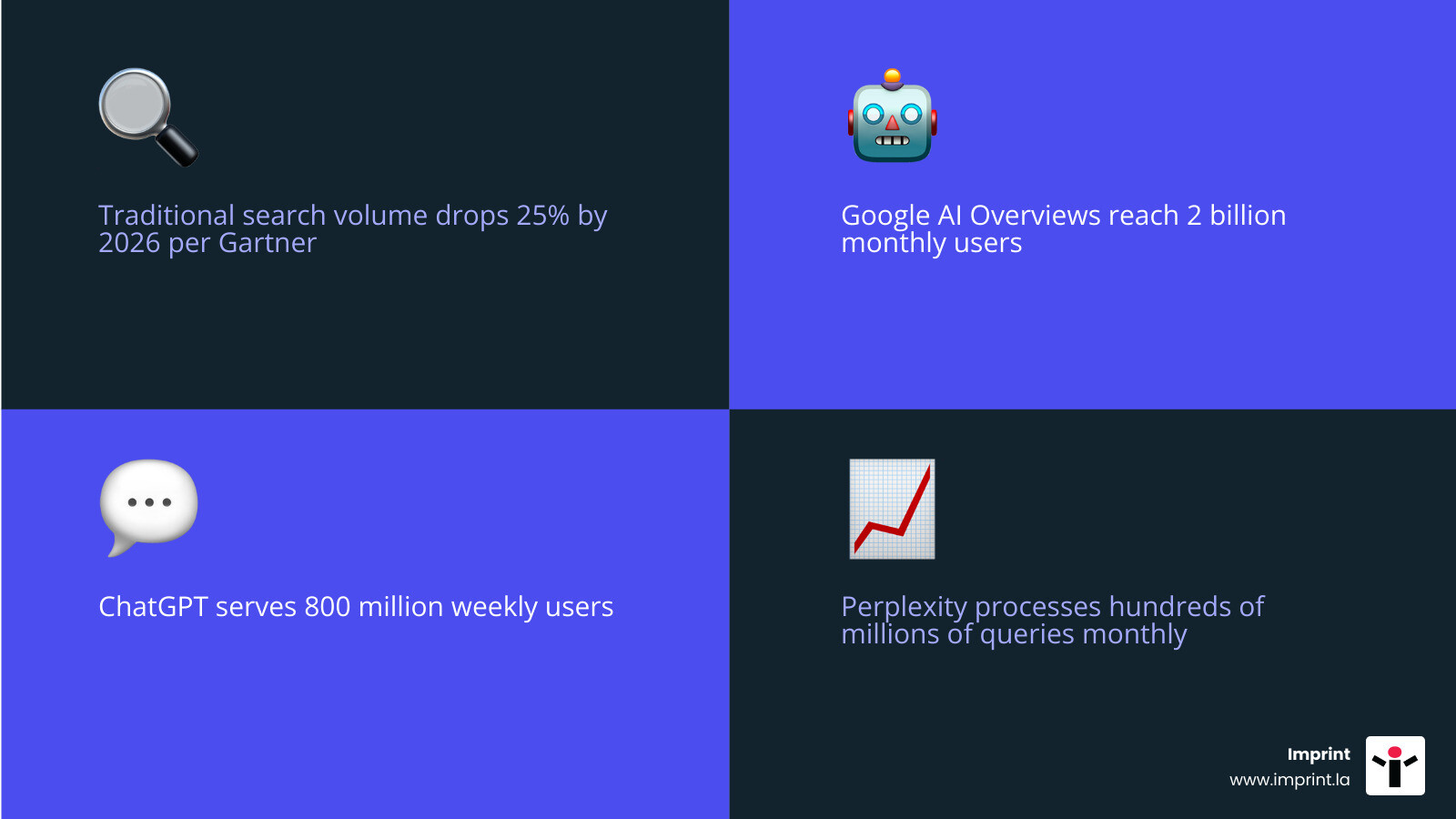
Here's the hard truth for growth-stage brands: Gartner predicted traditional search volume will drop 25% in 2026 as users shift to AI-powered answer engines. Google's AI Overviews already reach over 2 billion monthly users. ChatGPT serves 800 million people every week. Perplexity processes hundreds of millions of queries every month.
If your content isn't structured for AI retrieval, you're becoming invisible — not because your SEO is broken, but because the game itself has changed.
Ranking is no longer the finish line. Being cited inside the AI's answer is.
The brands winning right now aren't necessarily the ones with the biggest budgets. They're the ones who understood this shift early and built their content to be quotable, structured, and trustworthy to AI systems.
I'm Brent Burghdorf, founder of Imprint and a performance marketing specialist who has helped brands across e-commerce, healthcare, and high-ticket services build scalable acquisition systems — and ai seo mastering generative engine optimization geo is now a core part of how we drive durable, compounding growth for our clients. In this guide, I'll walk you through exactly how to implement GEO by leveraging our high-quality service standards and low-cost pricing, making advanced optimization accessible without an enterprise-level budget.
What is AI SEO Mastering Generative Engine Optimization GEO?
At its core, ai seo mastering generative engine optimization geo is about making your content "machine-readable" and "citation-ready." Unlike traditional SEO, which focuses on moving a link to the top of a page, GEO focuses on ensuring an AI model selects your information to synthesize an answer.
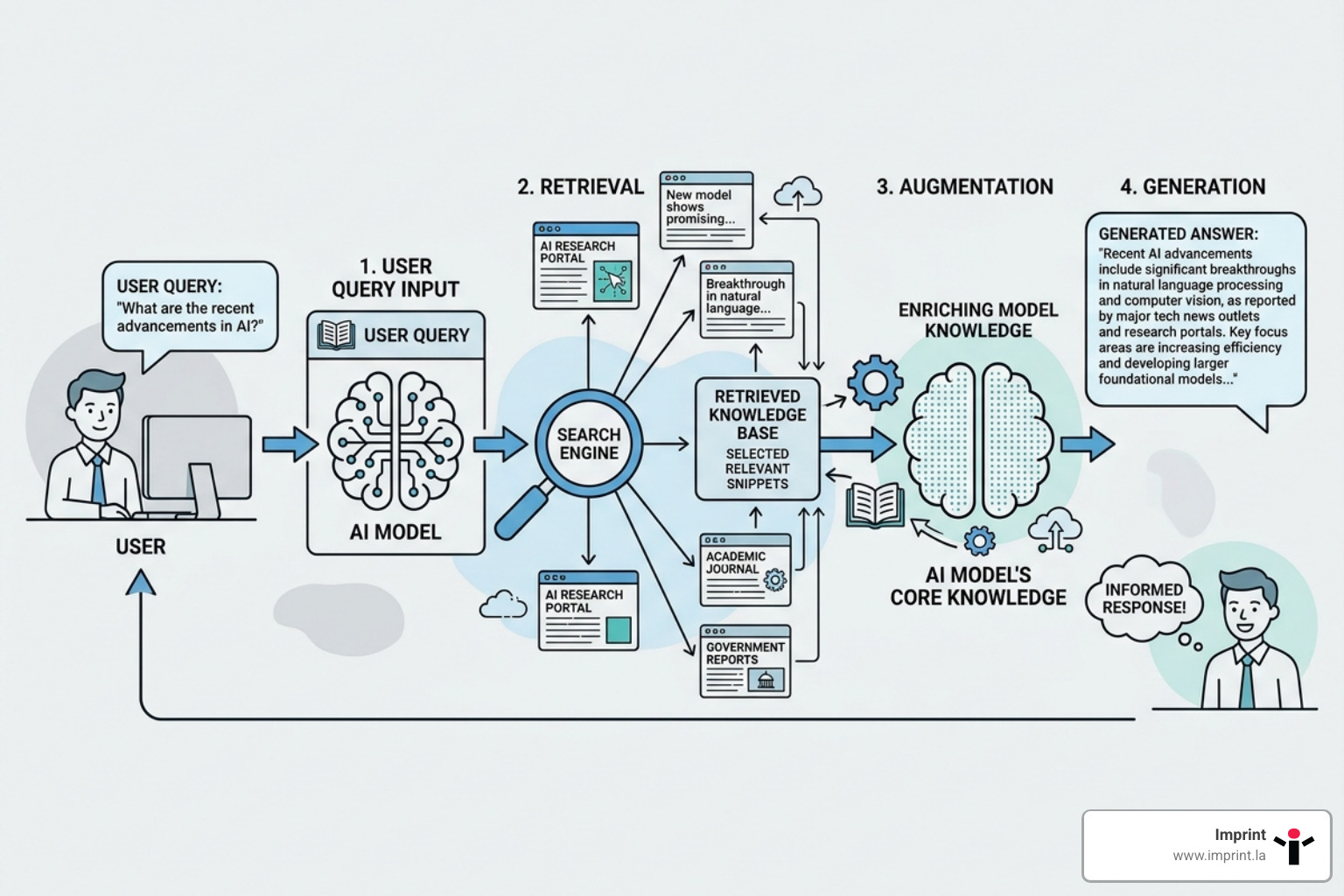
To understand this, we have to look at Retrieval-Augmented Generation (RAG). RAG is the process AI engines use to look up real-time information from the web to answer a user's prompt. Instead of relying solely on their training data (which might be months old), engines like Perplexity or Google’s Gemini "retrieve" relevant passages from websites, "augment" their knowledge, and then "generate" a response.
The "generative imperative" means that if you aren't cited, you don't exist in that user's journey. According to industry data, 40% of B2B queries will be satisfied within answer engines by 2026. If you want to stay relevant, you need to transition from just "ranking" to providing machine-readable evidence.
While traditional SEO relies on keywords, GEO thrives on entity recognition and semantic synthesis. AI models don't just look for words; they look for "entities" (brands, people, places) and the relationships between them. By providing high-quality, structured data, we make it easy for these models to understand your brand's authority. At Imprint, we believe this level of accessible optimization should be available to every brand through our high-quality service standards and low-cost pricing.
The 4-Phase Practical GEO Framework for 2026
Implementing a GEO strategy doesn't have to be a mystery. We use a practical 4-phase framework to ensure our clients in Los Angeles and beyond stay ahead of the curve.
Phase 1: Assess
Before you change a single word on your site, you need to know where you stand. We perform a "Generative Audit" by asking AI engines specific questions related to your products or services. Are you being mentioned? Is the sentiment positive? Are your competitors getting the citations instead?
Phase 2: Optimize
Once we know the gaps, we restructure the content. This isn't about keyword stuffing; it's about "chunking" content into digestible blocks that an AI can easily quote. We focus on adding clear definitions, comparison tables, and expert-backed stats. This is where strategy for Los Angeles companies becomes hyper-local, ensuring AI recognizes your physical presence in areas like Santa Monica or Beverly Hills.
Phase 3: Measure
Standard analytics like "page views" are becoming less reliable in a zero-click world. Instead, we track Citation Frequency and Share of Voice within AI responses. If an AI mentions your brand 4 out of 10 times a specific query is asked, that is your new benchmark for success.
Phase 4: Iterate
AI models update constantly. What worked for ChatGPT-4 might need a tweak for the next iteration. We continuously refine the content based on which passages are being pulled and which are being ignored.
| Metric | Traditional SEO | Generative Engine Optimization (GEO) |
|---|---|---|
| Primary Goal | Rank #1 in Blue Links | Be the primary cited source in AI answers |
| Success Indicator | Click-Through Rate (CTR) | Citation Share & Brand Mentions |
| Content Focus | Keyword Density | Information Density & Entity Authority |
| User Journey | Click -> Website -> Conversion | Answer -> Trust -> Branded Search -> Conversion |
By following our model of low-cost pricing and high-quality service standards, we ensure your brand receives professional auditing and a value-driven strategy that delivers real-world results, like our average 3.8x ROAS.
Technical Foundations and Content Structuring for AI Retrieval
Mastering Generative Engine Optimization GEO through Technical Excellence
Technical SEO has always been important, but for GEO, it’s the literal bridge between your site and the AI’s brain. If an AI crawler can't parse your site, you won't be cited.
- Bot Directives (robots.txt & llms.txt): While
robots.txttells bots where they can go, the newllms.txtstandard provides a "handbook" for AI models, offering a summarized version of your site’s most important information. - Schema Markup & JSON-LD: This is non-negotiable. Using schema tells the AI exactly what a piece of data is—whether it’s a product price, a review, or a founder’s bio. Pages with multiple schema types see a 2.3x higher citation rate.
- Crawlability: We recommend a comprehensive technical SEO audit to ensure there are no broken links or heavy code blocks slowing down AI discovery.
Our approach to Search Engine Optimization combines high-quality service standards with low-cost pricing, ensuring your site is a welcome environment for AI bots through affordable technical hygiene.
Content Architecture for AI SEO Mastering Generative Engine Optimization GEO
How you write is just as important as what you write. AI models prefer content that is "modular."
- Passage Chunking: AI models often retrieve content in "chunks" of about 200 words. If your answer is spread across 1,000 words of fluff, the AI might miss the point. Keep your definitions and key points concise.
- TL;DR Statements: Start your articles with a "Too Long; Didn't Read" summary. AI engines love these because they provide an instant, citable summary of the entire page.
- H2/H3 Boundaries: Use clear headings to signal semantic breaks. This helps the AI understand when you’ve moved from one topic to the next.
- Information Density: Avoid "filler" text. Every sentence should add value. Research shows that mastering GEO today requires a shift toward high-density, fact-forward writing.
When we run an SEO campaign, we prioritize professional clarity. We want your content to be the most "quotable" on the web.
Building Entity Authority and Content Freshness
In AI, your brand is an "entity." The AI's goal is to determine if that entity is trustworthy. This is where E-E-A-T (Experience, Expertise, Authoritativeness, and Trustworthiness) becomes "machine-graded."
To build this authority:
- Consistent Branding: Ensure your name, address, and phone number are identical across the web.
- Wikipedia & Earned Media: AI models heavily weight third-party sources. A mention in a major publication or a Wikipedia entry acts as a massive "trust signal."
- Cornerstone Updates: Content freshness is a huge factor in RAG. AI engines like Perplexity cite content published within the last 90 days 40% more often. Use "Last updated" timestamps and keep your SEO in Santa Monica or other local areas current with the latest community news or service updates.
By focusing on high-quality service standards and low-cost pricing, we help you become the "source of truth" in your niche through accessible authority building.
Frequently Asked Questions about GEO
How does GEO differ from traditional SEO?
Traditional SEO is about keywords and backlinks to rank "blue links." GEO is about semantic structure, entity authority, and "citability" to ensure your brand is the answer provided by AI models. SEO asks "How do I rank?"; GEO asks "How do I get cited?"
What are the best tools for tracking AI citations?
While traditional tools like Ahrefs and Semrush are evolving, specialized platforms like Geoptie or Evertune are emerging to track AI visibility. You can also perform manual audits by prompting ChatGPT or Perplexity with "What are the best [Your Industry] services in Los Angeles?" and seeing if you appear.
Why is 2026 the tipping point for generative engines?
2026 is the year Gartner predicts a 25% drop in traditional search. With 70% of enterprise searches now involving AI systems, we have moved past the "experimentation" phase. AI search is now the mainstream method for discovery and research.
Conclusion
The future of search isn't just coming; it's already here. As we move further into 2026, the brands that rule the digital world will be those that have mastered the art of being "AI-friendly." From API-level optimization to fine-tuning how models perceive your brand, the landscape is shifting toward a more intelligent, synthesized experience.
At Imprint, we specialize in navigating these shifts. We are a performance-driven digital marketing agency based in Los Angeles, dedicated to delivering data-backed strategies that result in an average 3.8x ROAS. Whether you need help with Meta/Google/TikTok Ads or you're ready to Master GEO with Imprint, we provide high-quality service standards and low-cost pricing that ensure your brand isn't just seen—it's cited.
Don't let your brand become a ghost in the machine. Start your GEO journey today and ensure that when the world asks AI for an answer, your brand is the one it chooses.
