
How to Get More Leads with SEO in 7 Simple Steps
Why SEO Is One of the Most Powerful Lead Generation Channels Available

Knowing how to get more leads with seo is one of the highest-leverage skills a growth-stage business can develop — and it consistently outperforms paid channels for lead volume according to the majority of marketers surveyed online.
Here's the short answer:
- Target high-intent, bottom-of-funnel keywords that signal buying intent
- Create content that matches search intent at each stage of the buyer journey
- Fix technical SEO issues — speed, mobile, Core Web Vitals
- Optimize your Google Business Profile and build local citations
- Add social proof — reviews, case studies, testimonials
- Convert traffic with clear CTAs and simple lead capture forms
- Track performance with GA4 and refine based on real data
Unlike paid ads, SEO doesn't stop working when your budget runs out. It compounds. A well-optimized page can generate qualified leads 24/7 — for months or years — without ongoing spend.
But here's the catch most marketers miss: ranking on Google is only half the battle. Getting the right visitors to take action is what actually moves revenue.
That gap — between traffic and leads — is exactly what this guide is designed to close.
I'm Brent Burghdorf, founder of Imprint and a performance marketing specialist who has built scalable SEO acquisition systems for brands across e-commerce, healthcare, real estate, and high-ticket services. My approach to how to get more leads with seo is rooted in full-funnel optimization and clear ROI accountability — not vanity metrics. Let's get into it.
Steps 1 & 2: Target High-Intent Keywords and Content Clusters
The biggest mistake we see businesses in Los Angeles and Santa Monica make is chasing "vanity traffic." They want to rank for broad, high-volume terms that look great in a report but don't actually put money in the bank.
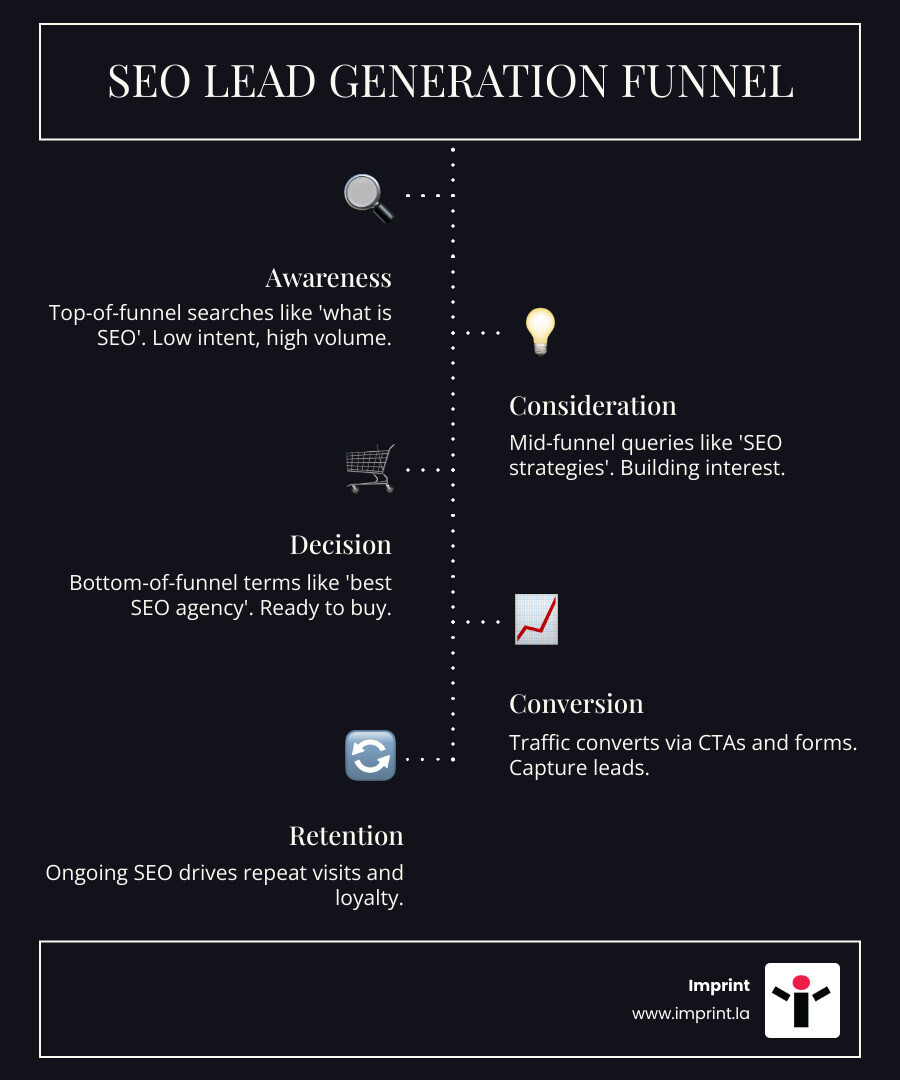
If you want to know how to get more leads with seo, you have to start with search intent. Not all traffic is created equal. A person searching for "what is digital marketing" is likely a student or someone just curious (Top of Funnel). A person searching for "best lead generation agency in Beverly Hills" is ready to hire (Bottom of Funnel).
The Power of Bottom-of-Funnel (BOTF) Keywords
Research shows a massive disparity in conversion rates depending on where a keyword sits in the funnel. Bottom-of-funnel keywords, which include commercial and transactional terms, have an average conversion rate of 4.78%. In contrast, top-of-funnel (TOF) informational keywords convert at a measly 0.19%.
Even though TOF content might get 4x the traffic, BOTF content often brings in over 3x the number of actual leads. This is why we prioritize "buying intent" over "search volume."
| Funnel Stage | Keyword Example | Avg. Conversion Rate | Goal |
|---|---|---|---|
| Top of Funnel (TOF) | "how to improve business sales" | 0.19% | Awareness |
| Middle of Funnel (MOFU) | "lead generation strategies" | ~1.5% | Consideration |
| Bottom of Funnel (BOTF) | "hire lead generation agency" | 4.78% | Conversion |
To master this, you need to understand The art of keyword research in 2019: everything you need to know and how it has evolved into targeting specific user "pain points."
Building Topic Clusters and Pillar Pages
Google no longer just looks at individual keywords; it looks at topical authority. We use a "Hub and Spoke" model.
- The Pillar Page: A comprehensive, high-level guide on a main topic (the "Hub").
- Topic Clusters: Smaller, more specific articles that dive deep into sub-topics (the "Spokes") and link back to the pillar.
For example, if you are a real estate firm in Beverly Hills, your pillar might be "The Ultimate Guide to Beverly Hills Real Estate." Your clusters could include "Best schools in Beverly Hills," "Property tax in 90210," and "How to stage a luxury home." This structure tells Google you are an expert, helping you rank higher for those high-intent terms.
Product-Led Content
We also recommend "product-led content." This is where you write informative articles that naturally weave your product or service into the narrative as the solution to the reader's problem. Instead of a hard sell, you're showing the reader exactly how you can help them while they are already in "learning mode."
Identifying high-intent keywords: how to get more leads with seo
To find these golden keywords, we move beyond generic buyer personas and focus on Pain-Point SEO. We ask: What keeps your customers awake at night? What specific problems are they trying to solve when they open Google?
- Talk to your sales team: They know the common objections and questions prospects have.
- Analyze competitor keyword gaps: Use tools to see what high-intent terms your competitors are ranking for that you are missing.
- Look for "Jobs-to-be-Done": Identify keywords where the user is looking to complete a specific task (e.g., "calculate ROI for SEO").
- Check Keyword Difficulty vs. Volume: Sometimes a lower-volume keyword is much easier to rank for and brings in a much higher quality of lead.
By focusing on these specific, high-intent terms, you ensure that the traffic you do get is actually interested in what you’re selling.
How to Get More Leads with SEO Through Technical Excellence
You could have the best content in the world, but if your website takes ten seconds to load, your potential leads will vanish before they even see your headline. Technical SEO is the foundation of your lead generation engine.
Speed and User Experience
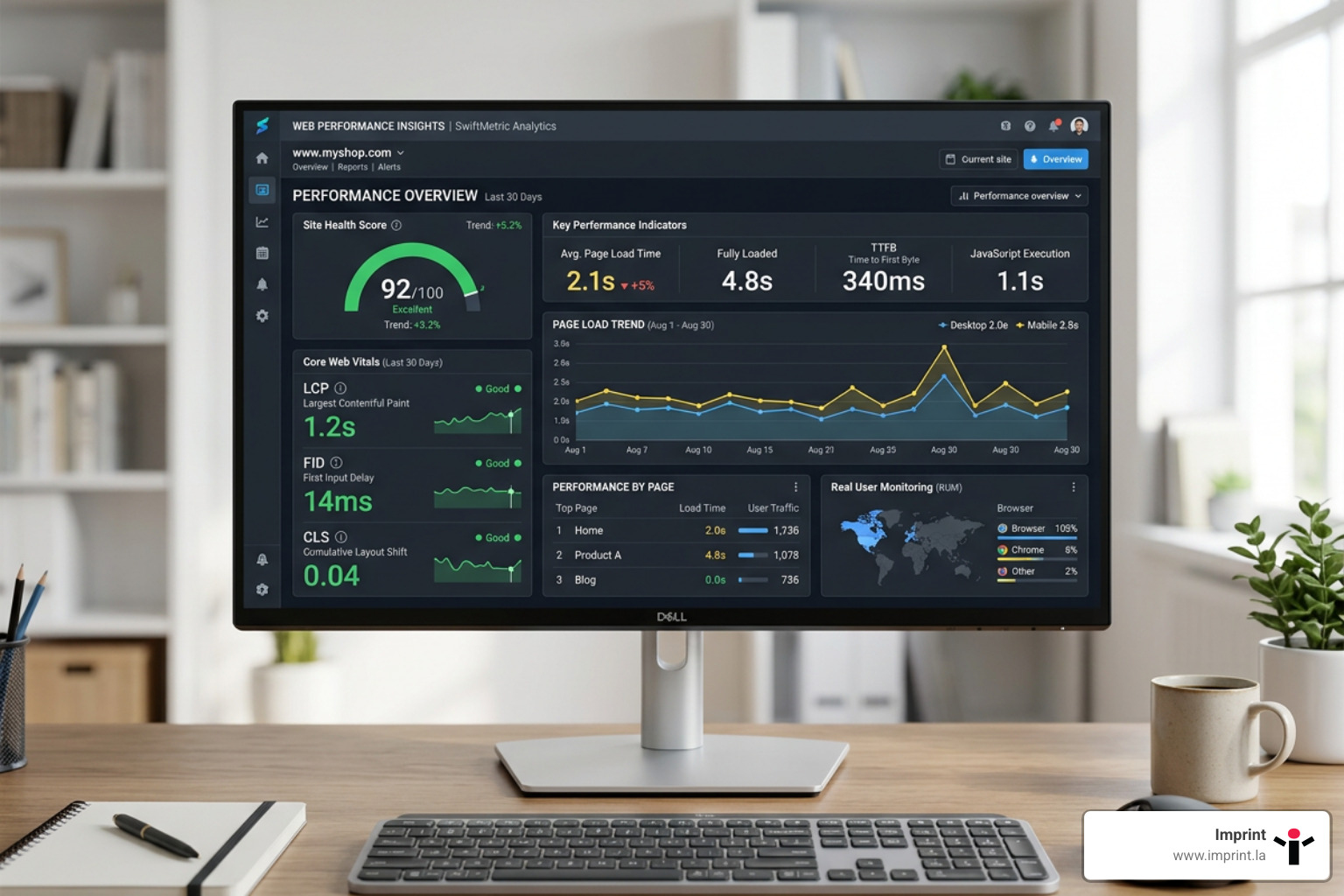
Google has been very clear: site speed is a ranking factor. But more importantly, it's a conversion factor. Research shows that as page load time increases from one second to three seconds, users are about one-third more likely to bounce.
We recommend using PageSpeed Insights to identify what is slowing you down. Common culprits include oversized images, unoptimized code, and slow server response times. For a deeper dive into how to fix these, check out our 7-step guide to a comprehensive technical SEO audit.
Mobile-First Indexing and Core Web Vitals
Most of your customers are likely searching for you on their phones. Google uses mobile-first indexing, meaning it looks at the mobile version of your site to determine your rankings. Your site must be responsive, with large, tappable buttons and easy-to-read text.
Furthermore, Google’s Core Web Vitals measure things like visual stability and interactivity. If your content jumps around while a page is loading (Cumulative Layout Shift), Google will penalize you. We make sure our clients' sites are "technically sound" so they don't lose leads to a frustrating user experience.
Site Architecture and Security
A clean site architecture helps both users and search engine crawlers find your most important pages. We use logical URL structures and internal linking to guide visitors toward your lead capture pages.
Security is also non-negotiable. An SSL certificate (HTTPS) is a basic requirement. Without it, browsers will label your site as "Not Secure," which is an instant trust-killer for any potential lead.
Schema Markup for Rich Results
Schema markup is a type of code that helps search engines understand the context of your content. By implementing schema for "FAQ," "Product," or "Local Business," you can earn "rich snippets" in the search results. These are the star ratings, prices, or dropdown questions you see on Google. They significantly increase your click-through rate (CTR) because they make your listing stand out from the crowd.
Steps 4 & 5: Leverage Local SEO and Social Proof
For businesses serving specific areas like Santa Monica or Beverly Hills, Local SEO is often the fastest way to generate leads. When someone searches for a service "near me," they usually have very high intent to purchase.
Dominating the Local Map Pack
The "Map Pack" is the section of Google that shows the top three local businesses related to a search. To get here, you must optimize your Google Business Profile (GBP).
- Claim and verify your listing: Ensure your Name, Address, and Phone number (NAP) are consistent across the web.
- Use geo-targeted keywords: Include mentions of your service areas (e.g., "SEO services in Santa Monica") in your profile and on your website.
- Add high-quality photos: Show off your office, your team, and your work.
- Post regular updates: Treat your GBP like a social media feed to show Google you are active.
As a premier SEO company Los Angeles, we've seen local leads skyrocket simply by cleaning up directory citations and ensuring a business appears in relevant local maps.
The Science of Social Proof
Trust is currency. Research shows that over 88% of consumers trust reviews online as much as personal recommendations from friends or family. If your search listing has a 4.8-star rating and your competitor has a 3.2, guess who’s getting the click?
We help our clients implement systems to:
- Request reviews automatically after a successful customer interaction.
- Showcase testimonials prominently on landing pages.
- Publish results-based case studies that prove you can do what you say you can do.
Social proof acts as a "shortcut" for the human brain. It signals that you are a safe, credible choice, which is essential for converting that cold SEO traffic into a warm lead.
Steps 6 & 7: Optimize for Conversions and Track Performance
Traffic is a vanity metric; leads are a sanity metric. Once you've successfully attracted a visitor to your site, you need to guide them toward a specific action. This is where Search Engine Optimization meets Conversion Rate Optimization (CRO).
The Art of the CTA
A "Call to Action" (CTA) shouldn't just be a "Submit" button at the bottom of a page. To get more leads, your CTAs need to be compelling and strategically placed.
Data from HubSpot shows that personalized CTAs perform 202% better than generic ones. Instead of "Contact Us," try "Get Your Free Santa Monica SEO Audit" or "Schedule My Beverly Hills Real Estate Consultation." Speak directly to the user's goal.
Optimizing Landing Pages: How to Get More Leads with SEO
Your landing pages should be laser-focused on one goal. If you give people too many options, they often choose none.
- Lead Magnets: Offer something of value in exchange for an email address. This could be an ebook, a whitepaper, a webinar, or a free tool.
- Form Simplification: Nobody wants to fill out a 20-field form. Ask only for the essentials (usually Name and Email). Every extra field you add can decrease your conversion rate.
- Heatmaps and A/B Testing: We use tools to see where people are clicking and where they are getting stuck. By testing two different versions of a headline or a button color, we can incrementally improve the lead-to-sale rate.
- Omnichannel Integration: SEO shouldn't live in a vacuum. Your landing pages should be integrated with your CRM and email nurturing sequences so that a lead is followed up with immediately.
Tracking and Measuring Success
You can't improve what you don't measure. We use Google Analytics 4 (GA4) and Google Search Console to track the entire journey of a lead.
Key metrics we monitor include:
- Organic Traffic Growth: Are we reaching more people?
- Keyword Rankings: Are we ranking for the right high-intent terms?
- Conversion Rate: What percentage of visitors are becoming leads?
- Cost Per Lead (CPL): How does SEO compare to our paid spend?
- Lead-to-Sale Rate: Are the leads we’re getting actually high quality?
By looking at these numbers, we can see exactly which pieces of content are driving revenue and which ones need to be optimized or replaced.
Frequently Asked Questions about SEO Lead Generation
How long does it typically take to see results from SEO lead generation?
SEO is a marathon, not a sprint. While you might see some "quick wins" by fixing technical errors or optimizing existing pages within 3 months, a comprehensive strategy usually takes 6 to 12 months to start generating a consistent, scalable stream of high-quality leads. The good news? Once that momentum builds, it is much harder for competitors to displace you than it is for them to outbid you on ads.
Can SEO generate leads single-handedly, or does it work best with PPC?
While SEO can absolutely generate leads on its own, it works best as part of a "multi-channel quartet." We often recommend running PPC (Pay-Per-Click) ads alongside SEO. Why?
- PPC provides immediate data: You can see which keywords convert into leads before you spend months trying to rank for them organically.
- Double Visibility: If you rank #1 organically and also have a paid ad at the top, you dominate the screen real estate and build massive trust.
- Retargeting: You can use SEO to bring people to your site and then use PPC to "follow" them around the web until they are ready to convert.
What are the most common mistakes to avoid in an SEO lead strategy?
The most common pitfall is prioritizing traffic over intent. It feels good to see your traffic graph go up, but if those people aren't your target audience, it’s a waste of resources. Other mistakes include:
- Ignoring mobile users: If your site is hard to use on a phone, you're losing half your leads.
- Keyword stuffing: Writing for search engines instead of humans.
- Set-it-and-forget-it: SEO requires regular content updates and technical maintenance to stay ahead of algorithm shifts.
Conclusion
Mastering how to get more leads with seo is about more than just keywords; it's about building a sustainable, data-backed engine that grows with your business. At Imprint, we don't just "do SEO." We build performance-driven marketing systems that align your organic visibility with your bottom-line goals.
Based in the heart of Los Angeles, we specialize in delivering data-backed strategies that result in an average 3.8x ROAS for our clients. Whether you are looking to dominate the local Santa Monica market or scale a nationwide e-commerce brand, we have the tools and expertise to make it happen.
Ready to stop chasing traffic and start capturing customers? Scale your business with expert lead generation today and let's see what we can build together.
