
Stop Ghosting Your Prospects with These Meta Lead Gen Funnels
Why B2B Lead Gen Meta Strategies Outperform LinkedIn Alone
B2B lead gen meta is the practice of using Facebook and Instagram ads to capture qualified business leads — and it works far better than most marketers expect.
Here's a quick breakdown of how to do it effectively:
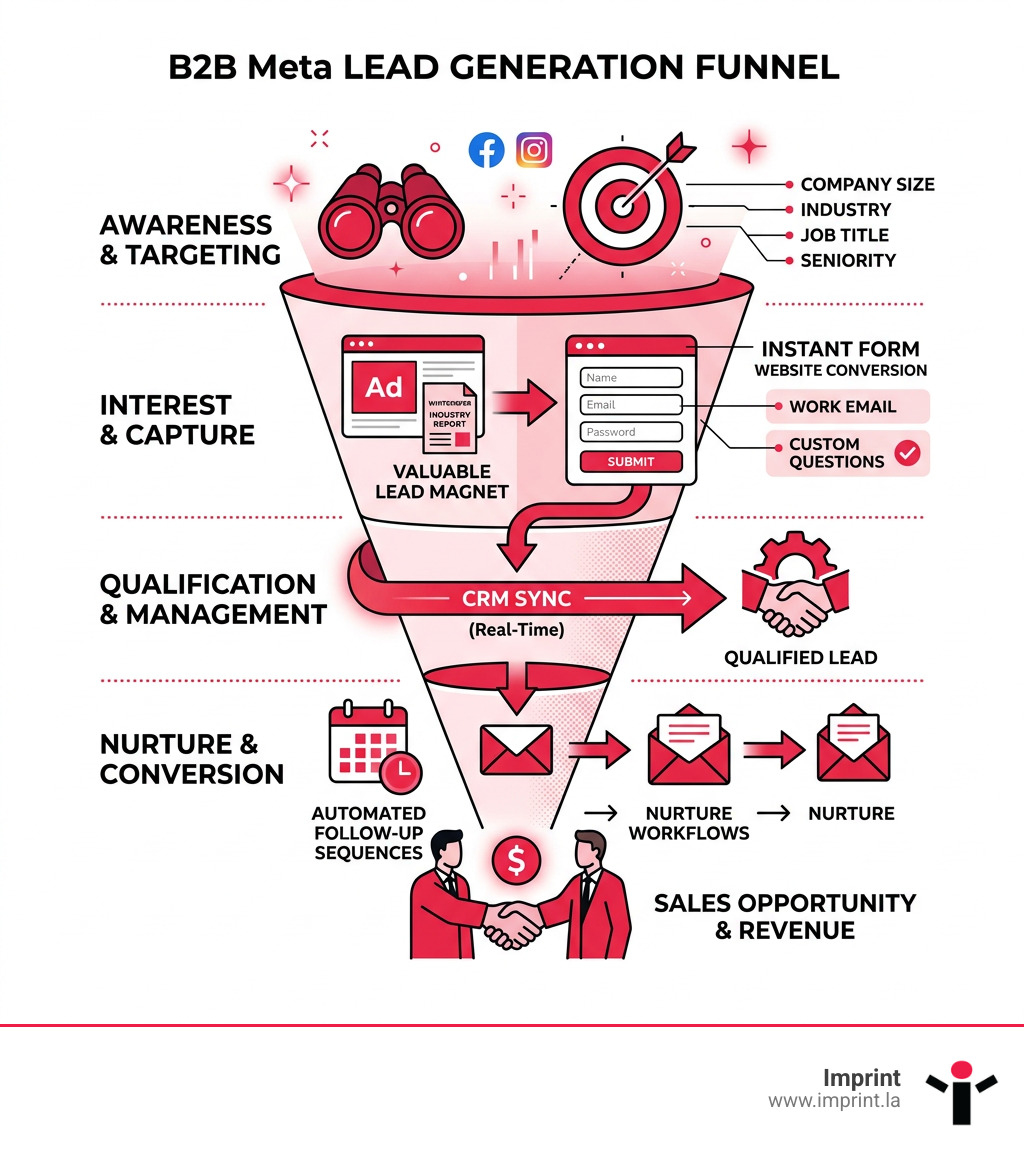
- Define your ICP — Use company size, industry, job title, and seniority to build a precise target audience
- Choose the right objective — Use the "Leads" campaign objective with Instant Forms or website conversions
- Build a lead magnet — Offer something valuable: a whitepaper, free audit, demo, or industry report
- Qualify inside the form — Add custom questions and require a work email to filter out low-intent leads
- Connect your CRM — Sync leads in real time and trigger automated follow-up sequences
- Optimize for 50+ weekly events — Let the algorithm exit the learning phase before making changes
- Scale winners gradually — Increase budget by no more than 20-30% every few days
Most B2B marketers default to LinkedIn. It makes sense on paper — it's a professional network, job titles are right there, and it feels like the right place to reach decision-makers.
But here's the problem: your prospects aren't on LinkedIn all day.
Research shows that B2B buyers spend roughly 95% of their waking hours off LinkedIn — scrolling Instagram, watching Reels, or catching up on Facebook. Meanwhile, business decision-makers spend close to 75% more time on Facebook daily than the average user. They're there. They're reachable. And ad space on Meta costs a fraction of what LinkedIn charges.
The gap between where B2B marketers advertise and where their buyers actually spend time is a real, exploitable opportunity — if you build the right funnel.
The challenge is that Meta wasn't designed with B2B in mind. Its native targeting leans consumer. Its algorithm optimizes for volume, not pipeline quality. And without the right structure, you'll generate plenty of leads that never turn into revenue — leaving your sales team frustrated and your ad budget wasted.
That's exactly the problem this guide solves.
I'm Brent Burghdorf, founder of Imprint and a performance marketing specialist who has built scalable B2B lead gen meta systems for brands across high-ticket services, SaaS, and technology. In this guide, I'll walk you through the exact frameworks we use to turn Meta's massive reach into predictable, qualified pipeline.
If you’ve ever looked at a LinkedIn Ads invoice, you know the "professional network tax" is real. While LinkedIn is great for targeting, the costs can be eye-watering. At Imprint, we often see a massive disparity in performance metrics. In one specific case study, a B2B client generated 2,706 leads on Meta at a Cost-Per-Lead (CPL) of roughly 45 EUR. On LinkedIn? The same offer produced only 32 leads at a staggering CPL of 1,039 EUR.
It isn't just about the price tag, though. It’s about the sheer scale of the opportunity. While LinkedIn has a respectable audience of around 750 million users, 3.35 billion active users browse the Meta network daily. This massive footprint means your Ideal Customer Profile (ICP) is almost certainly present. In fact, 67% of B2B marketers consider Meta the most important social platform for their lead generation efforts.
As a Digital Marketing Agency in Los Angeles, we’ve found that the most successful B2B brands don't choose one platform over the other; they use Meta to capture the massive volume that LinkedIn simply can't provide at a sustainable ROI.
| Metric | Meta Ads (Average) | LinkedIn Ads (Average) |
|---|---|---|
| Cost Per Click (CPC) | $0.97 | $5.26 |
| Cost Per 1k Impressions (CPM) | $7.19 | $6.59 |
| Audience Size | 3.35 Billion | 750 Million |
Reaching Decision-Makers Where They Actually Spend Time with B2B Lead Gen Meta
The biggest myth in B2B is that CEOs and VPs only care about business when they are on a "business" site. The reality is that most users access Facebook via mobile during their personal downtime. Whether they are waiting for a coffee in Santa Monica or scrolling before bed in Beverly Hills, decision-makers are still decision-makers.
Because business leaders spend 75% more time on Facebook daily than the general population, b2b lead gen meta allows you to catch them when their guard is down. A hyper-specific ad addressing a niche industry pain point—like optimizing injection molding flow lines for a plastic manufacturer—will grab a CEO's attention even if they were originally looking at memes. Understanding The Importance of Digital Marketing means meeting your audience where they are, not where you wish they were.
The Advantage of Lower Friction and Pre-Filled Forms
One of the primary reasons Meta converts so well is the Facebook Lead Gen Forms system. These forms live natively within the app, meaning the user never has to wait for a slow external website to load.
Even better, Meta pre-fills the fields with the user's profile data (name, email, phone number). This reduces friction to almost zero. For a PPC SEM Agency, this is the holy grail: high-speed, mobile-optimized conversion that keeps the user within their natural browsing flow.
Building a High-Converting B2B Meta Funnel
Setting up a campaign in Facebook Ads Manager is the easy part. Building a funnel that actually produces revenue is where the technical heavy lifting happens. At Imprint, we emphasize a "data-first" approach for every Digital Marketing Agency for Startups.
Before you spend a dime, your tracking must be airtight. This means:
- Installing the Meta Pixel: To track website interactions.
- Setting up the Conversions API (CAPI): To create tracking redundancy and bypass iOS privacy restrictions.
- Domain Verification: To ensure your ads aren't throttled by security protocols.
Optimizing Instant Forms for B2B Lead Gen Meta Quality
The biggest complaint about b2b lead gen meta is lead quality. If you make it too easy to sign up, you'll get "junk" leads. To solve this, we use "Higher Intent" forms. These add a review step that forces the user to confirm their info before submitting.
We also recommend:
- Custom Qualification Questions: Ask about their current software or their biggest business challenge.
- Work Email Requirement: Explicitly ask for a professional email to filter out personal Gmail/Yahoo accounts.
- Value-Driven Intros: Use the form's intro section to reiterate the ROI of your offer.
Timely engagement strategies are critical here. If a lead isn't contacted within the first hour, the conversion probability drops off a cliff. Using these forms correctly is one of the Seven Ways a CRM Can Increase Software Sales because it feeds your sales team high-intent data instantly.
Integrating Automation and CRM for Real-Time Follow-Up
Don't let your leads sit in a CSV file inside Ads Manager. Use the Graph API for lead ads or tools like Zapier to push data directly into your CRM.
Once the data hits your CRM, trigger an automated "Thank You" email. This is the first step in What is Email Marketing: A Guide to Getting it Right. You can even use the thank-you screen on the Meta form to offer a direct link to book a meeting on your calendar, qualifying the lead even further.
Advanced Targeting and ICP-Driven Frameworks
Meta’s native targeting can be broad, so B2B marketers need to be surgical. We use a layered approach to define the Ideal Customer Profile (ICP):
- Demographics: Job titles, industries, and company sizes.
- Interests: Industry publications, software they use (e.g., Salesforce, HubSpot), and professional organizations.
- Behaviors: "Business Decision Maker" roles and "New Active Businesses" (those started in the last 6-24 months).
As a Social Media Agency, we often warn against "Advantage+" targeting for B2B. While Meta’s AI is smart, it often wanders into B2C territory to find "cheaper" clicks, which ruins lead quality. Stick to your defined audiences until you have enough data to scale. You can find inspiration in various English (UK) B2B success stories that highlight how precise targeting drives results.
Leveraging Lookalikes and Interest Layering for B2B Lead Gen Meta
Once you have a list of at least 1,000 customers or high-quality leads, you can create a 1% Lookalike Audience. This tells Meta to find people who "look" like your best customers.
For even better results, test different "seeds" for your lookalikes. Don't just upload all leads; upload your highest-value customers. You can also look at Español B2B case studies to see how international firms use interest layering to exclude non-business users and focus purely on professional intent.
Retargeting and Cross-Platform Synergy
The most powerful b2b lead gen meta strategy is "The Surround Sound Effect."
- Target your ICP on LinkedIn with a high-value whitepaper.
- Install the Meta Pixel on that landing page.
- Retarget those same people on Facebook and Instagram with a video case study.
This cross-platform approach makes your brand feel omnipresent. It also allows our SEO Company Los Angeles team to capture the high-intent search traffic that often follows a successful social campaign.
Creative Best Practices and Lead Magnet Mastery
In the B2B world, your creative shouldn't look like an ad; it should look like a solution. Use problem-focused hooks. Instead of "We provide IT services," try "Is your server downtime costing you $5k an hour?"
Imprint Digital Agency: A Top Ranked Digital Marketing Agency in Los Angeles specializes in creating ads that stop the scroll. We’ve found that gated whitepapers, ROI calculators, and video case studies perform best for B2B.
Crafting Irresistible B2B Offers
Your offer is the "bait" of your funnel. If it’s weak, the funnel fails. Some of our top-performing offers include:
- Free Audits/Workshops: High value, high intent.
- Industry Reports: Positions you as a thought leader.
- Software Demos: Great for Middle-of-Funnel (MOFU) prospects.
You can explore Português (Brasil) B2B resources to see how global brands use value-based CTAs to drive webinar registrations and demo requests.
Mobile-First Ad Formats for Professionals
Since most B2B decision-makers are on mobile, use vertical video (9:16) for Reels and Stories. Carousel ads are also fantastic for B2B because they allow you to highlight multiple features or steps in a process.
Check out Français (France) B2B success stories to see how concise copywriting and social proof—like "Trusted by 500+ Tech Firms"—can drive massive engagement on small screens.
Measuring Success and Scaling Your Campaigns
Meta’s algorithm needs roughly 50 optimization events (lead submissions) per week per ad set to exit the "Learning Phase." If you aren't hitting this number, the algorithm won't stabilize, and your CPL will fluctuate wildly.
At our PPC SEM Agency, we follow the 20-30% rule: never increase your budget by more than 30% every few days. Sudden budget spikes can reset the learning phase and tank your performance. You can find more Español (España) B2B insights on how to manage these technical nuances for long-term stability.
Overcoming Common B2B Meta Challenges
- Low Lead Quality: Add more qualifying questions or switch to a "Higher Intent" form.
- High CPL: Refresh your creative. Ad fatigue happens fast on Meta; we recommend new visuals every 2-3 weeks.
- Slow Follow-Up: Automate your CRM sync.
If you run into technical hurdles, the Meta for Developers support documentation is an excellent resource for troubleshooting API and Pixel issues.
Long-Term Optimization and Pipeline Tracking
The "Cost Per Lead" is a vanity metric if those leads don't close. Use UTM parameters to track which specific ads are driving "Sales Qualified Leads" (SQLs) and actual revenue. By matching your CRM data back to your Meta Business Suite reports, you can calculate the true Lifetime Value (LTV) of a Meta-acquired customer.
Frequently Asked Questions about B2B Meta Ads
Is lead quality lower on Meta than LinkedIn?
It can be if you use "More Volume" forms without qualification questions. However, with "Higher Intent" forms and work email requirements, we often find Meta lead quality to be comparable to LinkedIn at a much lower cost.
How many leads do I need for the Meta algorithm to work?
Ideally, you want 50 leads per week per ad set. This provides enough data for the AI to understand who is most likely to convert and optimize your bidding accordingly.
Should I use Instant Forms or send traffic to my website?
For mobile users (which is most of Meta), Instant Forms almost always have a higher conversion rate because they are faster. However, if your product is extremely complex and requires a long-form sales page, sending traffic to your website might be better for lead education.
Conclusion
The era of "LinkedIn or nothing" for B2B marketing is over. By leveraging b2b lead gen meta strategies, you can reach your prospects where they actually spend their time, at a fraction of the cost of traditional professional networks.
At Imprint, we pride ourselves on being a data-backed PPC SEM Agency that doesn't just chase clicks—we chase revenue. Our strategies have delivered an average 3.8x ROAS for our clients by combining technical precision with high-impact creative. Whether you are in Santa Monica, Beverly Hills, or anywhere in the Los Angeles area, we are ready to help you stop ghosting your prospects and start filling your pipeline.
