
The Playbook for Massive Meta Revenue Growth
Why Most Meta Ads Scaling Strategies Fail (And What Actually Works in 2026)

Meta ads scaling strategies are the systems, tactics, and frameworks you use to grow your ad spend on Meta while keeping your cost per acquisition under control.
Here's a quick breakdown of the core approaches:
| Strategy | What It Means | Best For |
|---|---|---|
| Vertical Scaling | Increase budget on winning campaigns (max 20% every 3-4 days) | Campaigns with headroom and stable ROAS |
| Horizontal Scaling | Duplicate campaigns, expand audiences, test new markets | Avoiding audience saturation |
| Creative Scaling | Launch fresh ad variations weekly to beat fatigue | Sustaining performance at any budget level |
| Automation (CBO + Rules) | Let Meta's algorithm allocate budget dynamically | Managing multiple campaigns efficiently |
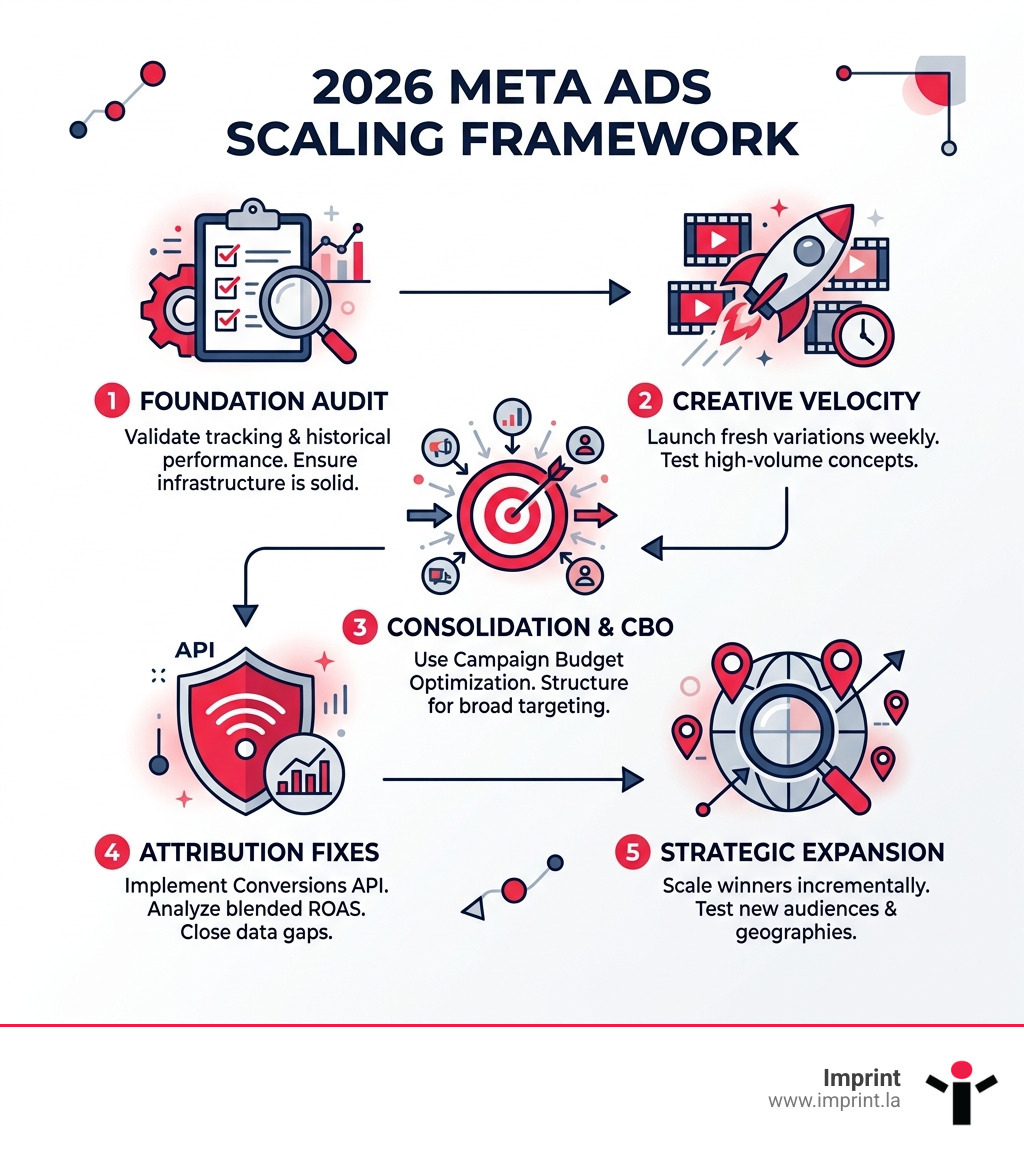
| Attribution Fixes | Use Conversions API and blended ROAS to close iOS data gaps | Accurate decision-making in 2026 |
The hard truth? 73% of scaling attempts fail within the first week. Not because advertisers lack ideas, but because they scale before the foundation is ready.
You find a campaign converting at a strong ROAS. You double the budget. Three days later, CPA spikes and performance collapses. Sound familiar?
That pattern happens because scaling isn't just about pushing more money into what's working. It's about teaching Meta's algorithm to spend smarter — across better audiences, stronger creatives, and cleaner account structures.
The brands hitting 4-8x ROAS on Meta in 2026 aren't using magic. They're using disciplined systems: server-side tracking, broad targeting, high-velocity creative production, and incremental budget increases that don't trigger algorithm resets.
This guide breaks all of it down, step by step.
I'm Brent Burghdorf, founder of Imprint and a performance marketing specialist who has built scalable acquisition systems across Meta and search for brands in e-commerce, healthcare, real estate, and high-ticket services. My work on meta ads scaling strategies focuses on building durable, data-driven marketing engines that compound over time. At Imprint, we combine low-cost pricing with high-quality service standards to ensure these systems are accessible to brands of all sizes.
Auditing Your Foundation: When to Trigger Meta Ads Scaling Strategies
Before you touch that budget slider, we need to talk about the "Boring Stuff." Most advertisers treat scaling like a trip to the casino—they see a win and immediately want to double down. But in our experience at Imprint, scaling a weak foundation is the fastest way to set your marketing budget on fire.

To ensure you aren't part of that 73% failure rate, you need to hit specific statistical benchmarks. First, your campaign must be generating at least 50 conversions per week. Why 50? Because Meta’s algorithm needs that volume to move out of the "Learning Phase" and into a stable optimization state. If you scale with only 10 conversions under your belt, you’re scaling noise, not a trend.
We also look for ROAS stability. If your ROAS swings from 5.0 on Monday to 1.2 on Tuesday, your campaign is volatile, not scalable. We look for a 30-day ROAS that stays within a 15% variance. Finally, check your Pixel Match Quality. In 2026, a score above 7.0 is mandatory. Without high-quality data feeding back to Meta, the algorithm is essentially flying blind.
Identifying Scale-Ready Winners
At our Los Angeles agency, we use a "Winner Score" to grade ads. A scale-ready winner isn't just an ad with a high ROAS; it’s an ad with:
- 7+ consecutive days of profitable performance.
- Consistent CPA (Cost Per Acquisition) that stays at or below target as delivery increases.
- High budget utilization, meaning Meta is actually spending the money you give it without hitting delivery snags.
Avoiding the 73% Failure Rate
The primary reason scaling fails is structural weakness. This often looks like "premature scaling"—increasing spend before the algorithm has finished learning. Another culprit is "data gaps" caused by poor attribution. We provide high-quality service standards and low-cost pricing to help brands build these robust scaling systems, ensuring that when we do step on the gas, the engine doesn't explode.
Vertical vs. Horizontal Scaling: Navigating the Point of Collapse
There are two primary ways to grow your spend, and knowing which one to use is the difference between sipping champagne and chugging cheap vodka (to borrow a phrase from the industry).
| Feature | Vertical Scaling | Horizontal Scaling |
|---|---|---|
| Action | Increase budget of existing ad set | Duplicate ad set or target new audiences |
| Risk | High (can reset learning phase) | Low (original ad set remains untouched) |
| Speed | Slow and steady | Fast and aggressive |
| Limit | Hits a "Point of Collapse" | Limited by creative/market depth |
Mastering Vertical Scaling Without the Point of Collapse
Vertical scaling is the act of increasing the budget on an existing, winning ad set. The golden rule here is the 20% rule: never increase your budget by more than 20% every 48 to 72 hours.
If you have a $100/day ad set and you jump to $500 overnight, Meta views that as a brand-new environment. It resets the learning phase, and your CPA will likely skyrocket. Think of it like a bell curve; every ad set has a "point of collapse" where the audience is saturated, and the next dollar spent actually yields a negative return. To avoid this, we monitor the "marginal ROAS"—the profit made on the additional dollars spent, not just the average.
For more on how these mechanics work in real-time, check out this video on Effective Strategies for Scaling Meta Ads Success - TikTok.
Horizontal Expansion and Audience Overlap Concerns
Horizontal scaling is about spreading the risk. Instead of asking one ad set to do all the work, you duplicate your winners into new "hot pockets" of the algorithm. This might mean:
- Lookalike Progression: Moving from a 1% lookalike to a 3-5% or even 10% lookalike.
- Geographic Expansion: Taking a winning US campaign and launching it in Canada, the UK, or Australia (where CPMs are often 30-50% lower).
- Broad Targeting: Removing all interests and letting the creative do the targeting.
Many advertisers fear audience overlap, but for most brands spending under $10k/day, it’s a myth. Meta’s auction is smart enough to ensure you aren't bidding against yourself in a way that hurts your bottom line.
Creative Scaling: The Primary Lever for 2026 Performance
In 2026, creative is the new targeting. Because of privacy changes, Meta’s ability to "read minds" through interests has diminished. Instead, the algorithm looks at who interacts with your creative and finds more people like them.
Implementing Creative Meta Ads Scaling Strategies
If you want to scale to $1,000/day and beyond, you cannot rely on one "hero" video. You need creative velocity. This means launching 3-5 new creative variations every single week. At Imprint, we specialize in high-quality service standards and low-cost pricing for creative production because we know that a "monotony tax" is real—if you show the same ad too many times, your CPMs go up and your CTR goes down.
We use a modular approach:
- The Hook: Test 3 different 3-second intros.
- The Body: Test UGC (User Generated Content) vs. polished brand video.
- The CTA: Test "Shop Now" vs. "Get the Offer."
For a deeper dive into what people are seeing work right now, this Reddit thread on the most effective creative strategy for scaling is a goldmine of peer-to-peer insight.
Combating Creative Fatigue at Scale
Creative fatigue is the silent killer of meta ads scaling strategies. You’ll know it’s happening when your frequency hits 3.0 or higher for cold audiences and your CTR drops by more than 20%. To combat this, we recommend a 30% monthly refresh rate for your creative library. By constantly rotating in fresh "winning patterns," you maintain "creative liquidity," allowing Meta to find new pockets of buyers who weren't moved by your previous ads.
Advanced Campaign Structures for the Post-iOS Era
The "old way" of running Meta ads involved dozens of tiny ad sets with hyper-specific interests. In 2026, that’s a recipe for failure. The "new way" is consolidation.
Optimizing Your Funnel with Meta Ads Scaling Strategies
We recommend using Campaign Budget Optimization (CBO). With CBO, you set the budget at the campaign level, and Meta’s AI moves the money to the winning ad set in real-time. This is "scaling with seatbelts on."
Your funnel should be simple:
- Top of Funnel (TOF): Broad targeting or large lookalikes.
- Middle/Bottom of Funnel: Retargeting (though with broad targeting, Meta often handles this automatically).
- Exclusions: Always exclude recent purchasers from your prospecting campaigns to avoid wasting spend.
Don't forget the destination! Your ads are only as good as the page they land on. Check our guide on Meta Ads Landing Pages to ensure your site is ready for the traffic.
Key Metrics for Sustainable Growth
Stop obsessing over platform ROAS. Because of iOS privacy changes, Meta misses 30-50% of conversions. Instead, track these "North Star" metrics:
- MER (Marketing Efficiency Ratio): Total Revenue / Total Ad Spend. This is your true profitability.
- Marginal ROAS: The return on the last dollar spent.
- Blended CPA: Your total cost to acquire a customer across all channels.
- Payback Period: How long it takes for a customer to become profitable (LTV).
Frequently Asked Questions about Meta Ads Scaling
When is the right time to scale a Meta ads campaign?
You’re ready to scale when you have at least 50 conversions per week, a stable ROAS that is 30% above your breakeven point, and your campaign has been out of the "Learning Phase" for at least 7 days.
What is the difference between vertical and horizontal scaling?
Vertical scaling is increasing the budget of your existing winners (low effort, higher risk of algorithm reset). Horizontal scaling is expanding into new audiences, markets, or creatives (higher effort, lower risk, more sustainable).
How has iOS privacy changed scaling in 2026?
iOS users represent up to 60% of mobile traffic. Since Meta can't track them perfectly, we've shifted toward broad targeting and creative-led optimization. We rely more on first-party data (Conversions API) and statistical modeling rather than the "perfect" tracking of 2020.
Conclusion
Scaling Meta ads in 2026 isn't about "hacking" the system; it's about respecting the math and the machine. At Imprint, we’ve spent years refining meta ads scaling strategies that prioritize long-term growth over "flash in the pan" wins. Our data-backed strategies deliver an average 3.8x ROAS for our clients by combining Los Angeles-based creative talent with rigorous technical execution.
We believe that every brand deserves access to professional-grade marketing. That’s why we offer low-cost pricing and high-quality service standards that don't compromise on results. Whether you're in Santa Monica, Beverly Hills, or anywhere in the LA area, we're here to help you turn your Meta ads into a predictable revenue engine.
Ready to stop "defusing the bomb" and start growing? Scale your revenue with our PPC-SEM Agency and let's build something massive together.
