
Meta Ads Landing Pages: From First Click to Final Checkout
Why Your Meta Ads Landing Pages Are Making or Breaking Your ROAS
Meta ads landing pages are the dedicated web pages users land on after clicking your Meta ad — and they're the single biggest lever you have for turning ad spend into revenue.
Here's what you need to know right now:
- A dedicated landing page converts at ~15% for Meta ads, versus just 1-2% for a standard website form
- Your landing page must match your ad — same offer, same visuals, same message
- Mobile speed is non-negotiable — 53% of mobile users leave if a page takes longer than 3 seconds to load
- One page = one action — no navigation menus, no distractions, no competing CTAs
- Landing Page Views (LPVs) — not just clicks — are how Meta measures real traffic quality
If your ROAS is inconsistent or your cost per lead keeps climbing, your landing page is almost always part of the problem. The ad gets the click. The landing page closes the deal.
Most brands obsess over ad creative and targeting while ignoring what happens after the click. That's where the money gets left on the table.
I'm Brent Burghdorf, founder of Imprint and a performance marketing specialist who has built and optimized meta ads landing pages across e-commerce, healthcare, real estate, and high-ticket service brands. In this guide, I'll walk you through everything — from page structure and compliance to LPV tracking and AI-powered build tools — so your landing pages work as hard as your ads do.
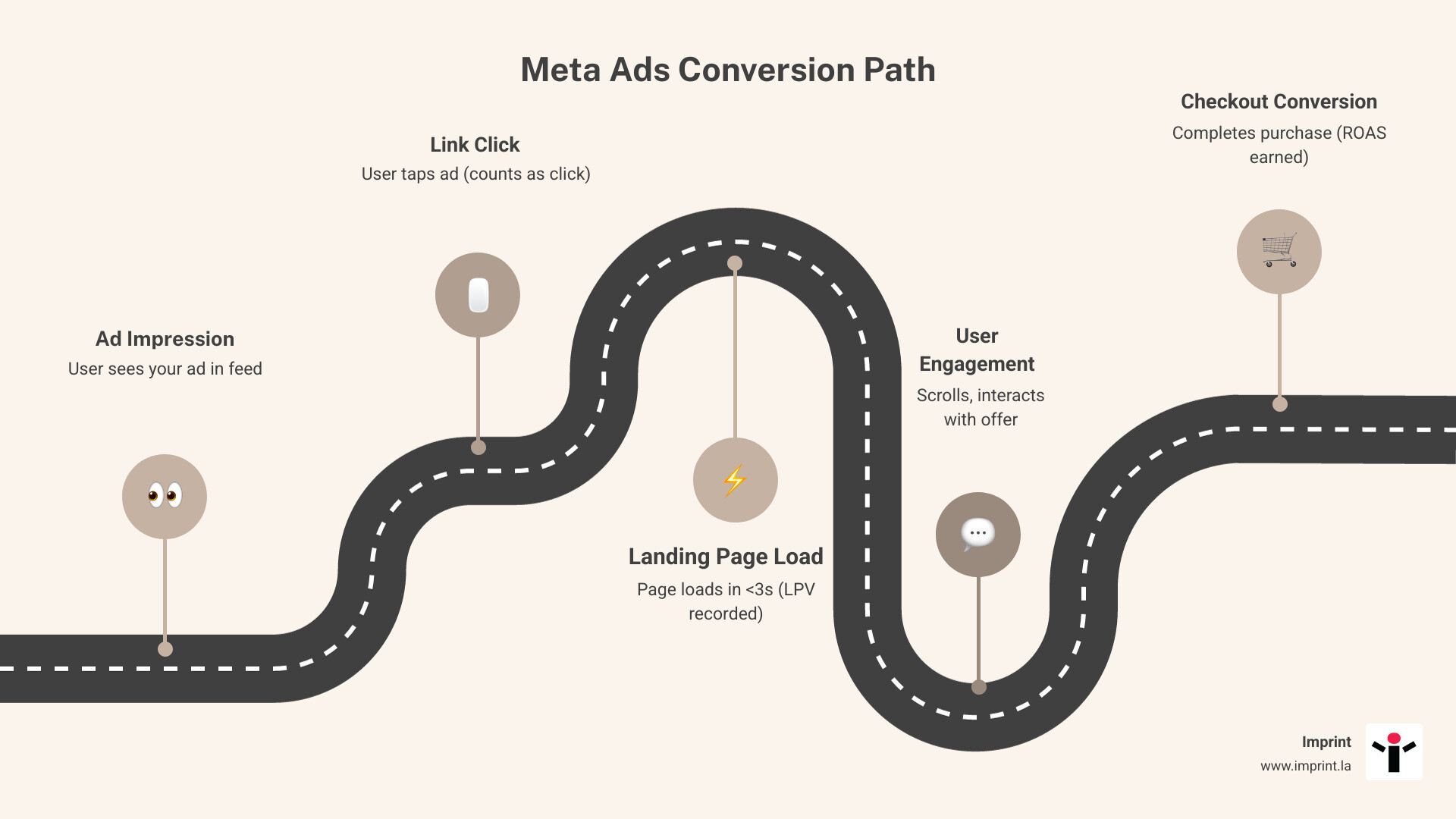
Measuring Success: LPVs and Reporting Changes
When we look at the Meta Ads Manager dashboard, it’s easy to get distracted by "Link Clicks." But here is a reality check: a click doesn't mean a visitor. Many users click an ad and then bounce before the page even loads. This is why Meta Ads Landing pages are the backbone of successful Meta Ads campaigns; if the page doesn't load, the campaign fails.
To truly measure success, we focus on Landing Page Views (LPVs). An LPV is recorded only when a person clicks your ad and then successfully loads the destination web page or Instant Experience. This distinction is vital because it filters out "fat-finger" accidental clicks and users with slow connections who give up.
How Meta measures meta ads landing pages performance
Meta’s measurement of meta ads landing pages is currently undergoing a significant shift. Historically, if you used Collection Ads, a click into the "Instant Experience" (the full-screen mobile storefront within the app) counted as an LPV.
However, starting in June 2025, Meta is changing its reporting. Instant Experience views will no longer count as LPVs. Only successful loads of an external website will count. For advertisers in Los Angeles and beyond, this means you might see a "drop" in LPV counts, but don't panic—this actually represents a higher-quality, higher-intent signal. It ensures you are optimizing for users who are willing to wait for your full site to load. To stay ahead of these technical shifts, we often recommend that brands Upgrade your marketing skills with free online courses and certifications through Meta Blueprint.
Improving traffic quality with LPV optimization
Starting in July 2025, Meta is rolling out specialized LPV optimization for advertisers facing "pixel sharing challenges." This is a game-changer for businesses that struggle with data gaps due to iOS privacy changes or browser blocking.
By selecting "Landing Page Views" as your optimization goal at the ad set level, you tell Meta's AI to find people most likely to actually wait for your page to load. Meta uses statistical modeling to estimate these views when direct data is missing, ensuring your delivery system stays smart even when the data is partial. This moves the needle from "cheap traffic" to "quality traffic."
Core Principles of High-Converting Meta Ads Landing Pages
At Imprint, we’ve seen that the best meta ads landing pages follow a strict hierarchy. If a user has to think about what to do next, you’ve already lost them. We specialize in creating these frictionless journeys as a leading E-commerce Agency.

The "Golden Rule" is continuity. If your ad features a specific red sneaker and a 20% discount, the landing page must feature that exact sneaker and that exact discount prominently "above the fold." If the user lands on a generic homepage, they’ll feel misled and bounce.
Mobile-first design for meta ads landing pages
With adults in the US spending more than 4 hours a day on their mobile phones, and 66% of consumers calling mobile their most important shopping tool, "mobile-friendly" isn't enough. It must be mobile-first.
The "3-Second Rule" is the law of the land: 53% of mobile consumers will leave a site that takes longer than 3 seconds to load. To achieve this, we compress images, limit heavy scripts, and use thumb-friendly navigation. Buttons should be large enough to tap easily, and forms should be simplified with autofill enabled. Furthermore, we must ensure our pages are inclusive, adhering to standards like Accessibility and the Americans with Disabilities Act to provide a great experience for every potential customer.
US market localization and trust building
If you are targeting the US market—specifically in hubs like Santa Monica or Beverly Hills—localization is key to building trust. This means using:
- Imperial Units: Inches, pounds, and miles.
- USD Currency: Clearly marked prices with the $ symbol.
- American English: Using "color" instead of "colour" and "optimize" instead of "optimise."
Trust is the currency of the internet. Since 32% of consumers would stop doing business with a brand after just one negative experience, you must prove your reliability immediately. We do this by showcasing Client Stories - Ecommerce, displaying trust badges (like Secure Checkout or Money-Back Guarantees), and featuring real, metric-driven testimonials.
Essential Components, Compliance, and AI Tools
Every high-converting page we build includes five non-negotiable elements:
- A Magnetic Headline: Focused on the benefit, not the feature.
- Hero Media: A high-quality image or video showing the product in action.
- Social Proof: Reviews or "As Seen In" logos.
- A Single CTA: One clear button that tells the user exactly what to do.
- A Simple Form: Only ask for the information you absolutely need.
Building and automating the conversion path
You don't need to be a coder to build elite meta ads landing pages. Tools like ConvertFlow and Leadpages allow for rapid deployment. ConvertFlow is particularly powerful for e-commerce because it allows for form elements and custom fields and conditional actions for conversion elements. This means you can show different offers to a user based on how they answered a quiz or what’s in their cart.
For those looking to scale even faster, AI tools like Heyflow can generate entire end-to-end campaigns—ads, copy, and funnels—in minutes. This is especially useful for Instagram Ads and E-commerce brands that need to test dozens of variations quickly. Most of these tools integrate directly with Shopify, making the "Final Checkout" part of the journey seamless.
Meta compliance and prohibited content
Nothing kills a campaign faster than an ad account ban. Meta has strict rules for what can appear on your landing page. You cannot use deceptive claims, "before and after" photos that imply unrealistic results, or language that suggests you know a user's personal characteristics (e.g., "Are you struggling with debt?").
For specific industries, the rules are even tighter:
- Supplements: Must include FDA warnings for supplements if making health claims.
- Age-Restricted: Alcohol or financial services require age gates.
- Social Proof: Ensure Reviews from platforms like Trustpilot are authentic and not fabricated.
Meta’s crawlers look at your landing page just as closely as your ad. If your page is broken, contains prohibited content, or provides a poor user experience, your ad will be disapproved.
Frequently Asked Questions about Meta Ads Landing Pages
Why is my Landing Page View count significantly lower than Link Clicks?
This is the most common question we get at Imprint. Usually, it’s a speed issue. If your page takes 5 seconds to load, half your traffic is gone before the pixel even fires. It can also be caused by tracking errors—if your Meta Pixel isn't placed correctly in the header, it won't record the view even if the user stays. Finally, some users click by accident and close the browser immediately; LPVs filter these out to give you a more accurate look at your real audience.
How many unique landing pages should I create for my Meta campaigns?
The short answer: as many as you have unique audiences or offers. If you are running an ad for "Summer Sandals" and another for "Winter Boots," they should never go to the same page. Personalization is a massive driver of conversion. We also recommend creating separate pages for A/B testing headlines or hero images. Understanding SEO for Your Ecommerce Business can also help you structure these pages so they capture organic intent alongside your paid traffic.
Can I use my website homepage as a Meta Ads destination?
Technically, yes. Strategically, no. Homepages are designed to be "choose your own adventure" hubs. They have menus, "About Us" links, and blog posts. For Meta ads, you want a "dead-end" funnel where the only two options are "Convert" or "Leave." Dedicated landing pages convert at 15%, while homepages typically hover around 1-2%. Don't pay for traffic just to let it get lost in your navigation menu.
Conclusion
Building high-performing meta ads landing pages is both an art and a science. It requires a deep understanding of Meta’s evolving reporting, a commitment to mobile-first design, and a relentless focus on user trust.
At Imprint, we take the guesswork out of the equation. As a performance-driven agency based in Los Angeles, we combine data-backed strategies with expert UX/UI design to deliver an average 3.8x ROAS for our clients. Whether you're in Santa Monica or Beverly Hills, our team is ready to help you optimize every step of your funnel—from that very first click to the final checkout.
Ready to stop leaving money on the table? Let’s build something that converts. Partner with our PPC/SEM Agency today and see the difference that a professional Meta strategy can make.
