
Agentic Workflows 101: Moving Beyond Rigid If-Then Rules
Why Agentic AI Workflow Automation Is Replacing Traditional Rules-Based Systems

Agentic AI workflow automation is the use of autonomous AI agents to plan, decide, and execute multi-step business processes — with little to no human intervention.
Here's a quick breakdown of what that means in practice:
- What it is: AI systems that observe a situation, reason through it, and take action — then learn from the results
- How it differs from old automation: Traditional tools follow rigid if-then rules and break when something unexpected happens; agentic AI adapts on the fly
- What it can do: Handle customer support, process invoices, route leads, fix IT issues, optimize ad campaigns, and much more
- Who it's for: Any business that wants to scale operations without scaling headcount
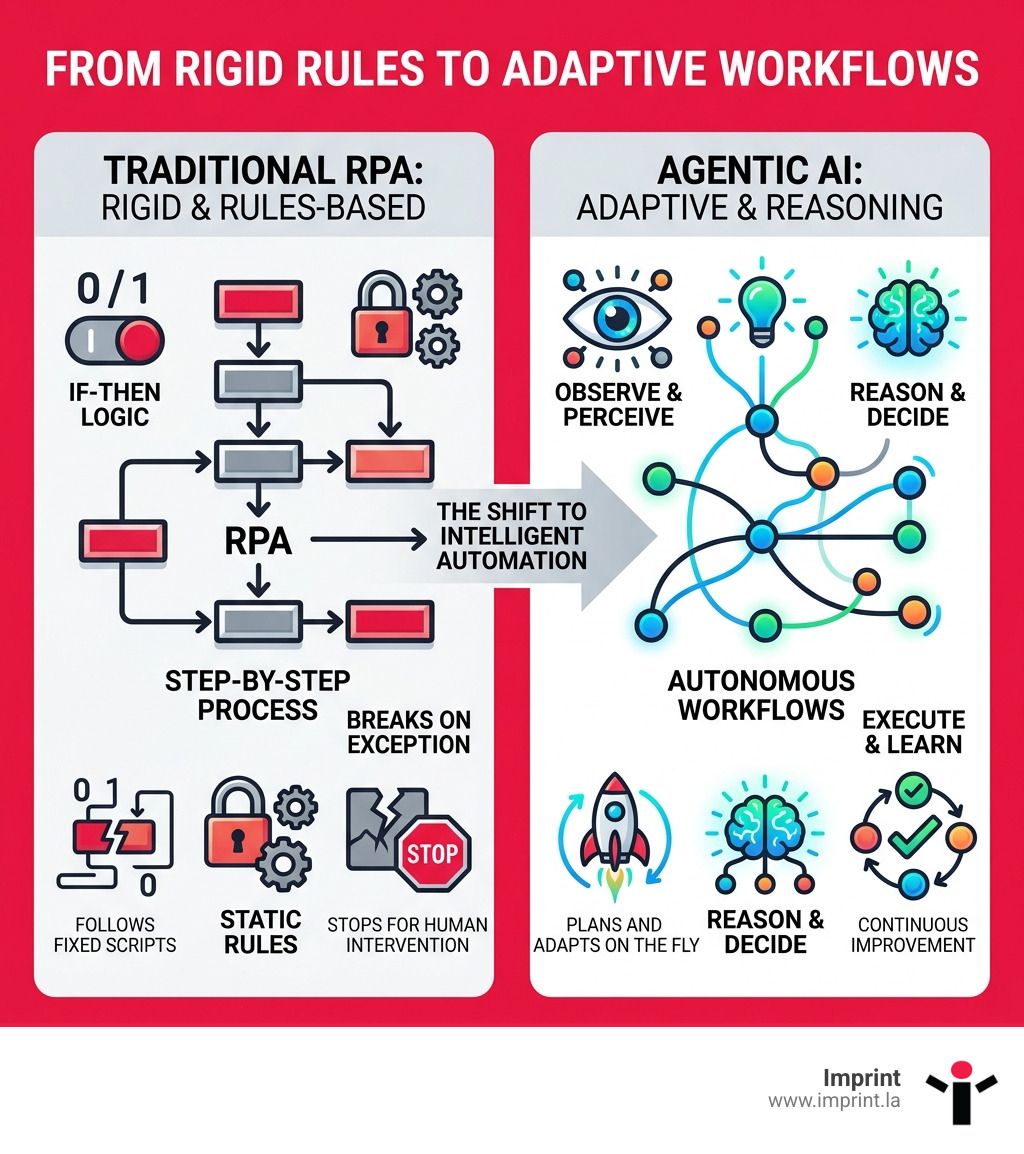
Most automation tools follow a script. The moment something unexpected happens — a missing field, a changed layout, an edge case — they stop. They wait. Someone has to fix them manually.
That's been the reality for businesses relying on traditional rule-based automation or robotic process automation (RPA) for years.
Agentic AI is different. Instead of following a fixed script, these systems reason through problems, choose the right tools, and adapt when things go sideways. Think of them less like a rigid conveyor belt and more like a capable team member who figures things out independently.
The business opportunity here is enormous. Nvidia CEO Jensen Huang has called enterprise AI agents a "multi-trillion-dollar opportunity" — and the numbers back that up. By 2023, 35% of organizations had already adopted AI agents, with another 44% planning to deploy them in the near term.
I'm Brent Burghdorf, founder of Imprint and a performance marketing specialist who has built data-driven growth systems across e-commerce, healthcare, and high-ticket services — and agentic AI workflow automation is now central to how I help brands scale smarter without inflating their budgets. At Imprint, we combine high-quality service standards with low-cost pricing to ensure that cutting-edge automation is accessible to every brand. In this guide, I'll break down exactly how these systems work, where they deliver the most value, and how to implement them without needing a PhD in machine learning.
What is Agentic AI Workflow Automation?
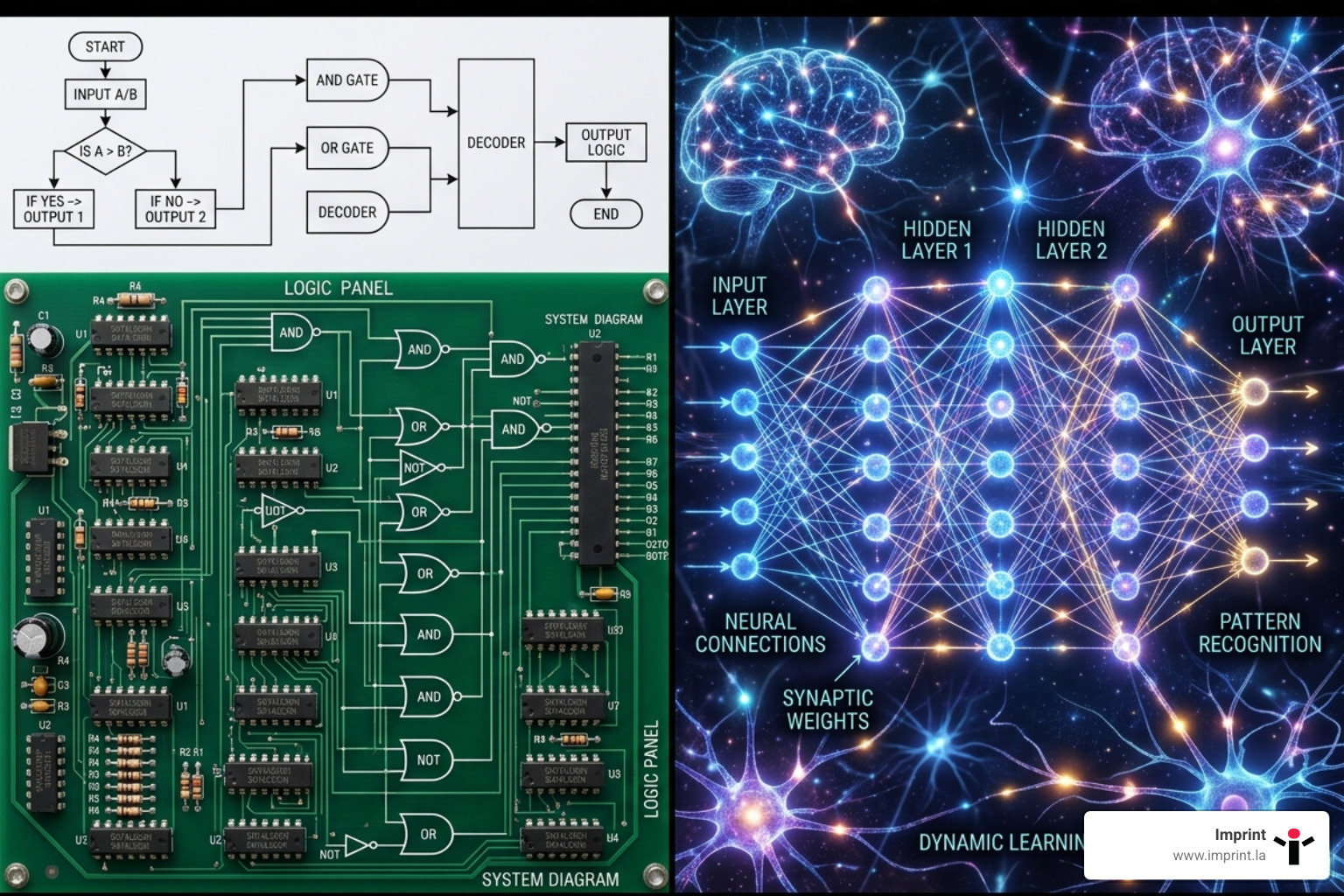
At its core, agentic AI workflow automation represents a shift from "doing" to "thinking." Traditional automation is a series of logic gates: If X happens, do Y. If X looks slightly different than expected, the system fails.
Agentic AI, however, uses Large Language Models (LLMs) to provide a reasoning layer. This allows the system to engage in "perception-action cycles." It perceives data (an email, a spreadsheet, a system error), reasons about the best course of action based on a goal, and executes that action using various tools.
According to Engini AI Automation Platform, these workflows don't just follow a script; they navigate ambiguity. This is why Nvidia’s leadership views this as a multi-trillion-dollar opportunity. For businesses in Los Angeles and beyond, this isn't just a "cool tech" update—it’s a way to achieve low-cost, high-impact implementation that scales infinitely.
Legacy RPA vs. Agentic AI Comparison Table
| Feature | Legacy RPA (Traditional) | Agentic AI Workflow Automation |
|---|---|---|
| Logic | Rigid "If-Then" scripts | Autonomous reasoning & planning |
| Data Handling | Structured data only | Unstructured data (emails, voice, images) |
| Adaptability | Breaks on UI/data changes | Self-healing and adaptive |
| Decision Making | Human-defined rules | AI-driven based on goals |
| Learning | Static; requires manual updates | Continuous learning from feedback |
How Agentic AI Workflow Automation Differs from RPA
The primary weakness of Robotic Process Automation (RPA) is brittleness. If a website moves a button two pixels to the left, a traditional RPA script might break. Agentic AI workflow automation thrives on dynamic adaptation. It understands the intent of the task rather than just the coordinates of a click.
When an agent encounters an obstacle, it doesn't just error out. It uses "self-healing execution" to find an alternative path. For example, if a primary API is down, an agent might switch to a web search or a secondary database to find the required information.
This level of sophistication is why we focus heavily on LLM Optimization Services. By fine-tuning how these models reason, we can deliver high-quality results at accessible price points that were previously only available to Fortune 500 companies with massive R&D budgets.
The Core Components of Agentic AI Workflow Automation
To understand how these "digital coworkers" function, we can look at the four pillars of their architecture:
- Information Gathering (Perception): The agent ingests data from multiple sources—APIs, PDFs, or even live web scraping.
- Reasoning Frameworks (Thinking): Using frameworks like ReAct (Reason + Act) or Chain-of-Thought, the agent breaks a complex goal into smaller, logical steps.
- Tool Use (Action): The agent isn't just a chatbot; it has "hands." It can write to a CRM, send an email, or execute code.
- Feedback Loops (Learning): Platforms like Beam AI allow agents to learn from failures. If a task fails, the agent analyzes why, rewrites its own prompt, and tries again.
This "Observe-Think-Act" cycle ensures that the system is constantly improving its accuracy without a human developer needing to rewrite the code every week.
The Business Benefits of Autonomous Workflows
The move toward agentic AI workflow automation isn't just about staying trendy; it's about the bottom line. We have seen that companies adopting these intelligent systems experience a radical shift in efficiency.
- 10x Faster Cycle Times: Tasks that used to take days of back-and-forth now happen in minutes.
- 85% Task Elimination: By automating the mundane "middle-work" (sorting, routing, basic data entry), teams can focus on high-level strategy.
- 200+ Hours Saved Per Month: For a typical mid-sized team, this is the equivalent of adding an entire full-time employee without the overhead.
- Reduced Transaction Costs: AI agents can handle searching, communicating, and contracting at a near-zero marginal cost, making high-quality decisions affordable for smaller brands.
This professional-grade efficiency is further enhanced by Facebook's New AI and other platform-level advancements that make it easier for agents to interact with the digital tools we use every day.
Real-World Use Cases Across Industries
While the concept might sound futuristic, the adoption rate is already at 35% and climbing. High-value automation is no longer a luxury; it's a necessity for growing brands in competitive markets like Santa Monica and Beverly Hills.
- Customer Support: Instead of a basic chatbot that says "I don't understand," an agentic workflow can diagnose a technical issue, check a user's subscription status, and issue a refund or a fix autonomously.
- IT & Troubleshooting: Agents can ingest error logs, cross-reference documentation, and apply a patch via cloud APIs, only alerting a human if the problem persists.
- Finance & Fraud Detection: Beyond simple flags, agents can reason through transaction patterns, verify identities across systems, and draft suspicious activity reports.
- HR & Onboarding: From screening resumes to scheduling interviews and setting up payroll, agents coordinate the entire lifecycle of an employee.
Leading platforms like OpenAI are already providing the infrastructure for these multi-agent systems, where a "Supervisor Agent" delegates tasks to "Specialist Agents" to complete complex projects.
Precision Marketing and Campaign Optimization
At Imprint, we see the most dramatic results in digital advertising. Agentic AI workflow automation allows us to move beyond simple A/B testing.
We use agents for:
- Psychographic Analysis: Understanding the "why" behind customer behavior to create more resonant ad copy.
- Real-Time Creative Testing: Deploying 250+ creative iterations using only 10% of a typical budget to find winners instantly.
- Dynamic Audience Targeting: Adjusting campaign parameters mid-run based on real-time performance data.
This data-backed strategy is how we consistently deliver a 3.8x average ROAS for our clients. By integrating these agents with your AI Search and SEO Strategy, we ensure your brand isn't just seen, but chosen by the AI-driven search engines of 2026.
Overcoming Challenges and Ethical Considerations
Implementing agentic AI workflow automation isn't without its hurdles. It’s often said that 80% of the work is in the "boring" stuff: data engineering, governance, and integration.
Key Challenges to Address:
- Data Engineering: Your AI is only as good as the data it can access. Converting messy, siloed data into structured, machine-readable formats is the first step.
- Human-in-the-Loop: For high-stakes decisions—like a €50k invoice or a sensitive customer escalation—we always recommend a human approval gate.
- Security & Reliability: Using SOC 2 compliant platforms and robust API management ensures that agents don't "hallucinate" or leak sensitive information.
- Accountability: Who is responsible if an agent makes a mistake? Establishing clear governance boards and audit trails is essential for affordable risk management.
By following these professional standards, even small businesses can deploy powerful agents safely and effectively.
Frequently Asked Questions about Agentic AI
Are agentic workflows reliable for enterprise use?
Yes. Modern platforms use "guardrails" and verification layers to ensure the AI stays within its operational boundaries. With completion rates hitting 99.9% in some specialized tasks, they are often more reliable than human workers prone to fatigue or distraction.
Do I need deep AI expertise to implement these workflows?
Surprisingly, no. While the underlying tech is complex, many no-code and low-code platforms now exist that allow businesses to build and deploy agents through visual interfaces. Our role at Imprint is to provide the professional-grade strategy and integration to ensure these tools actually drive ROI.
What is the expected ROI for agentic automation?
Most organizations see a 300-500% ROI within the first year. Between saving human work hours and reducing error rates by up to 90%, the savings often range from $1 million to $5 million annually for companies automating 50 or more processes. We specialize in providing these high-end results at low-cost entry points.
Conclusion
The future of work isn't about humans vs. AI; it's about multi-agent collaboration. As we move deeper into 2026, the companies that thrive will be those that offload their "rigid" processes to autonomous agents, freeing up their human talent for creative and strategic breakthroughs.
At Imprint, we are a performance-driven digital marketing agency that believes high-quality service standards should be the norm, not a luxury. Our low-cost pricing models ensure that businesses in Los Angeles, Santa Monica, or Beverly Hills can access elite automation. Our data-backed strategies and creative services are designed to help you scale without the traditional costs.
Ready to move beyond rigid rules and embrace the power of autonomy? Transform your business with expert AI development and let us show you how agentic workflows can deliver the 3.8x ROAS your brand deserves.
