
User Experience Design Company: Why Your App is Ghosting Its Users
Your App Is Losing Users — Here's Why UX Design Is the Fix

A user experience design company is a specialized agency that designs digital products — websites, apps, software — so they're easy, intuitive, and enjoyable to use.
Quick answer: What does a user experience design company do?
- Researches your users — identifies who they are, what they need, and where they struggle
- Designs the experience — maps user journeys, builds wireframes, and creates prototypes
- Refines the interface — combines visual design (UI) with usability to guide users toward action
- Tests and iterates — validates designs with real users before and after launch
- Improves conversions — removes friction so more visitors complete the actions that matter
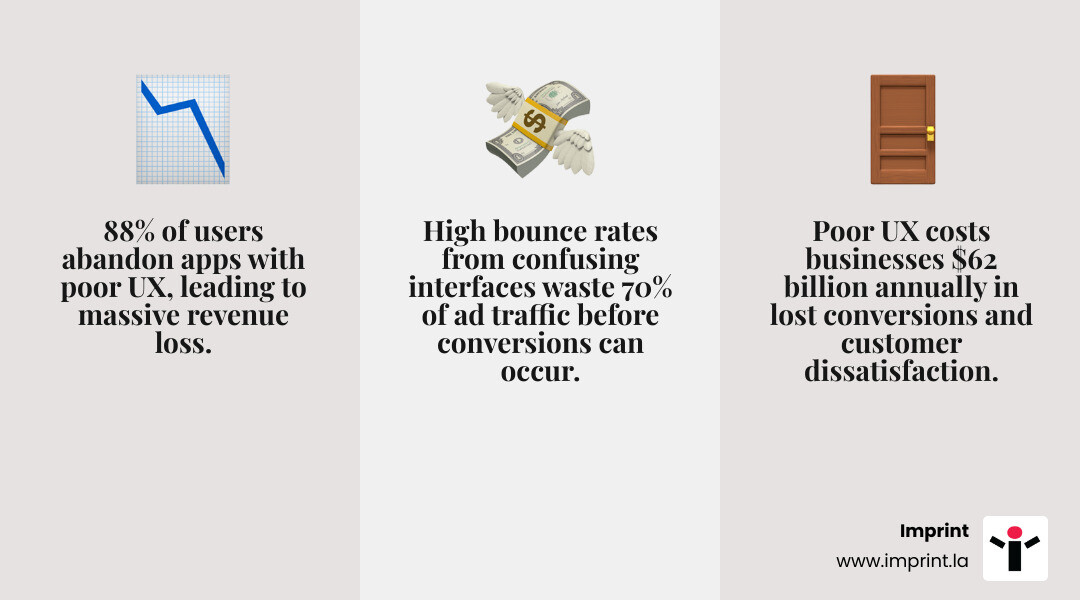
Here's a frustrating truth: you can run great ads and drive real traffic — and still bleed money.
Why? Because users land on your product, get confused, and leave. Silently. No complaint. No feedback. Just gone.
Over 85% of consumers research online before buying. That means your digital experience is often the first — and sometimes only — chance to earn their trust. If that experience is clunky, slow, or confusing, they don't give you a second shot.
Poor UX doesn't just hurt user satisfaction. It directly tanks your ROAS. Every dollar you spend on ads is wasted if the landing page or app experience drives users away.
I'm Brent Burghdorf, founder of Imprint and a performance marketing specialist who has seen how a broken user experience quietly destroys ad campaign ROI across e-commerce, healthcare, and high-ticket service brands — which is exactly why pairing a strong user experience design company with paid media strategy is non-negotiable for scaling brands. In the sections below, I'll walk you through exactly how UX design works, what it costs, and how to use it to turn your traffic into revenue.
Defining the Role of a User Experience Design Company
When you hear the term "design," it’s easy to think about pretty colors and stylish fonts. But a user experience design company looks far beneath the surface. We focus on the "how" and the "why" of a digital product. Does the person using this app actually enjoy the experience? Is the navigation a labyrinth or a clear path?
At its core, UX design is about outcomes. It’s about creating an environment where function, convenience, and usability meet to make a user’s life easier. Whether we are working with a startup in Santa Monica or an established enterprise in Beverly Hills, our goal is to turn digital friction into a seamless flow. This involves more than just sketching screens; it requires a deep dive into web design services to ensure the technical foundation supports the user's journey.

The Difference Between UX, UI, and CRO
In digital growth, three acronyms get tossed around constantly: UX, UI, and CRO. While they are best friends, they aren't the same thing.
- UX (User Experience): This is the logic and the "feel." It’s the architect’s blueprint for the house. It focuses on interaction design—how a user gets from Point A to Point B without getting a headache.
- UI (User Interface): This is the "look." It’s the interior design. It involves the visual hierarchy, buttons, typography, and colors. A good UI is aesthetically pleasing and remains consistent with your brand identity.
- CRO (Conversion Rate Optimization): This is the "result." It’s the science of making sure the user actually buys the house (or clicks the "Sign Up" button).
A top-tier user experience design company ensures these three work in harmony. If you have a beautiful UI but a confusing UX, people will leave. If you have great UX but no CRO strategy, people will enjoy your site but never spend a dime. We integrate these disciplines to drive business growth and maximize your profit margins.
Why Every User Experience Design Company Prioritizes User Research
We don't design for ourselves; we design for your customers. That’s why we start every project with intensive user research. We create fictional but data-backed "personas."
Think of a persona as a character profile. For a healthcare app, we might look at "Jane, a 45-year-old busy professional who needs to book appointments in under three clicks because she’s constantly on the go." We identify her pain points (long wait times, confusing insurance jargon) and her goals (quick confirmation, easy-to-find history).
By conducting user research and insights gathering, we move away from guesswork and toward evidence-based design. This often involves looking at high-value data and observing how real people interact with existing products. You can see examples of how these research-driven insights turn into jaw-dropping designs by exploring collections on Dribbble.
The Business Case for Professional UX Design
Investing in a user experience design company isn't a luxury; it’s a survival strategy. The statistics are hard to ignore. Over 85% of consumers conduct online research before making a purchase. If they land on a site that feels outdated or broken, they’ll assume your service is too.
Furthermore, 50% of mobile users are more likely to visit a physical store after performing a local search on their smartphone. If your mobile UX is clunky, you aren't just losing digital sales—you're losing foot traffic in places like Los Angeles and Beverly Hills.
Professional UX design provides tangible benefits:
- Increased Traffic: Search engines like Google favor sites with good usability and fast performance.
- Higher Conversions: By simplifying interactions, we remove the "friction" that causes people to abandon their carts.
- Boosted Profits: When users have a frictionless experience, they are more likely to return, increasing customer lifetime value.
- Lasting Impressions: First impressions are everything. We help you make a lasting impression that turns a one-time visitor into a brand advocate.
Our Proven UX Design Process: From Research to Reality
We don't just "make things pretty" and hope for the best. We follow a rigorous, step-by-step process to ensure every pixel serves a purpose. This methodology is designed to reduce risk and maximize the impact of your development efforts.
| Phase | Goal | Key Activities |
|---|---|---|
| Market Identification | Understand the landscape | Competitive analysis, stakeholder interviews, persona creation. |
| Prototyping | Test the logic | Low-fidelity wireframes, mapping user flows, rapid iteration. |
| Visual Interface Design | Apply the brand | High-fidelity UI kits, typography, motion design, micro-interactions. |
| User Testing | Validate with reality | Usability testing, A/B testing, heatmaps, and feedback loops. |
- Identify Your Market: We dive deep into who your users are and what they expect.
- Visual and Interface Design: We craft a look that isn't just "trendy" but functional and accessible.
- Simplify Interactions: We look for every opportunity to remove a click or a form field. Less is almost always more.
- Test and Iterate: We launch, we listen, and we fix. Design is never truly "finished"; it’s an ongoing cycle of improvement based on real-world behavior.
Maximizing Growth Through Advanced UX Services
In today’s market, standard design isn't enough. To truly stand out in a competitive landscape like Los Angeles, you need to leverage advanced UX strategies.
Mobile-First Mastery is no longer optional. Since mobile devices redefined the web, your site must look and function perfectly on a 6-inch screen before you even think about the desktop version. We focus on performance optimization to ensure lightning-fast load times, as even a one-second delay can tank your conversion rates. Check out our guide on optimizing for mobile audiences for more tips.
Personalization and Interactivity also play massive roles. Modern users demand experiences tailored to their specific behaviors. Whether it’s an AI-powered chatbot or a dashboard that remembers a user's preferences, interactivity keeps people engaged and reduces bounce rates.
Essential Services Offered by a User Experience Design Company
A comprehensive user experience design company offers a suite of services that go beyond simple layouts:
- Information Architecture: Organizing content so it’s easy to find. Think of it as the "GPS" for your website.
- Design Systems: Creating a library of reusable components (buttons, headers, icons) to ensure consistency as your company scales.
- Usability Audits: Reviewing your current site to find "leaks" where users are dropping off.
- Accessibility Compliance: Ensuring your site is usable for the 15% of the world's population with disabilities. This isn't just good ethics; it’s often a legal requirement. We specialize in helping businesses make their websites ADA compliant to avoid litigation and reach a wider audience.
Frequently Asked Questions about UX Design
Navigating UX can be confusing. Here are the most common questions we hear from businesses in Santa Monica and Los Angeles.
What is the difference between site usability and UX?
Usability is a subset of UX. Usability focuses on the technical aspects: Can the user complete the task? Is the site fast? Is the navigation logical? UX is much broader. It encompasses the user's emotional response, the brand's storytelling, and the overall satisfaction of the interaction. Usability is about "can they," while UX is about "how do they feel while doing it."
How much does a user experience design company cost?
Pricing varies wildly based on project complexity, the scope of services, and the agency's expertise. A simple UX audit for a small Los Angeles business might cost a few thousand dollars, while a full-scale enterprise transformation for a fintech or healthcare platform can reach six figures. Factors influencing price include:
- Number of user personas to be researched.
- Complexity of the product (e.g., a simple landing page vs. a complex SaaS dashboard).
- The depth of user testing required.
- Timeline (rush projects typically command a premium).
Which industries benefit most from professional UX services?
While every digital product needs good UX, certain industries see a higher ROI:
- eCommerce: Where every micro-interaction directly impacts sales.
- Fintech & Banking: Where trust and clarity are paramount for handling sensitive data.
- Healthcare: Where accessibility and ease of use are critical for patient outcomes.
- SaaS & Enterprise: Where reducing complexity for daily users increases productivity and retention.
Conclusion
At Imprint, we don't believe in design for design’s sake. We are a performance-driven agency that treats UX as a vital component of your overall marketing ecosystem. By integrating world-class user experience design company expertise with our data-backed Meta and Google Ads strategies, we help our clients achieve an average 3.8x ROAS.
Whether you are based in Santa Monica, Beverly Hills, or the heart of Los Angeles, your digital product is the face of your business. Don't let a "labyrinthine" layout ghost your users and drain your ad spend. It's time to turn those bounces into breakthroughs.
Start your UX transformation today and see how data-driven design can revolutionize your bottom line.
