
Everything You Ever Wanted to Know About Generative Engine Optimization
What is Generative Engine Optimization GEO?
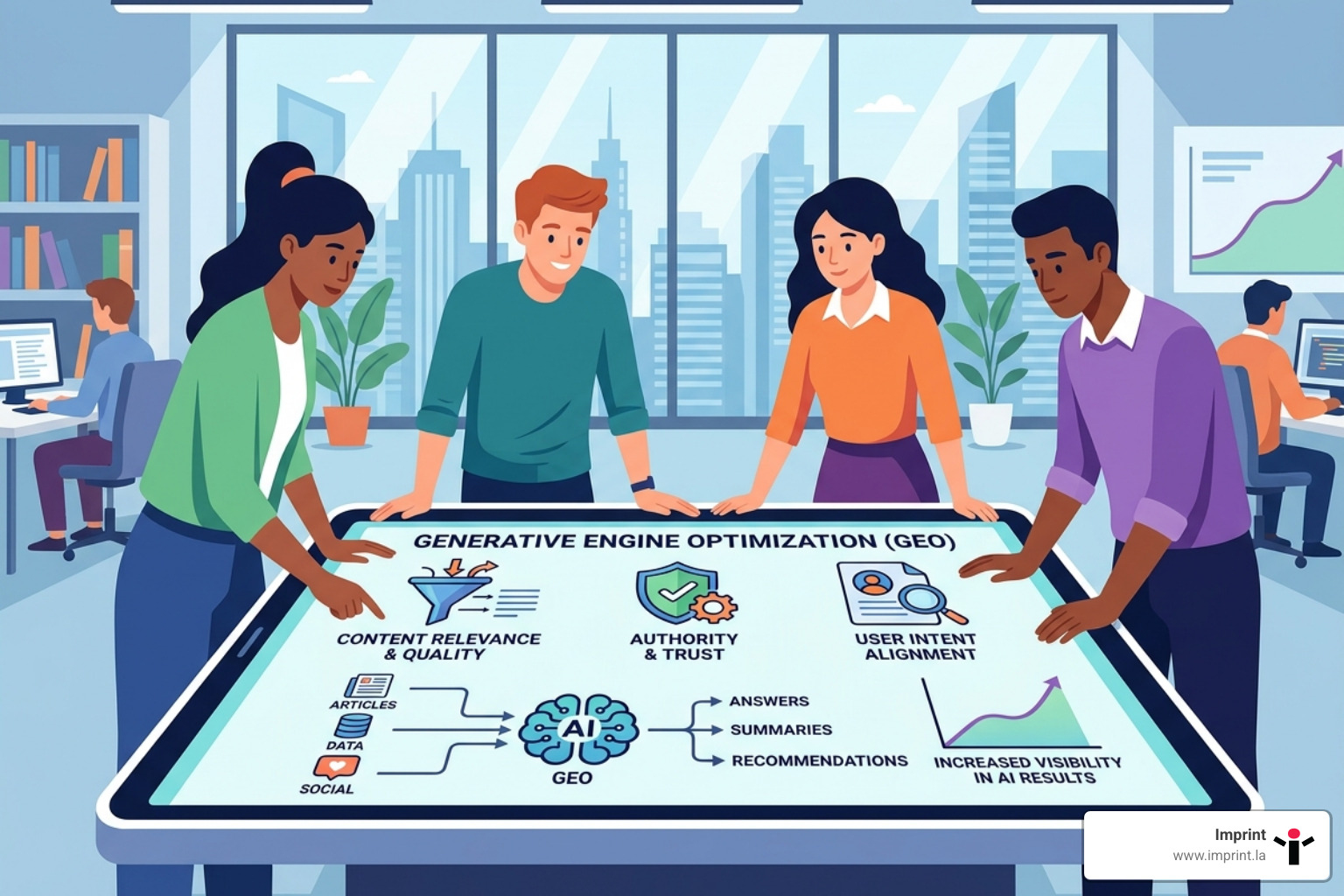
What is generative engine optimization geo is one of the most important questions in digital marketing right now — and the answer is simpler than you might think.
Generative Engine Optimization (GEO) is the practice of structuring your content and online presence so that AI platforms like ChatGPT, Google's AI Overviews, Perplexity, and Gemini cite, recommend, or mention your brand when users ask questions.
Here's a quick breakdown:
| Traditional SEO | GEO | |
|---|---|---|
| Goal | Rank in search results | Get cited in AI answers |
| Success metric | Rankings, clicks | Citations, brand mentions |
| Primary platforms | Google, Bing | ChatGPT, Perplexity, Gemini, AI Overviews |
| Content focus | Keywords | Factual clarity, extractability |
| Credibility signals | Backlinks | Entity authority, structured data, off-site presence |
This matters because search behavior is changing fast. When an AI Overview appears in Google results, the average click-through rate drops by 34.5%. ChatGPT now reaches over 800 million weekly users. Gemini has surpassed 750 million monthly users. Users are getting answers directly from AI — without ever clicking a link.
If your brand isn't being cited by these systems, you're simply not in the conversation.
I'm Brent Burghdorf, founder of Imprint and a performance marketing specialist with deep experience in SEO, media buying, and data-driven growth — and understanding what is generative engine optimization geo has become central to how I build durable, compounding marketing systems for brands. In this guide, I'll walk you through everything you need to know to show up where your buyers are actually searching.
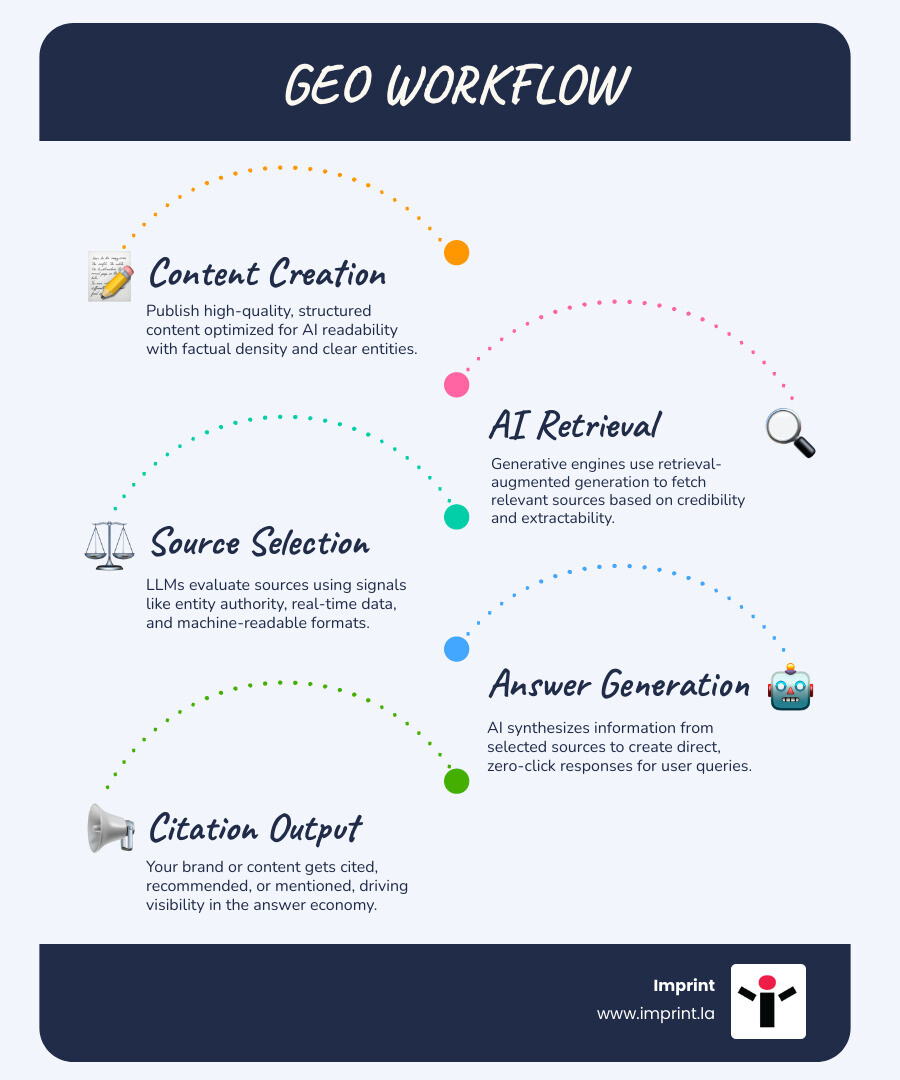
When we look at the digital landscape in April 2026, the definition of "search" has fundamentally shifted. To answer the question of what is generative engine optimization geo, we have to look at how AI systems actually "read" the internet.
Unlike a traditional search engine that gives you a list of links, a generative engine (like ChatGPT or Perplexity) synthesizes information from dozens of sources to create a single, cohesive answer. GEO is the strategic process of ensuring your brand is one of those sources. It’s about AI visibility. If SEO was about being the first book on the library shelf, GEO is about being the expert the librarian quotes during a conversation.
At Imprint, we view GEO as a way to influence Large Language Models (LLMs) through specific citation mechanics. It isn't just about "tricking" an algorithm; it’s about providing high-quality, structured data that makes it easy for an AI to trust you. We believe that professional-grade optimization should be accessible to everyone, which is why we focus on low-cost pricing for high-impact strategies that maintain the highest professional service standards.
The Core Pillars of what is generative engine optimization geo
To succeed in this new era, your content must excel in four specific areas. These Generative Engine Optimization (GEO) Concepts are the foundation of any modern strategy:
- Factual Density: AI models love facts. Research shows that adding statistics and verifiable data can boost your visibility in AI responses by up to 40%.
- Content Extractability: AI doesn't read a whole page; it "chunks" it. If your information is buried in fluff, the machine can't extract it.
- Entity Clarity: You need to make it crystal clear who you are and what you do. If your brand name is also a common word (like "Apple" or "Monday"), you must use structured data to define your entity.
- Machine Readability: This involves using clean HTML and schema markup so that the "black box" of the AI can parse your site without errors.
How AI Platforms Like ChatGPT and Gemini Select Sources
Understanding how AI search engines select sources is key to jumping ahead of your competitors. Most modern AI engines use a process called Retrieval-Augmented Generation (RAG).
When a user types a prompt, the AI does a quick "live search" of the web, pulls 5 to 15 candidate documents, and then summarizes them. They look for credibility signals like:
- Training Cutoffs: While models have base knowledge (e.g., Gemini 3’s cutoff was January 2025), they use real-time retrieval to find the latest news.
- Authority: They prefer sources that are cited elsewhere on the web (Reddit, YouTube, news sites).
- Formatting: Content that uses lists and tables is much easier for the AI to "grab" and put into a response.
GEO vs. Traditional SEO: A Strategic Evolution
It's tempting to think that SEO is dead, but that’s not the case. Instead, we are seeing a Strategic Evolution where GEO sits on top of your existing SEO foundation.
| Feature | Traditional SEO | Generative Engine Optimization (GEO) |
|---|---|---|
| Primary Goal | Rank #1 for a keyword | Be the "Source of Truth" in an AI answer |
| User Action | Click a blue link | Read the summary (Zero-click) |
| Optimization Focus | Keyword density & Backlinks | Factual density & Quotability |
| Winning Strategy | High volume of content | High authority and precision |
The reality of 2026 is that zero-click searches are skyrocketing. Users want the answer immediately. By focusing on a value-driven strategy, we help brands capture "Share of Model"—which is how often the AI mentions you compared to your competitors.
Why SEO Fundamentals Still Matter for what is generative engine optimization geo
You can't have great GEO SEO without the basics. AI engines still use crawlers to find your content. If your site is slow, has broken links, or blocks "GPTBot" in your robots.txt, you won't be cited.
E-E-A-T (Experience, Expertise, Authoritativeness, and Trustworthiness) is more important than ever. AI models are trained to avoid "hallucinations" (making things up), so they look for signals that you are a real expert. This includes having clear author bylines, cited sources, and a strong domain authority. We provide these high-quality service standards and technical audits at a low-cost pricing point because we believe every business deserves a seat at the AI table.
Key Differences in Success Metrics and KPIs
How do you know if your GEO is working? You can't just look at Google Search Console anymore. You need to track new metrics:
- AI Signal Rate: How often your brand appears in responses for your target prompts.
- Share of Model: Your "voice" in the AI ecosystem relative to competitors.
- Citation Frequency: The number of times your URL is actually linked in the "Sources" section of an AI answer.
- Conversion Multipliers: Interestingly, AI-referred traffic converts 4x to 23x better than traditional search traffic. Why? Because the AI has already "pre-sold" the user on your brand before they even click.
Key Best Practices for Winning AI Mentions
If you want to win in 2026, you need to change how you write. We’ve found that the "standard blog post" format is often too wordy for AI systems. Here is how to optimize for winning AI mentions:
- The Answer-First Structure: Start your articles with a 40-60 word summary that directly answers the primary question. This is the "snackable" bit the AI will likely quote.
- Use Schema Markup: Tell the machine exactly what your content is. Use FAQ schema, Product schema, and Organization schema to remove any guesswork.
- Content Freshness: AI has a massive recency bias. Over 76% of ChatGPT’s most-cited pages were updated within the last 30 days. Regular updates are a must.
- Statistical Authority: Use the format: "[Number] according to [Source], [Year]." This makes your data "verifiable" for the AI.
Optimizing Content Structure for AI Extraction
AI systems use "chunking" to understand your page. To make your content easy to extract, use a rigid heading hierarchy (H1, then H2, then H3).
- Bulleted Lists: Perfect for "How-to" steps.
- Comparison Tables: AI models love tables for "Best of" queries.
- Summary Boxes: Place these at the top of long sections to give the AI a "TL;DR" (Too Long; Didn't Read).
- Factual Precision: Avoid vague language. Instead of saying "we have many clients," say "we have served over 450 clients in the Los Angeles area."
The Role of Multi-Platform Presence and Entity Authority
AI doesn't just look at your website; it looks at the whole web to see who you are. This is what we call "off-site signals."
- Reddit and Quora: These are huge for AI training data. If people are talking about your brand on Reddit, ChatGPT is much more likely to recommend you.
- YouTube Visibility: AI models can now "watch" and transcribe videos. Having a presence here builds your topical authority.
- Review Platforms: Sites like G2, Trustpilot, and Yelp are "trusted hubs." Brands with strong reviews on these sites are 3x more likely to be cited by AI.
- Brand Consistency: Ensure your Name, Address, and Phone number (NAP) are identical across the web. This is especially vital for our clients in Santa Monica, Beverly Hills, and Los Angeles.
Challenges and the Future of AI-Driven Discovery
As we look toward the future of AI-driven discovery, there are hurdles to clear. The "black box" nature of AI means we don't always know exactly why one source is picked over another.
- Hallucination Risks: AI can sometimes misattribute a quote or get a fact wrong. This is why we advocate for "Citation Verification"—checking how AI describes your brand and correcting the record on your own site.
- Citation Volatility: Between 40% and 60% of cited sources in AI answers change every month. This means GEO is not a "one and done" task; it requires ongoing maintenance.
- Algorithm Transparency: Unlike Google, which gives us some clues, AI models are often proprietary. We rely on empirical testing—running thousands of prompts to see what "sticks."
Adapting to Different AI Models and Engines
Each engine has its own "personality."
- Perplexity: Heavily favors technical accuracy and academic-style citations. It uses its own crawler, "PerplexityBot."
- Gemini: Deeply integrated with Google’s ecosystem. It prioritizes Google Business Profiles and YouTube videos.
- ChatGPT Search: Focuses on conversational relevance and often pulls from high-authority news sites and "trusted" forums like Reddit.
By maintaining a cross-platform authority, you ensure that no matter which "librarian" the user talks to, your name comes up.
Frequently Asked Questions about GEO
Is GEO replacing traditional SEO?
No, they are complementary strategies. Think of SEO as the foundation of your house and GEO as the modern interior design that makes it livable in 2026. You still need to rank well in Google to be found by the AI crawlers that power the answers. We recommend a "dual-track" visibility strategy: optimize for the click and the citation.
How do I measure my brand's visibility in AI answers?
You should track your AI Signal Rate and Citation Frequency. There are now emerging tools that allow you to "audit" your brand mentions across ChatGPT, Claude, and Gemini. At Imprint, we help our clients set up these dashboards so they can see exactly how their "Share of Model" is growing over time.
Does content freshness impact AI citations?
Absolutely. In the current 2026 search environment, recency is a massive ranking factor for AI. Because these models want to provide the most "up-to-date" answers, pages updated within the last 30 days receive the lion's share of citations. Older content (over 4 years old) accounts for less than 4% of AI-referred traffic.
Conclusion
The shift to an "answer economy" is the biggest change in marketing since the invention of the smartphone. Understanding what is generative engine optimization geo is no longer optional—it is the key to staying visible in a world where users may never click a link again.
At Imprint, we specialize in these data-backed, performance-driven strategies. Whether you are a local business in Beverly Hills or a national brand, we provide high-quality service standards and GEO/SEO solutions at a low-cost pricing point. We don't just chase clicks; we chase authority and growth.
Ready to see how your brand stacks up in AI? More info about GEO SEO services is just a click away. Let's build your brand's future together.
