
GEO vs SEO: The Ultimate Guide to Comparing Them
Search Is Changing Fast — Here's What GEO vs SEO Actually Means
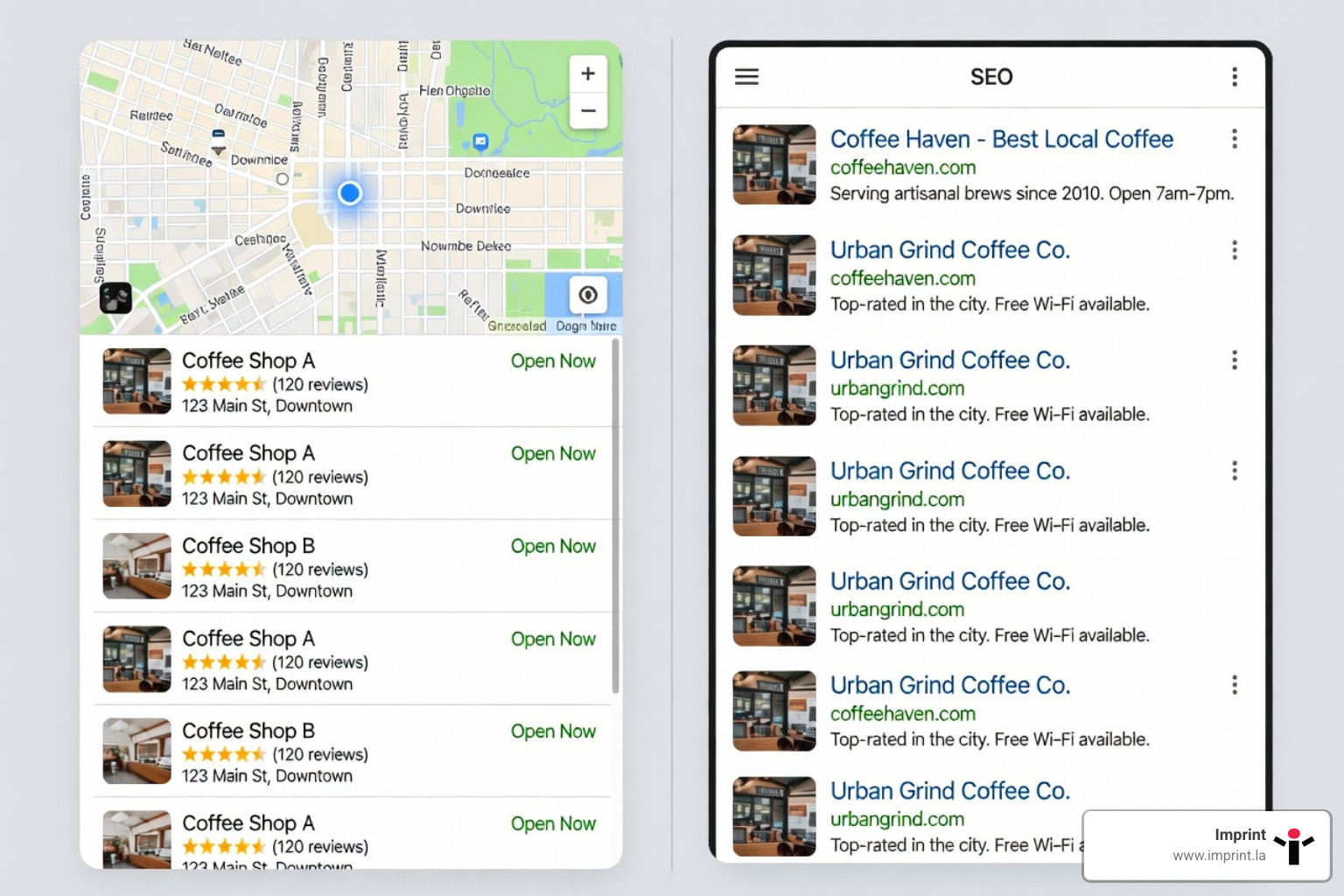
GEO vs SEO is one of the most important strategic questions in digital marketing right now — and the short answer is: they're not the same thing, but you need both.
Here's the quick breakdown:
| SEO | GEO | |
|---|---|---|
| Full name | Search Engine Optimization | Generative Engine Optimization |
| Goal | Rank high in Google/Bing results | Get cited in AI-generated answers |
| Platforms | Google, Bing, Yahoo | ChatGPT, Perplexity, Google AI Overviews |
| Success metric | Rankings, clicks, traffic | Citations, impressions, brand mentions |
| Result type | Blue links on a SERP | Synthesized AI answers |
| Replaces the other? | No | No — they work together |
Search used to be simple: rank on page one, get clicks. But something shifted in late 2022 when ChatGPT launched, and again in 2023 when Google rolled out AI Overviews. Now a growing share of users get their answers directly from AI — no click required.
The numbers tell the story. Position-one CTR has dropped from 7.3% to 2.6% year over year on keywords with AI Overviews. Organic CTR for informational queries has fallen by as much as 65% when AI summaries appear. And 26% of searches with AI summaries now end with zero clicks at all.
That doesn't mean SEO is dead. Traditional search engines still handle roughly 94% of all searches. But the rules for the other 6% — and for how AI surfaces your brand across all platforms — are genuinely different.
I'm Brent Burghdorf, founder of Imprint and a performance marketing specialist who has built scalable search acquisition systems across e-commerce, healthcare, and high-ticket services — which means I've watched the GEO vs SEO tension play out in real campaigns with real revenue on the line. Below, I'll break down exactly how these two disciplines differ, where they overlap, and how to build a strategy that wins in both worlds.
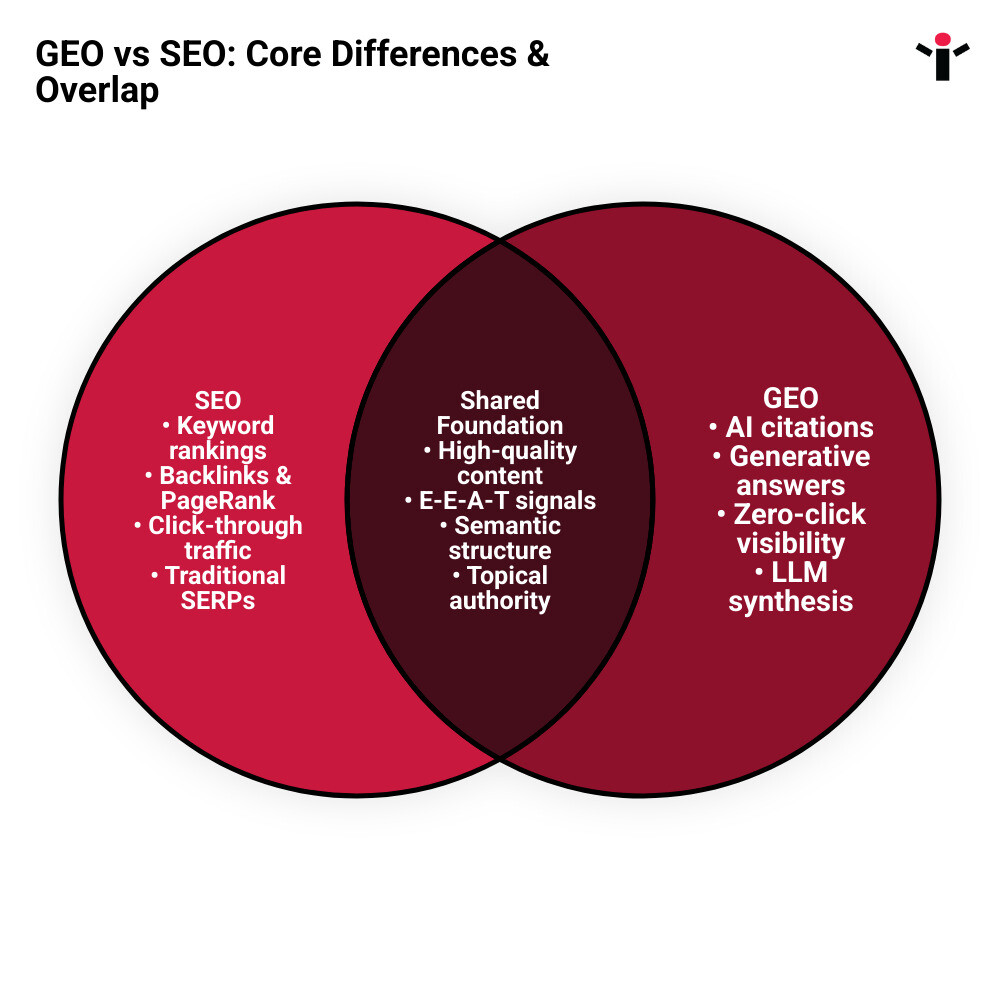
Understanding the Core Differences: GEO vs SEO
To understand the debate of GEO vs SEO, we have to look under the hood at how these systems actually "think." While they both aim to connect users with information, their internal logic is worlds apart.

Generative Engine Optimization (GEO) is the practice of structuring content so that AI platforms—like ChatGPT, Perplexity, and Google AI Overviews—cite it in their generated answers. The term gained academic weight following a 2024 research paper by researchers from Princeton and Georgia Tech, which highlighted how specific content tweaks can increase a brand's visibility in AI responses by up to 40%.
Search Engine Optimization, on the other hand, is the classic discipline we've used for decades. It relies on web crawlers to index pages and algorithms to rank them in a list of "blue links."
The fundamental shift is from indexing to synthesis. Traditional SEO helps a search engine find a page; GEO helps an AI model understand a concept well enough to repeat it (and cite it) to a user.
| Feature | Traditional SEO | Generative Engine Optimization (GEO) |
|---|---|---|
| Technology | Web crawlers & Boolean logic | Transformer architecture & LLMs |
| Primary Output | Ranked list of URLs | Synthesized, multi-source paragraph |
| User Action | Click to visit website | Read answer on-platform (Zero-click) |
| Core Signal | Backlinks & Keyword density | Entity authority & Corroboration |
The Mechanics of Traditional Search
Traditional SEO is built on the foundation of PageRank and keyword indexing. Search engines like Google use "spiders" to crawl the web, following a trail of links to discover new content. They evaluate your site based on:
- Keyword Indexing: Matching the user's query to the words on your page.
- Backlink Profiles: Using other sites' links as "votes of confidence."
- Technical Health: Site speed, mobile-friendliness, and secure connections.
- Domain Authority: How much weight your entire website carries in a specific niche.
The goal here is SERP visibility—showing up in the top three results to capture the highest possible click-through rate (CTR).
The Rise of Generative Engine Optimization (GEO)
GEO is the "new kid on the block," powered by platforms like ChatGPT, Perplexity, and Google Gemini. These engines don't just point you to a website; they read dozens of websites and write a custom answer for you.
Key factors in GEO include:
- Citation-Based Visibility: Being the source the AI chooses to link to in its "Sources" or "References" section.
- LLM Training Data: How your brand was represented in the massive datasets used to train the models.
- Answer Synthesis: Providing "modular chunks" of information that an AI can easily pluck and place into a summary.
Key Differences: How GEO and SEO Diverge
The most jarring difference in the GEO vs SEO landscape is what happens after the search is performed. We are entering the era of the "Zero-Click Search."
According to SparkToro, 58.5% of US Google searches now end without a single click to the open web. AI Overviews accelerate this trend by giving users the answer they need right on the results page. Furthermore, user behavior is changing: AI-native search queries are longer (averaging 23 words compared to just 4 in traditional search), and sessions are deeper, often lasting 6 minutes as users ask follow-up questions.
User Intent and the Click Economy
In traditional SEO, we optimize for clicks. In GEO, we optimize for mentions.
While AI Overviews can cause a 34.5% reduction in CTR for some keywords, the traffic that does come through is often higher quality. Semrush data shows that AI-referred visitors convert at 4.4x the rate of traditional organic visitors. Why? Because the AI has already done the "pre-selling" for you. By the time a user clicks a citation to your site, they’ve already been told you are a trusted source.
For businesses looking to capture this high-intent traffic, exploring specialized Geo SEO services is becoming a necessity to stay visible as the click economy shifts.
Ranking Factors and Selection Signals
If you think ranking #1 on Google guarantees you'll be the top AI citation, think again. A study by BrightEdge found that 83.3% of AI Overview citations come from pages that are not in the traditional top 10 organic results.
AI models look for different signals:
- Brand Entity Authority: How often your brand is mentioned across the web in a positive, authoritative context.
- Corroboration: Does your information match what other trusted sources say?
- Freshness: Perplexity and other real-time engines are highly sensitive to recency. Content older than 30 days can see a 40% drop in citation frequency.
- No Keyword Stuffing: While traditional SEO sometimes rewards high keyword density, LLMs are trained to spot and penalize unnatural language.
The Overlap: Why SEO is the Foundation for GEO vs SEO
Despite their differences, it is a mistake to view GEO vs SEO as a choice between two rivals. In fact, strong SEO is the prerequisite for GEO. AI engines like Perplexity and ChatGPT (with Browse mode) use search indexes to find the information they summarize. If your site isn't indexed and technically sound, the AI will never find you.
Content Structure and E-E-A-T
Google’s E-E-A-T (Experience, Expertise, Authoritativeness, and Trustworthiness) guidelines are the bridge between these two worlds. Both traditional algorithms and generative models favor content that comes from a verifiable expert.
To win in both, we recommend:
- Modular Chunks: Structure your content so that "one block = one intent." Use clear headings and short, punchy paragraphs.
- FAQ Formats: AI models love the question-answer structure. It makes it incredibly easy for them to extract a direct answer.
- Listicles and Tables: These are highly "citeable" formats that often get pulled directly into AI summaries.
Technical SEO and Schema Markup
Machine readability is the name of the game. Using JSON-LD schema markup helps define your "entities" (your business, your authors, your products) in a way that AI can't misinterpret.
While some marketers worry about blocking AI crawlers, the reality is that for Google AI Overviews, the controls are tied to Googlebot. Blocking the AI often means disappearing from the search results entirely—a trade-off most businesses in Los Angeles or Santa Monica can't afford to make.
Strategic Implementation: Optimizing for the AI Era
How do we actually "do" GEO? It starts with a content marketing roadmap that accounts for how AI perceives your brand.
Content Tactics for GEO vs SEO Success
To ensure your content is ready for the generative age, follow these steps:
- Lead with Direct Answers: Place a 40–60 word summary at the top of your sections. This is prime real estate for AI extraction.
- Use Quotable Definitions: Write as if you want to be quoted in a textbook.
- Attribute Statistics: Don't just say "sales are up." Say "According to our 2025 Internal Audit, sales increased by 22%," and link to the data.
- Prompt-Test Your Brand: Go to ChatGPT and ask, "What are the best digital marketing agencies in Los Angeles?" See if you appear. If not, analyze the sources the AI did cite and aim to get mentioned there.
For brands looking to measure their "AI sentiment," new platforms like Profound, Goodie, and Daydream are emerging to track how models frame your business.
Measuring Success in a Zero-Click World
We have to move beyond just tracking "Rankings." In a GEO world, we track:
- AI Referral Traffic: Use GA4 filters to isolate traffic from
chatgpt.com,perplexity.ai, andbing.com(Copilot). - Share-of-Voice: How often is your brand mentioned in AI answers compared to competitors for your top keywords?
- Citation Frequency: Are you being linked as a source, even if the user doesn't click through? This still builds massive brand authority.
Frequently Asked Questions about GEO vs SEO
Is GEO replacing SEO?
No, it is an evolution. While LLM-based searches are growing (currently making up about 6% of search share), traditional search still dominates with 94%. We view them as a "single roadmap with two clocks." SEO is your long-term compounding traffic play; GEO is your immediate visibility and brand authority play.
How do I start optimizing for GEO?
Start with entity clarity. Ensure your Google Business Profile is updated, use Organization Schema, and focus on "fact-dense" publishing. If you're a local business in Beverly Hills, ensure your NAP (Name, Address, Phone) is consistent everywhere, as AI models use this to corroborate your existence.
Which delivers faster results?
GEO often has a faster "speed-to-impact." You can see citations in AI answers within 2–4 weeks of publishing high-quality, structured content. Traditional SEO typically takes 3–6 months to show significant movement in rankings for competitive terms.
Conclusion
The fragmentation of search is here. Whether a user is looking for an "SEO Company Los Angeles" on Google or asking ChatGPT "Who are the best performance marketers in Santa Monica?", your brand needs to be there.
The transition from GEO vs SEO as a debate to a unified strategy is where the biggest opportunities lie for 2025 and 2026. At Imprint, we specialize in these data-backed, performance-driven strategies. Based in Los Angeles, our team focuses on Meta and Google Ads, UX/UI, and advanced search strategies that deliver an average 3.8x ROAS for our clients.
Don't let your brand be forgotten by the models. Partner with a leading SEO Company Los Angeles today to future-proof your digital presence.
