
5 Do's and Don'ts for LLM Optimization
Introduction

Why LLM Optimization Services Are the Next Frontier in Search Visibility
LLM optimization services are the process of making your brand, content, and website more likely to be cited and recommended by AI tools like ChatGPT, Gemini, Perplexity, and Claude.
Here's a quick breakdown of what they include:
- Content structuring — formatting content so AI tools can easily read and extract it
- E-E-A-T signals — building trust through authoritative backlinks and brand mentions
- Semantic SEO — using clear, conversational language that matches how people prompt AI
- Citation engineering — earning placements on high-authority sources AI tools pull from
- Technical SEO — schema markups, metadata, and site architecture built for AI discoverability
AI-powered search is no longer a future trend — it's where your buyers are right now. And the brands showing up in those AI answer boxes aren't there by accident.
If your growth strategy still relies entirely on ranking #1 in Google, you're already playing catch-up. The highest-intent buyers are increasingly getting their answers from AI tools, not traditional search results pages.
I'm Brent Burghdorf, founder of Imprint and a performance marketing specialist who has built scalable acquisition systems across search and paid media for brands in e-commerce, healthcare, and high-ticket services — including llm optimization services as a core part of our modern SEO toolkit. My approach always comes back to one thing: measurable revenue growth, not vanity metrics.
The Do’s: Essential Strategies for LLM Optimization Services

When we talk about the "new" search, we aren't just talking about a different layout; we're talking about a fundamental shift in how users convert. A recent study shows that LLM conversion rates are 9x better than traditional channels, which suggests that when an AI tool recommends your brand, the user is significantly more likely to pull the trigger.
Why? Because AI tools like Perplexity and ChatGPT act as high-trust filters. They don't just give you a list of links; they provide a synthesized answer that feels like a personal recommendation. To win in this space, our llm optimization services focus on building that trust and making your brand the obvious choice for the algorithm. This starts with foundational search engine optimization but layers on strategies specifically designed for machine consumption.
Do Prioritize Machine-Readable Content and Structured Data
If an LLM can’t parse your data, it won’t cite you. It’s that simple. While humans are great at inferring context, AI models rely heavily on Google’s SGE and AI platforms to understand the relationship between entities.
To make your site "AI-friendly," we implement advanced semantic structuring. This includes:
- Advanced Schema Markups: We don't just stop at basic organization schema. We use specific JSON-LD tags for products, FAQs, and "Speakable" content to ensure AI crawlers know exactly what your page is about.
- Metadata Optimization: Ensuring every image, header, and paragraph has clear, descriptive metadata that an LLM can use to verify facts.
- Clean Site Architecture: A messy site with broken redirects is an LLM’s nightmare. We ensure your technical foundation is rock-solid, which is especially vital for SEO for your ecommerce business where product attributes need to be perfectly clear for AI comparison tools.
Do Focus on E-E-A-T and High-Authority Citations
In llm optimization services, your reputation is your currency. LLMs are trained on massive datasets, and they prioritize information that appears consistently across high-authority sources. This brings us back to the core pillars of E-E-A-T: Experience, Expertise, Authoritativeness, and Trustworthiness.
As a digital marketing agency in Los Angeles, we’ve seen that LLMs love "community" data. They frequently pull from:
- Reddit & Quora: These platforms are goldmines for conversational data. If your brand is being discussed positively here, ChatGPT is more likely to mention you.
- Wikipedia: Still the ultimate authority for factual verification.
- Niche Publications: Being cited in industry-specific journals or news sites provides the "proof" the LLM needs to recommend you as an expert.
We use "citation engineering" to ensure your brand isn't just a name on a page, but a recognized entity across the digital ecosystem.
The Don’ts: Common Pitfalls in AI Search Visibility
One of the biggest risks in the AI era is the "hallucination"—when an AI confidently states something incorrect about your brand. This often happens because the AI couldn't find clear, authoritative information. If you aren't actively managing your AI presence, you're leaving your brand's reputation up to a non-deterministic algorithm. Choosing an SEO agency that understands these nuances is the difference between being a top recommendation and being a victim of AI misinformation.
Don’t Ignore the Difference Between Traditional SEO and LLM Optimization Services
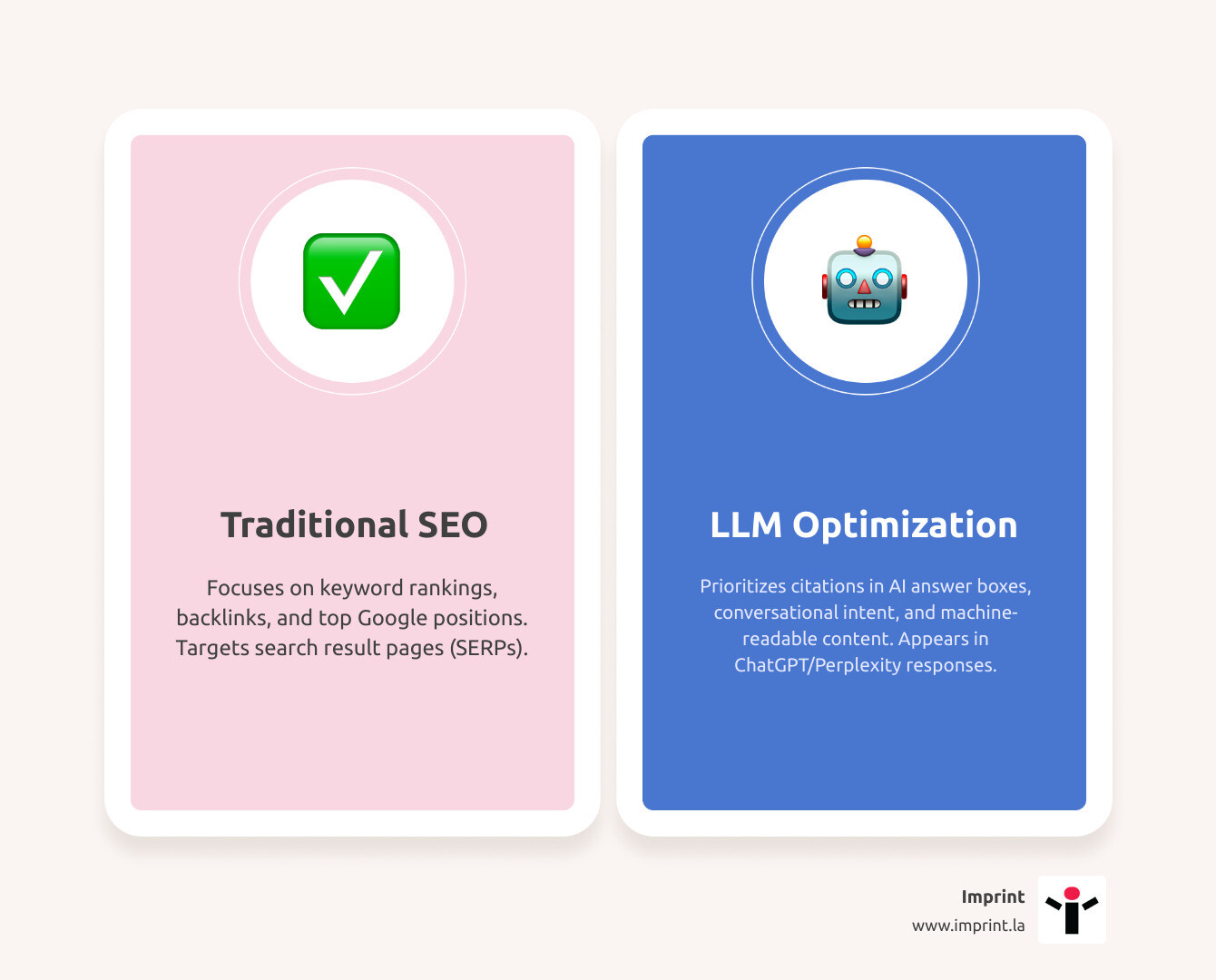
Many businesses make the mistake of thinking that if they rank #1 on Google, they’ll automatically win in ChatGPT. That’s not how it works. While traditional SEO is the foundation, LLM optimization (or GEO - Generative Engine Optimization) requires a different lens.
| Feature | Traditional SEO | LLM Optimization (GEO/AEO) |
|---|---|---|
| Primary Goal | Rank #1 in SERPs | Be the cited answer/recommendation |
| Target | Search Engine Algorithms | Large Language Models |
| Content Focus | Keywords & Backlinks | Conversational Intent & Factual Accuracy |
| User Intent | Navigational/Informational | Conversational/Direct Action |
| Format | Web Pages/Blogs | Machine-Readable Snippets/Structured Data |
To succeed, you must move beyond keyword stuffing and embrace SEO best practices that prioritize "Answer Engine Optimization" (AEO). This means creating content that directly answers specific user prompts in a clear, concise manner.
Don’t Overlook Fine-Tuning and RAG for Custom LLM Optimization Services
For B2B SaaS and enterprise companies, generic AI responses aren't enough. You might need your own internal AI to be an expert on your proprietary data. This is where OpenAI platform tools for model optimization come into play.
We help businesses implement:
- Retrieval-Augmented Generation (RAG): This allows an LLM to "look up" your specific, private data before answering a prompt, drastically reducing hallucinations.
- Fine-Tuning: Training a model on your brand's specific tone of voice and technical documentation.
- Instruction Tuning: Ensuring the AI follows specific workflows or compliance rules.
While we are experts in PPC SEM services, we know that the future of lead generation involves these custom AI layers that turn a "search" into a "solution."
Measuring Success and ROI in the AI Era
How do you know if your llm optimization services are actually working? Unlike traditional SEO, where you can just check your "rank" for a keyword, AI visibility is more fluid. However, the results are often much more dramatic.
For example, we’ve seen cases where structured content and AI-focused optimization led to a 350% increase in sales because the brand became the "default" recommendation for high-intent queries. For local businesses in Santa Monica or Beverly Hills, this can manifest as a 60% increase in foot traffic simply because Gemini or Apple Intelligence suggested their shop as the best nearby option.
When we partner with companies, especially as a digital marketing agency for startups, we track:
- Brand Citation Share: How often is your brand mentioned in AI responses compared to competitors?
- Sentiment Tracking: Is the AI speaking about your brand in a positive, neutral, or negative tone?
- Inbound Lead Quality: Are you seeing that 9x conversion rate boost from AI-driven traffic?
- Direct Citations: Are the AI tools linking back to your site as the source of truth?
Frequently Asked Questions about LLM Optimization
What is the difference between SEO and LLM optimization?
Traditional SEO focuses on optimizing for search engine crawlers (like Googlebot) to rank links on a results page. LLM optimization services focus on making content digestible for Large Language Models so your brand is used as a primary source or recommendation in an AI-generated answer. One is about "links," the other is about "answers."
How long does it take to see results from LLM optimization services?
While traditional SEO can take 3-6 months to show significant movement, LLM optimization can sometimes yield results faster—within weeks—if you are targeting specific AI search engines like Perplexity or using RAG for internal tools. However, building broad authority across all major models (ChatGPT, Claude, Gemini) is a continuous process that involves ongoing content updates and citation building.
Can LLM optimization help reduce AI hallucinations about my brand?
Yes! Hallucinations usually occur when an AI has a "data gap." By providing clear, structured, and consistent information across the web (and using tools like schema and official "LLMs.txt" files), you give the AI the correct facts to pull from. This significantly reduces the chance of the model making things up about your products or services.
Conclusion
The shift toward AI-driven search is the biggest change to the digital landscape since the invention of the smartphone. At Imprint, we don't just watch these trends; we master them. Based in Los Angeles, we are a performance-driven agency that combines data-backed strategies with cutting-edge llm optimization services to ensure our clients stay ahead of the curve.
Whether you are looking for a SEO Company in Los Angeles to dominate local search or you need a global strategy for AI visibility, our team is ready to deliver. We pride ourselves on delivering an average 3.8x ROAS for our clients by focusing on what matters: revenue.
Ready to make your brand the #1 recommendation in the AI era? Book a consultation with Imprint today and let's start building your future-proof search strategy.
